
Punk rock in Tompkins Square Park

This coming weekend two free punk rock shows will be held in Tompkins Square Park in New York City’s East Village.
The shows commemorate the Tompkins Square Park riot of 1988, when police clashed with squatters, homeless and others that had been camping out in the park. Accounts of that night very but few dispute it involved widespread police brutality. Police lined up on the street for an extended period of time before moving into the park, and they were subject to sustained abuse by activists that did not want them there and saw them as agents of a landlord-controlled city that (to this day) lets property go abandoned rather than occupied while working people struggle to pay rent.
The riots were one of the first instances of widely-publicized videos of reported police misconduct thanks to the efforts of East Village video archivist and neighborhood stalwart Clayton Patterson. His videos showed police covering their badge numbers and chasing down protesters and beating them without arresting them. “Little brother is watching big brother,” he told Oprah Winfrey.
The 30-plus years have done a lot to change the East Village. Tompkins Square Park is no longer a homeless encampment or open-air drug market; it is now a safe place you can bring children. The abandoned buildings and art spaces that were abundant in the late 1980s have been replaced by high-end restaurants and expensive homes. The story is the same throughout the city.
It would be useless to pretend the East Village is the same, but it would be a disservice not to commemorate a scene that produced great art. Even if the crucible that created an esteemed body of art is long gone, the art does not get thrown away. I’m happy that feudal Italian city states no longer wage war on the Italian peninsula, but the art that survives from this period is among the finest in the civilized world.
The scene may be over, but the art endures. So let it be with punk rock. Though please don’t think that punk rock is over or that new generations don’t have the same legitimacy as the old-timers that were there when New York was a shithole. There are excellent bands playing in the city today, comprised of young people who were not born yet in 1988, and they are as punk rock as anyone else.
And the East Village is still a home for punk rock. The Bowery Electric, located a short distance away from where CBGB once stood on the Bowery, still hosts great punk rock shows. Niagara, which his located where punk rock club A7 once stood, has started booking hardcore punk concerts there regularly again.
And free punk rock still reigns in the park. Full disclosure: my band Blackout Shoppers is scheduled to play the free punk rock show in Tompkins Square Park this Sunday, Aug. 4, with The Voluptuous Horror of Karen Black, Hammerbrain, Porno Dracula (one of the greatest band names ever, but please don’t Google them at work), Jennifer Blowdryer Soul Band, Ruckus Interruptus, and Young Headlight. Saturday the 3rd hosts the first of the two-part series with Disassociate, the Nihilistics, Rapid Deployment Force and more.
Blackout Shoppers have been rehearsing and sounding good, even judging by my overly critical, curmudgeonly ears. We don’t play as often as we used to and it’s a blast when we can get together and play a show. It was touching when people came out to see us last year when we bid farewell to Philthy Phill of World War IX. We don’t want to wear out our welcome, but we are playing more shows this year than we’ve played more recently and it feels good to be out there being loud.
See you in the park this weekend.
The pure Hell of New York Summer

A few years ago a friend who lives in Las Vegas posted a photo of his car’s dash board, which displayed a temperature reading of close to 120 degrees Fahrenheit. “Still nowhere near as bad as New York City subway in the summer,” was his photo caption.
New York City survived its first major heat wave of 2019 this past weekend and survived is as good as it gets.
Public pools were kept open an extra hour, though one pool had to close during the heat wave. Large numbers of homes lost power throughout Brooklyn and Queens during some of the hottest hours of Sunday. In Times Square, where the heat index got as high as 110 degrees, my colleagues from Ask A New Yorker began frying an egg on the sidewalk.
To endure a New York City summer is to taste the atmosphere of Hades if Hades had fewer redeeming qualities. It was Sunday and the heat was high early. I couldn’t avoid doing the grocery shopping and I’d be subjected to consistent air conditioning, at least while I was indoors.
At the local supermarket, I got to the crowded parking lot and found a space on the perimeter. The blacktop of the lot was a welcoming carpet of black lava. I saw containers of recycled glass sitting by the can and bottle redemption machines. Four large tubs were filled with the smashed remains of recycled bottles. The image summarized the weekend’s heat wave. There in all the gleaming punishment its jagged shards could dish out, penned in for all to see, the shards seemed to taunt us. This is my time, the broken glass could boast to passers-by. I was born of a blast furnace and your city’s asphalt is a cool breeze in the mountains to be. How fragile you must be…
I stopped to take a photo of the glass. It was so simple yet so brutal.
“What’s wrong with my glass?” a man asked me. I turned to see a man in a blue jumpsuit with ear protection headphones on. He was collecting the recycled glass and thought maybe I was taking a photo to establish some kind of complaint. I explained it was unusual to see all the glass out of the machines like that and made for a neat photo. This was true. I decided that a parking lot in 100-degree weather was not the place to have a discussion about the murderous indifference of nature and human kind’s being at the mercy of the Earth despite our collective ability to damage it, especially as this gentleman was spending his day working in the hot sun collecting the industrial chum of the recycling machines.
The supermarket requires shoppers use a quarter to unlock a shopping cart from another. It also employs a locking system that stops someone from wheeling a shopping cart off its premises. Because I parked on the edge of the parking lot, my shopping cart locked up once I got it to my van. I loaded my groceries but now the wheels on the cart couldn’t move.
I was enraged and determined that I would get this quarter back if it was the last thing I ever did. I dragged the shopping cart across the parking lot to one of the docking stations where you can return cars without walking all the way back to the store. All the carts at the station had been self-locked and I would not be able to get my quarter back there. I dragged the cart all the way back to the store where an army of locked carts stood silently as I strained and cursed my way to redemption.
I managed to lock my shopping cart to another and retrieve my quarter from its infernal lock. I celebrated this victory by taking a photo of the quarter held aloft before the shopping cart in victory.
If I had looked closer at the photo before driving home I would have noticed my glasses inside a case on the seat. I have not yet found these glasses. Heat wave: 1, Matthew Sheahan: 0.
Blackouts in a changed New York
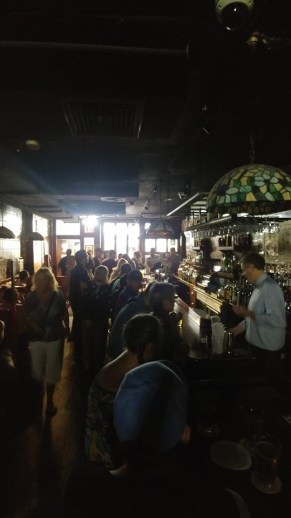
This past Saturday I noticed a friend posting on social media from the dark interior of one of Hell’s Kitchen’s finer dive bars, Rudy’s.
“Uh-oh. Power’s out. Better drink all the beer before it gets warm.” That was the caption accompanying a photo of business as usual on a busy Saturday night at Rudy’s. There was never a lot of interior light there to begin with, so one had to take her word for it that there was a blackout.
A little while later, a message from work indicating a “Code Red” situation—the company’s building in Times Square was without power and this was a problem. I scrambled to join the emergency communications line, only to be told there were enough people working on this already, I could drop.
News reported that the West Side of Manhattan and a significant portion of midtown were dark. This was a major event though it was small potatoes compared to previous New York City blackouts. It was short-lived as well. By 10 p.m. power had been restored to much of the affected areas, and my employers’ building in midtown had power again but was still waiting for electricians to arrive to make sure everything was up and running.
The cause was not immediately known and Con Edison does not have a great track record of accountability when these things do happen. Several years ago, a significant portion of Astoria, Queens was out of power for an extended period of time. Sadly, an outage in Manhattan generates greater news coverage and more intense scrutiny.
New York City suffered a blackout exactly 42 years ago to the day of the one this past Saturday. On July 13, 1977 a blackout hit New York City and was the scene of widespread looting and arson.
Seventeen years ago this August marks the anniversary of the 2003 blackout that darkened a significant swath of the Northeastern United States. I was downtown getting ready for a late night of editing at work and wound up taking a 12-mile walk home over almost the entire length of Manhattan. Although incidents of looting were underreported, they were indeed rare and the peaceful evening rush hour and dark night was a testament to the transformation that had happened in the years since 1977.
Even after walking 12 miles to get home in crumbling shoes that blistered my feet, I walked around my neighborhood of Inwood in Manhattan, amazed at the peacefulness of the city at such a time. People played dominoes in the moonlight near the Dyckman Farmhouse, and the sound of steel drums and street parties filtered up from blocks away.
Power outages serve as a barometer of where New York resides along the lawlessness spectrum. Are we close to widespread chaos or will the line hold during a night in the total dark? The Manhattan blackout of July 2019 showed we are holding the line for now.
It was a relief to find that New York has not regressed to the point of making our blackouts more of the 1977 variety. But that question will always linger in the back of New Yorkers’ minds, and maybe we should get to a point that it shouldn’t be there at all. How much has to be done to create that city, that country, that world, and will we ever get there? And what is being done to make sure that we don’t lose power during critical summer months?
A relieved city needs those answers.
Bounce Castles and Bratwurst

The July event our family looks forward to ever year is a party held in Connecticut by Evil Jesus, the guitar player for Premature Strangulation. Premature Strangulation hasn’t played since their record breaking* world tour in 2015, but this annual gathering predates the concert series that served as a featured element.
After making a modest batch of Double Satanic Deviled Eggs and packing our children and other necessary accoutrements, we set out to make the journey from Queens to Killingworth. Despite typical heavy I-95 traffic, one children’s bathroom emergency and monsoon-like rains on I-91, we made pretty good time.
The Double Satanic Deviled Eggs were a hit, and others inspired by their long-standing success brought their own delicious but less Satanic versions.
It was a family-friendly event where children were so well occupied that attempts to check on them were met with a mix of perturbation and disgust. Older girls were magnets for young children and were incredibly gracious in minding toddlers. There was even a piñata that yielded great treats for the gathered children, and it was miraculous that no one was rendered unconscious with multiple youths swinging aggressively to break open the treat.
There was plentiful food and drink, but the real attraction is catching up with old friends. Our host, Evil Jesus, has known some of us since high school and others from college. Like his mother’s house was when we were in high school, his home is a center of an expansive social scene, a community. The guests at the party included includes Republicans, Democrats, Christians, atheists, lawyers, housewives, and other derivations of the human condition.
I met a young man who did extensive work in North Korea working to help reunite people with families in South Korea and has a grandmother north of the DMZ who has not seen family for decades. I learned another good high school friend is pursuing his dream of being a radio DJ, and heard about our host family’s recent trip to Paris.
The members of Premature Strangulation were not all there. The band has as many as nine members at any one time, like a more intoxicated and less-well-rehearsed Allman Brothers. Those members who were present discussed the possibility of getting together to play songs again. Maybe next year will be the reunion world tour that their adoring public is waiting for**.
The drive back was along less-crowded highways and under a clouded sky. Buzzing as best one can on diet Pepsi and Five Hour Energy, I was the only one awake for part of the drive. A slender golden moon haunted the night sky with a sense of beauty and adventure yet to come. Fireworks silently illuminated the sky from the far side of the highway.
Evil Jesus did it again. Another great gathering is in the books, and it produced good memories and good times, and a true sense of community. The human race needs more of this.
Thank you.
*largest concert attendance by a cover band in Killingworth Connecticut in the first-half of July on a non-leap year, according to the Evil Jesus Research Institute for Beer and Cynicism
**adoring public may be limited to sympathetic spouses, children, and pets
Fireworks and the American life

Last Wednesday thousands gathered in Fort Totten Park in Bayside, Queens for a fireworks display. The event had all the makings of potential disaster by modern metrics. Thousands of diverse people crammed into a limited area and jockeying for space to get a good view. A little league soccer team was wrapping up practice as people took their places in the expanse of green field between portable toilets and a row of food trucks. Bounce castles entertained children before the fireworks started and people took what they thought were the best positions to view the show as they waited for the sky to get dark enough.
The fireworks started promptly and a roaring whoop went up from the crowd as fireworks lit up the sky. New Yorkers cheered enthusiastically for this celebration of our War of Independence. When it was over, the crowd made its way out of Fort Totten without incident, or at least any major ones.
From parts of Fort Totten you can see the glitter of the Manhattan skyline and be inspired by the nighttime majesty of the Throgs Neck Bridge lit up. It is a marvel how New York holds itself together while the country seemingly tears itself apart. Gotham is as rife with division as everywhere else: New York City gave us both Donald Trump and Alexandria Ocasio-Cortez.
The greatness of New York serves as a microcosm of America. We see all the same issues in New York first, and the city, rightly or wrongly, serves as a template for how the rest of the country can navigate its problems.
The Fourth of July brings us down to Earth, reminds us of how American we are. It is popular to look upon outward signs of patriotism as right-wing or quaint, but if you believe America is for everyone and that patriotism is expansive and great, then join the celebration. The freedom we have was purchased in a bloody war, several actually.
The land we are on we do not claim by divine right. Every inch of America was fought over. We waged war on France, Great Britain (twice), Mexico (twice), Spain and countless Native American nations to get the current borders of the United States. July 4th celebrates the birth of our nation, a hard-fought war for Independence that was in effect our first civil war. When the war started it was not a foregone conclusion that we would win. The patriots who signed their names to the Declaration of Independence knew that the document would serve as their death warrant if the war didn’t go their way.
The Battle of Brooklyn was one of the bloodiest fights in the history of the American Revolution, and the war would have ended had Washington not been able to retreat to Manhattan. The British held New York for most of the war, but the city has signs of the American Revolution everywhere. The first woman who took up arms for America, Margaret Corbin, fought at the Battle of Fort Washington in Manhattan.
Some are fatalistic and see America as it is headed now as intrinsically doomed. There is no cultural coherence to sustain us through these times, they say, and new communities and nations will rise out of what is now a crumbling empire. But New Yorkers have bridged these divides in the crucibles of ambition and creativity. We are strong when we demand truth and strength, and turn to leaders not afraid to speak honestly and make the right enemies. We can do that in America as a whole if we are willing.
Let the American Revolution be our call to action today.
Camping in the Catskills: Chipmunks, Trout and Bear
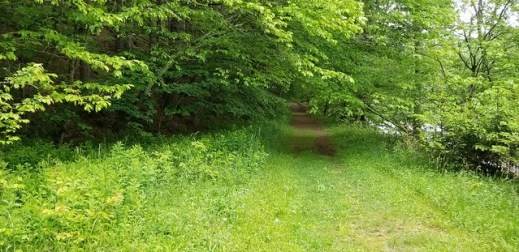
Two years ago my wife and I packed our small children into our van and drove to the Catskills for a camping adventure. Based on the success of that year, we chose to head to the mountains again for another vacation spent in the wild.
We chose the Beaverkill Campground, which is outside Roscoe, New York, about two hours’ drive north of New York City. It runs along the Beaverkill River, which is known as one of the country’s greatest trout streams. After turning off the highway, it’s maybe a twenty minute drive through some winding one-lane roads before you reach the Beaverkill campground.
One of the principal attractions of the campground is a one-lane wooden covered bridge that dates to 1865. It sits over the Beaverkill River at one of the most prime fishing spots, and the calm pools beneath the bridge are occupied during the day by fly fishers looking to hook a trout.
Because the bridge is one lane but serves cars in both directions, the proper etiquette is to honk your horn as you head into the bridge. A car coming the opposite direction should honk back to avoid a head-on collision.
Although rain was expected, we managed to arrive at the campsite when it was sunny, and owning to my wife’s expert organizational and general DIY skills, we had our tent up pretty quickly. That night we had our first s’mores of the season.
With small children, we are not in the market for deep-woods camping and gravitate towards campsites with bathrooms and access to showers. That doesn’t mean this was not a wildlife-filled week for us and the kids though. Our campsite had two chipmunks that were bold enough to jump up on our picnic table when we were a safe distance away and got closer to us than chipmunks are normally wont to do. They know campers can be messy and bring a lot of food and these cute rodents were well fed.
The restrooms had lots of bugs, and large beetles found themselves trapped in the sinks and urinals of the men’s room. I took pity on one beetle in the sink and scooped him out before thoroughly washing my hands, but did not attempt to rescue any of the insects trapped in the porcelain hell of the urinal, preferring to let the murderous indifference of nature take its course there.
Because there are bears in the area, there are strict rules regarding leaving food or garbage out overnight. The campgrounds has a garbage bin that it locks up after 8:30 p.m. and any food or garbage you have after that point has to be locked in your vehicle (tough luck if you backpacked in there I guess).
On our third night, I was making my evening journey to the designated garbage/recycling area when I saw a large animal coming down the road that runs between the check-in office and the campgrounds. At first I thought it was a large dog—we met several campers who had large dogs with them—but soon realized that this was in fact A BEAR!!!! It was walking at a slow pace with the mundane expression of easy existence in its (pun intended) bearing.
I thought maybe my eyes deceived me and I quickly deposited my garbage and recycling and started back towards our campsite.
The bear was still walking in my direction.
For a moment it looked as if it was two bears close together, in which case I may between a mother and her cubs, and that is bad news.
I remember reading somewhere that if you come across a mother and her cubs, you are to remain facing them and walk backwards calmly. I did that.
The bear—it was only one after all—saw me and our eyes met for a moment. It turned off the road and headed down a wooded hill. I moved quickly back to our campsite. “I don’t mean to be alarmist,” I told my wife, “but I am pretty sure I just saw a B-E-A-R.”
I sped packing up our campsite for the night, getting all of our food in the van and shut tight. There was no sight of the bear beyond that. I reported the sighting the next day to campground officials. We continued our camping as planned.
We were completely unplugged when we were camping. We had no mobile phone reception and no computers or laptops available. No television, no video games on tablets or anything else. It was good for a change like that, to spend time with family and nothing else. Our kids found adventure in going to the river’s edge and creating their own secret hideout on glacial rocks.
We had mobile phone reception on the few visits to the town or Roscoe, which consists of a few blocks of buildings with only one main street. The dichotomy of the Catskills is evident there. We bought fishing equipment across the street from a guns and ammo store before going to a farmer’s market to buy local honey. There is a railroad museum and several bed and breakfasts there, as well as a grocery store that was our lifeline for ice, batteries, and other necessities.
The real attraction in the Catskills is nature and the abundance of greenery. Being a city dweller, we become accustomed to concrete and glass as our natural environment, and there’s something inherently unhealthy in that. We should be spending more time close to grass and trees, or the green ferns that sprout ubiquitously in the country. I understand why New Yorkers escape to the Catskills and I am not ashamed to be among their number.
We plan to be back north as soon and as often as possible. See you there.
Dulce et decorum est pro patria mori

“It is sweet and right to die for one’s country,” wrote the Roman poet Horace in his ‘Odes.’ The Roman army still influences our world today; its conquests built an empire. But it could not stop Rome from rotting from within.
Monday was Memorial Day in the U.S. While we can hope to spend some time in quiet reflection of the people who gave their lives for our country, it mostly serves as the start of the summer season. There are many tributes to America’s fallen on my social media feeds, but the posts that feature barbecues and sunbathing are more abundant.
The American public is tragically disconnected from our own military. I count myself among the guilty. I know several veterans of the Iraq and Afghanistan wars. I wrote and sent them things while they were away. But had you asked me where exactly they were and when, I couldn’t tell you.
As the public flag-waving gets more fervent, the actual involvement with our military becomes more detached. We have had an all-volunteer military for several decades now. Not since the Vietnam War have Americans been called up in a draft. When I turned 18 I had to register for the Selective Service and I still have my card someplace. While still the law, draft numbers are lower; we don’t have reminders to register. The military is simply not a reality for wide swaths of our population.
It is easy to wave a flag and heap praise on people who are gone. It’s a lot tougher to turn that sentiment into real action that helps the living. As a country, we’re falling short on both grounds.
My brother knows people who live six hours driving time away from the Veterans Affairs hospital where he goes regularly. Some take hours-long bus trips to the VA only to find that their medical appointments were canceled without notification. Veterans have been known to commit suicide in the parking lots of VA hospitals; this phenomenon doesn’t surprise my brother one bit. He’s been negotiating the bureaucracy of the Veteran’s Administration for the better part of the last 20 years, with an increased intensity over the last 10. He was recently ordered to have an unnecessary EKG done so he could get a refill of medicine he needs. He knows his prescription regimen better than the rotating doctors and orderlies assigned to help him; and every so often he has to essentially retrain the people who should know how to help him.
We’ve trained soldiers who can survive poison gas and terrorist bombs but not our own healthcare system. This would be inexcusable in a second-world country, let alone the richest country in the world. And the VA didn’t suddenly collapse; it’s been infamously bad for generations now.
Let’s remember the people we’ve lost, but let’s also try to make time to listen to the living.
Our commitment to our country and our fallen veterans has got to spread far beyond the traditional ceremony and observances if our patriotism is to have lasting meaning. Let’s start today.
Taxi scams are born anew
Technology continues to advance and change our world, human nature does not change. Technological advancement does not mean moral advancement. While we can summon a wealth of information in less than a second, the human race isn’t applying this knowledge in a way that makes our world any more just and fair.
And so it is with our taxi cabs. While technology enables us to hail cabs, it has not improved the ethical standards of drivers or riders. I have seen this illustrated across our city in several ways, but most vividly this past week.
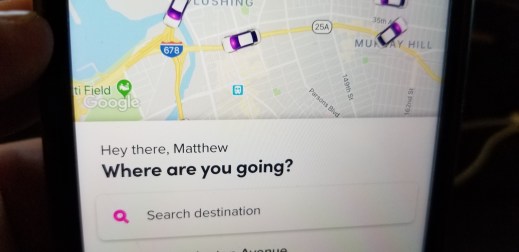
It was after 6 p.m. and since I was out of work late I wanted to waste no time in getting home. I was in downtown Manhattan and the traffic looked painfully slow. I positioned myself near a street corner so a car could make a quick exit off of a bumper-to-bumper Broadway. I requested a ride from Lyft.
I got a call from the first Lyft driver.
“Hi this is your driver from Lyft, can I confirm where you are?”
“Yes. I am at Broadway and Worth Street. I’m a bit before Worth Street so you can make a left and get out of this terrible traffic.”
“And can I confirm where you are going?”
“Flushing, Queens,” I said truthfully.
A few seconds after our call ended. I saw that the driver had canceled my ride and the mobile app was searching for a new driver for me.
I also realized how I had made a terrible mistake. One of the features that is supposed to make ride hailing services better than hailing cabs on the street is that the application does not tell the driver where you are going until they confirm on their device that you are in their vehicle. This stops them from cherry picking rides the way yellow cab drivers do, asking passengers where they are going before they get in the cab, so they can avoid taking fares to destinations they don’t like.
Ride hailing drivers subvert this system in two ways: they will pull over and confirm on their device that you are in the cab when you are not, and then canceling the ride before you get to them. And, like they did with me, they call you and ask where you are going and then cancel the ride if they don’t like what you tell them.
The second Lyft driver called a few minutes later, doing the same thing. I didn’t tell them, but it didn’t help anyway.
“Can you confirm where you are going?”
“I’m on Broadway and Worth. I’ll see you soon. Are you nearby?”
“Yes. I am at Broadway and White Street. I will be there soon. … Can you confirm where you are going?”
“That’s a great question. I’ll confirm when I see you. And I’ll see you soon,” I said with the friendliest confidence I could muster.
My phone soon indicated that this driver had canceled as well, and now I had to start the request for a driver all over again. And guess what? The price for a ride was now about $20 more than when I was first looking for a ride. This made me livid but I was too tired to get worked up about it, and besides, I would have been mistaken for a crazy person, shouting at my smartphone in the middle of Broadway as downtown traffic slowly crawled by.
The third driver arrived and completed the trip. With all the shady driver shenanigans, I probably saved no time in getting home and would have been better off taking a subway or express bus.
A friend who is a yellow cab driver broke down the one issue he may have with taking fares to the outer boroughs: if it’s towards the end of his shift, he faces late fees if he brings his cab back to the garage late. That’s the only time he picks and chooses his fares, and he recommends reporting those drivers that won’t take customers where they want to go. My friend is exceptionally good at what he does, and even lets passengers know when they can get somewhere faster using public transit. I had one Lyft driver tell me that in Maryland recently, and I much appreciated it.
In a few short years, the drivers at ride-share services like Uber and Lyft have perfected many of the repugnant practices that sent riders away from yellow cabs to begin with. Ride-hailing service drivers are known to cancel rides in time to take advantage of surge pricing times. No-show cab drivers can still saddle would-be riders with $5 cancelation charges which are difficult (though not impossible) to fight through the companies’ Web sites. And yellow cab drivers are left in the lurch, many of them deeply in debt with loans for medallions that they may never be able to pay back, a situation regulators ignored.
At the same time, ride sharing services are in greater demand, since our public transit system is so rotten to the core the subways lines can be delayed even by an overflowing toilet.
As with yellow cabs, remain vigilant when you are taking one of the raid hailing services. What looks like a minor inconvenience could be another scam.
Losing our matriarch

At the start of April, some of my aunts and uncles mentioned to my Grandmother, Mary Sheahan, that her birthday was coming up, reminding her that her birthday is April 10.
“Oh,” she said as casually as if she were discussing the bus schedule. “I’m not going to make that.”
She passed away less than a week shy of her 95th birthday. Her death was not a shock, and we were as prepared, at least bureaucratically, as a family can be.
My Grandmother was born Mary Fogarty in 1924 in Roscrea, Tipperary, in what was then the Irish Free State. There were only 48 United States at that time, and Calvin Coolidge was President. Prohibition would last another nine years in America.
Her father had been in the British Army, enlisting in the early 20th century when all of Ireland was under British control. He had spent time in India and had fought in the First World War, including the fierce Battle of the Marne. When he came to the U.S. he worked as a janitor and had fought for the right to organize a union, winning a court battle to form a union. This sense of right and wrong, and fighting for your principles is one that runs strongly in our family to this day.
My Grandmother married my grandfather, John Sheahan, in 1948 and their first child was born in 1949. At one family barbecue, her oldest son, my uncle Tim, pointed out to her that his birthday was exactly nine months and one day past her wedding date. She giggled and, noticing me observing this conversation, instructed me not to comment. Tim smiled and said, “It was Bear Mountain,” referring to where my grandparents had honeymooned.
I doubt I will ever know anyone who embodies unconditional love and the joy of living the way my grandmother did. Her world centered around her family and with seven children, nine grandchildren and four great grandchildren, she had a lot of love to share and names to keep straight. Hers was always the voice of kindness and love, and her generosity of spirit never waned. Whether it was caring for my Grandfather through decades of debilitating health problems or facing her own mortality years later, she was always an example of great strength. It was she who went about my Grandfather’s wake comforting others who were weeping, even though it was her moment to mourn more than anyone’s. We would have easily forgiven her a moment or two of self pity, having lost a husband, a daughter, and son-in-law along the way and dealing with difficult health issues in her final years. But she was a rock of strength, sustained by a strong religious faith and a dedication to her family that went beyond what anyone could ever ask.
My Grandmother’s life was her family, and she showed us that the greatest joys are often the ones of simply being present and investing time and care into the lives of the people around you. Her power stretched far beyond her blood relatives and her wake and funeral saw visitors from every part of her life, including people she had worked with decades ago or knew her as a neighbor for only the last few years.
If there is any available measure of the amount of love my Grandmother brought into the world, it was reflected in the care and hard work her own children did during her final months and years. My Father and aunts and uncles worked around the clock taking care of her and navigating through our Byzantine and often inept healthcare system. When her final course was set, relatives flew to New York from all over the country to be with my Grandmother at the end.
When my Grandmother passed, our family became a team effort yet again. My Aunt Patty’s house became a central gathering place, my cousins gave readings at the funeral or served alongside me as pallbearers. My Aunt Peggy arranged for the Ridgefield Chorale to sing at church and they did beautifully. My Father delivered a beautiful eulogy that left not a dry eye in the house and had both humor and inspiration.
One thing that my older relatives taught me is that the work you have to do during a wake and funeral is helpful, in that it keeps your mind occupied on something else other than the loss of your loved one. I was honored to be a pall bearer, and focused on making sure things went smoothly at what is the most heart-wrenching part of the funeral.
In the years after my Grandfather died, my Grandmother described a dream she had. She sees my Grandfather, appearing as he had when younger, dressed sharply in a suit and hat. He strides through the lobby of a building and gets into an elevator. She goes to follow him in but he puts his hand up, signaling this was not her time. The elevator doors close and the car begins its climb without her. I hope this dream replayed again for my Grandmother, and she joins my Grandfather on the elevator this time. The doors now close on the rest of us.
We are without our matriarch, but she has left us with loving instructions in the way of her example. If we live our lives with a fraction of the love, dignity and grace that Mary Sheahan had, we will have earned our rest.
Congestion pricing will not fix our subways

New York is a city of many firsts. It was the first capital city of the United States; it had the first hot dog, first American public brewery, ATM, mobile phone call, and children’s museum.
It also promises to be the first American city to institute congestion pricing on cars driving into its busiest areas. Although these fees are not expected to take effect until 2021, it could cost motorists up to $10 to drive into Manhattan below 60th Street according to a plan expected to be passed April 1 as part of the New York State budget.
It could mean as much as $14 for a car and more than $20 for a truck going into Manhattan. That’s likely going to be on top of heavy tolls already paid to take the bridges and tunnels needed to get into Manhattan in the first place. Cities such as London and Stockholm have instituted congestion pricing and it’s considered a success there, but those cities have more viable public transportation.
New York City has one of the most comprehensive public transit systems in the country, and that’s more of a statement on how sorry the U.S.’s transit system is than a compliment to New York.
The politicians that are advocating for congestion pricing are doing so because they don’t want to do the hard work it would take to fully fund the M.T.A. It means possibly raising taxes and definitely raising fares. It means significantly reforming construction policies to reduce exorbitant costs. Governor Andrew Cuomo and Mayor Bill de Blasio, who despise one another, agree 100% that this is a good idea, which is as good a reason as any to oppose it.
People are turning more to cars because public transit is so unreliable and unpleasant. I once worked with a man who had health issues and had to go to the Bronx every other day from work in order to have kidney dialysis done. He took a cab there because he couldn’t be late and his health issues meant he couldn’t be wedged into a subway car with a few hundred of his closes friends. He was able to get some of his cab fare subsidized, but that’s money that could have been spent elsewhere if we had a reliable transit system, and it’s on the backs of people like my former coworker that this new tax is going to be balanced.
I would rather not spend about three times the regular fare to get to work, but I know I need to be on time to work and not on the cattle car that passes for the 7 train these days, so I splurge for an express bus. It’s still a lot less than a cab but more expensive than a regular subway or bus fare.
Congestion pricing is going to cost the people who can afford it the least: cab drivers or people who have their spouses or friends drive them to work or who are carpooling like good citizens. There will be a significant portion of people who will avoid paying it using the same schemes that work with the now toll-booth-free tolls and red light cameras.
We will fight this out in the press and in the courts until congestion pricing becomes the law of the land or not. But all that will be time wasted building the political capital, civic will, and thoughtful plans needed to truly fix our transit system.
The mystery commuter on the QM20 bus

For about a year and a half, I have commuted to and from my job in Manhattan using an express bus, a more expensive but comfortable coach bus run by the Metropolitan Transit Authority.
Most of the bus drivers who drive these buses hustle to get us through traffic and make good time getting into Manhattan from the Eastern reaches of Queens. A meek or extremely defensive driver is going to fail at driving and express bus, and fail hard.
And that’s been happening recently in the early morning on the QM20 line. One driver I have not seen but only heard about, an older gentlemen, is a slow-paced driver that is content to hang in the slow lane of early rush-hour traffic while his passengers fret about reaching work on time. I have spoken with people who have stopped riding the 6:45 bus because they cannot get to work on time if they ride it. In fact, the 7 a.m. bus routinely reaches Manhattan sooner.
Because the driver of the 6:45 a.m. bus is such a pathetic slowpoke, passengers that used to take that bus now flood to the 6:30 bus. There are now at least three times as many passengers waiting at the bus stop for the bus I take, which means the other stops are all more crowded as well. I used to be able to find a seat all to myself with regularity, now it’s nearly impossible.
Yet still people insist on putting their bags on seats, even knowing that they’ll have to move them at some point. It’s a gamble on their part, they’ll possibly get the seats to themselves if enough passengers decide not to ask them to move. I usually make it a point to make these rude people move their bags, though if they are an exceedingly large person then I will often pass them by because I’m a large person also and then we’re both crammed into our seats seething and miserable. There is one rude fat bastard on my bus line who does this without fail and sits in corpulent luxury every day.
Sometimes I’ll choose people who are polite and thin because I’ll have more room. There’s a man who uses his time on the bus to sketch drawings and I feel camaraderie sitting next to someone interested in the arts, even if I never talk to him.
This past Monday however, there was a mystery man and I felt I had to sit next to him. By mystery man I mean someone who had a black wool hat pulled down all the way over his face. This was not a ski mask (aka balaclava), but just a hat that normally sits on top of the head and over the ears. He had it pulled down all the way over his face, so that his head was just one monolithic orb of woolen darkness.
I was appreciative of the aesthetic and felt a kinship to it. I often wear a ski mask when I perform in bands, and have enough ski masks at home to clothe a paramilitary battalion for a decade. So I sat next to this man. He was a bit spread out but I managed to get comfortable enough and read the news on my work phone. I didn’t want to see the man’s face, wanting his mystery to be kept for all eternity or at least until the weather was warmer and one would have to be psychotic to wear a winter cap. But no, soon after we rolled into Manhattan the man woke up and pulled up his hat revealing the countenance of a middle-aged commuter.
I don’t know where the man departed the bus. I got off at my usual stop at Herald’s Square and made my way downtown, hoping to engage with more of life’s mysteries as the day wore on.
The gritty oasis of Liberty Place

The Financial District in New York is known for large office towers of glass and marble facades of old buildings. It is considered the epicenter of the financial world.
Many of the large banking institutions that comprise the symbolic “Wall Street” are located in midtown now. And very little actual stock trading happens on Wall Street itself. Most actual stock trading happens on giant data servers in New Jersey. But the name is going to stay and new banks will move in to replace the old ones.
There is a charm to lower Manhattan that is missing from midtown and other parts of the island. The streets retain the narrow dimensions of the early Dutch settlers, and now they are lined with tall buildings instead of brick homes. The chaos of the streets is part of what makes it different. You have to know where you are going, and the logical numerical grid of midtown is choked off for good farther uptown at Houston Street. South of there, you have to know where you are going.
Lower Manhattan retains some of the old world charm of the early settlers, even though Manhattan today looks nothing like it did when it was New Amsterdam. You can still see remnants of Revolutionary War history and the days of our nation’s founding. If you are close enough to Battery Park, you can wander away from some of the tourists to the Korean War Memorial or one of the gardens that are quieter, or see working bee hives.
An additional charm to lower Manhattan generally and the Financial District in particular is the scattered network of small alleyways. When I first started working downtown, I had more time to take walks on my lunch hour and whenever I came across a small alley I had not experienced before, I had to walk down that alley. It still seems a sin not to.
Near where I work now is one such alleyway: Liberty Place. It’s among the alleys that populate lower Manhattan and serve as secluded getaways that are enticing for midday walks.
Forgotten NY points out that Liberty Place used to be called Little Green Street and dates to the era of the early Dutch settlers. People who walk or drive on the extremely narrow, one-way street are traveling where there once was a graveyard and Quaker meeting house.
I make a point to walk down Liberty Place whenever I can. It’s an oasis of old New York City grit in a scrubbed land of tourists and high finances. I often smell skunk weed and see people taking a break from work. The people who linger there are sharing a joint, drinking discreetly, or making a phone call away from the usual noise and bustle of the New York workday.
And even though I don’t drink or smoke weed I walk down this alleyway feeling I am among my people. I also would rather loaf and feel at ease and spend my days enjoying the random beautiful madness of our city streets rather than sit at a desk and answer emails for hours. I too should have stayed a rambling, impoverished poet looking for eternity in the eyes of strangers.
Liberty Place is just that, a place we can seek a breath of liberty even within a shadowy alleyway. I try to make it part of my daily routine, another way to get through the everyday and be a tourist in your own city.
The universal benevolence of a snow day

This winter has been a strange one for the Northeast and New York in particular. We’ve been absent the traditional snowstorms that usually blanket our area a few times each season. We had a slushy sleet in November that snarled traffic and quickly dissipated and a few snowfalls that failed to bring much snow volume.
This past Sunday night we had our most commonplace snowstorm yet, and the predictions were serious enough for New York City to cancel its public school classes that following Monday.
That Monday morning, with the full weight of a snowstorm having made its mark on our city, I decided to not have a snow day and went to work. The snowpocalyspe that had been predicted did not come to pass, at least not on the roads in Flushing. They were clear at 5:30 in the morning and I went through my normal routine and got to work in great time.
So many were taking a snow day, it served as extra motivation to make it into the office. I could have likely remained at home and few would have blamed me. The buses and subways were less crowded than they usually are.
Enjoying the relative quiet of the hushed urban snowscape, broken by the crunching of my office-appropriate rain/snow boots on the un-shoveled sidewalks, it was a harder walk to the bus stop through the crusted sludge.
A few years ago, a snowstorm that was raging through the night and into the commuting time of the morning meant that the office where I worked declared a “work from home” day. It was one of the most productive work days I have ever had. I managed to draft an 800-word op-ed that morning on top of all my usual work, and the lack of commuting hell made everyone generally happier.
The greatest snow day I ever had was in an April of my elementary school years, when there was a spring snow storm in the Northeastern U.S. and I got to take the day off from Catholic School. No more stifling white shirt and blue fake tie with the stenciled sEs (Saint Eugene’s School, Yonkers, New York) for the day. I waged war against my own blood kin and neighbors through snowball fights, barricaded into a snow fortress that numbed my hands and feet, and cherished respite in the warm caverns of our two-bedroom apartment.
Making it into work during a snow day is an easy way to prove dedication to your job without doing any extra work. There’s a saying attributed to Woody Allen that 80 percent of success in life is showing up. On a snow day that jumps to 95 percent. It feels good to be one of the few and the brave at the office when things are quiet. In a city as crowded as New York, you take your quieter times whenever you can.
With today’s technology, the central office as we know it is due for an overhaul. With public transportation unfortunately on the decline, people who live only a few miles from their job commute for more than an hour. That hour can be spent more productively at home, and employees will be happier. We can’t say the same for schools.
What I fear now is that a deep freeze coming later this week will create an icy menace on sidewalks and roads, including black ice that can be harder to see and prepare for.
But no matter what shape our school and office lives take, the allure of the snow day will not be completely gone. Whether you take it at home or elsewhere, enjoy the snow day.
Come to the Flushing Eco-Fest

Sustainability and the environment are not just for hippies anymore.
Although when you think about it, hippies were late to the game on wanting save the Earth. The greatest environmentalists in American history is most likely the 26th President of the United States and great New Yorker, Theodore Roosevelt. Roosevelt used the power of his Presidency to create national parks and other public lands. And when you think about it, accomplished hunters like Roosevelt are among the best environmentalists.
Ask yourself what would Theodore Roosevelt do? If he were still with us today, he would probably be bold enough to bicycle from Oyster Bay to the Flushing Quaker Meeting House (a trip of only 25 miles, an easy two hours for T.R.) and find common cause with the many diverse people working for the preservation of our natural world at the Flushing Eco-Fest on Saturday, March 23.
The festival is being organized by Flushing C.S.A. (Community Supported Agriculture), a local farm share group (full disclosure: our family is a member of the Flushing C.S.A. and my wife is a core member and Eco-Fest organizer) and being cohosted by the Flushing Chamber of Commerce.
The Eco-Fest is free and offers free workshops, eco-friendly kids’ crafts sponsored by Macaroni Kid, and a host of vendors with locally grown and organic goods. There will be well over a dozen vendors and groups there, each one is in some way working towards making things on the planet more sustainable.
There is guaranteed to be something to appeal to everyone. My personal favorites are some of the local food businesses such as Spice Tree Organics and Astor Apiaries. You will be doing something good for the environment when you attend, even if you just stick around to learn something about watersheds or how to compost or get a few cycling or energy-saving tips. There will also be environmentally-friendly soaps, home décor, seedlings, and baked goods for sale. And a raffle. Nothing is too small to do to make a difference.
You will also meet an interesting group of people there. Events like this can give you a great cross-section of this part of Queens. The Flushing Quaker Meeting House is the oldest, continually-used house of worship in New York City, and Flushing has several important landmarks in the cause of religious freedom in the U.S. Inside the Meeting House, you will be surrounded by history older than the United States. And whatever you think of the current trajectory of the U.S. or its politics, there is no disputing that this is an interesting time to be alive.
And it is a perfect time to increase your civic and conservationist involvement. Don’t let cultural stereotypes about environmentalists dissuade you from joining with those who want to keep our nation’s land strong. Everyone has a part to play.
Teddy Roosevelt promoted national greatness, and he understood that a nation that depleted its natural resources and did not invest time in strengthening its land and future could not sustain itself. In Flushing, people will gather and, consciously or not, help build on Roosevelt’s vision of a great America that treasures its natural resources and strives to be a unified community.
 Matthew Sheahan
Recent Comments