
Book rescue in Queens and its vortex of unknows

I was cleaning out my motor vehicle, disposing of a handful of parking meter receipts that accumulate on the dashboards of cars in large American cities. As I deposited my trash in a receptacle, an open book nearby caught my eye.
Someone had dropped or thrown a book, and it had landed open against a curbside trash shed outside a co-op. It was an odd place to see a book, and it looked like it was thrown from a moving car or dropped out of bookbag that was being kicked down the street. I retrieved it.
The book, “Who Put This Song On?”, by Morgan Parker, was in good condition considering its rough treatment. Upon inspecting the book further, it bore a label on its back cover that read “FLUSHING HIGH SCHOOL LIBRARY.”
Flushing High School is a mile away from where I found the book. I made a note to return it. No book should be homeless, and someone may be looking forward to reading that, or may not be able to afford whatever fine may be levied for losing it.
A host of possibilities flooded my mind regarding how the book came to rest upon the sidewalk a mile away from its library home. Did someone steal it and try to throw it in the trash bin? Was a student carrying this when they were attacked by a kidnapper or serial killer, and the page was open to a passage that would reveal the whereabouts of the victim or give a clue as to the motive of a brutal killing? Am I now a suspect in a kidnapping or murder that has not been made public yet? Or will I be considered a cringeworthy thief, found with a book stolen from a local high school?
I made it my mission to return the book as soon as it was convenient, lest I be unwittingly caught up in these mysteries, but more likely, that the book can continue to be enjoyed by students. I was prepared for whatever grilling I would receive when I brought the book back—I can explain my fingerprints on the book were from finding the book, not stealing it or doing anything untoward to whatever student checked it out.
I set about my task taking a public bus to the high school, arriving in the afternoon after classes were over for the day. I tried to look as assuming and non-threatening as possible while carrying a book clearly geared toward young women.
Flushing High School is on a nice green campus surrounded by the dense vertical sprawl of downtown Flushing, Queens. It’s an oasis of beautiful architecture and calm grass and trees amid the rapid overdevelopment of a city fueled by commerce without a thought for beauty and cohesion. I hope it fights to the death to stay the way it is.
My returning the book was anticlimactic. I stepped into the front entrance of the school and handed the book to a school safety officer behind a desk, who thanked me for returning it. I walked out of school and enjoyed the walk home, having done my good deed for the day and rescued a book from oblivion.
Illegal fireworks are as New York as bagels
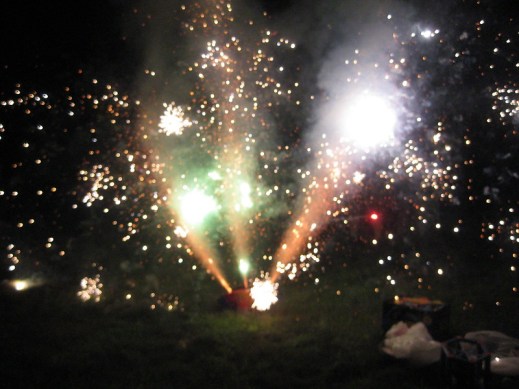
Years ago, when I lived in Inwood, I walked to the public pier at Dyckman Street on the Hudson River to see fireworks on the Fourth of July. The sightings were disappointing. Through clouds in the distance I could see the faint glow of a few shows over New Jersey and could see none of the official Macy’s fireworks happening farther downtown.
I returned to my apartment disappointed but was soon treated to shows of illegal fireworks that more than compensated. The barrage of ordnance that filled the northern Manhattan sky was a welcome sight that took me back to my childhood in Yonkers. I would emerge from our apartment in Yonkers on July 5th to a scene that resembled a war zone. The curbs and corners were filled with the spent paper from reams of firecrackers, and one time I saw a metal garbage can that had been exploded and overturned, looking like a giant metallic banana peel.
When I first returned to the city to live as an adult, I lived in Ozone Park, once the home to professional-grade illegal fireworks shows and street festivals paid for by the Gambino Crime Family boss John Gotti. Gotti had been in prison several years at that point, and the authorities worked hard to prevent the return of a large-scale illegal fireworks display. Police were all over 101st Ave. and the surrounding streets, but it made little difference. Managing to get on the roof of my building, I could see the official fireworks far away in Manhattan, but the cat-and-mouse game of cops and illicit fireworks was more entertaining.
Illegal fireworks have been a New York City staple for decades. When I was in fifth grade in the New York suburbs, I went to a neighbor’s yard where a friend’s father let me light sparklers off some candles set on the ground. I felt like the greatest outlaw on Earth. Kids waved around sparklers while adults set off bottle rockets and M-80s. When we heard police sirens in the distance, adults blew the candles out and we ran to the backyard until the danger had passed.
More recently, we have enjoyed the sights of fireworks over Whitestone and College Point. Early morning jogs through Flushing Memorial Field has found launch sites of the previous evenings fireworks displays, the tubes still smelling of gunpowder in the cool dawn, like a mortar position of a recently passed battle.
The allure of illicit explosives dates to the birth of the American nation. The first battles of the American Revolution were fought over the British Army’s attempt to seize illegal weapons.
New York, which was under the yoke of British rule for the bulk of the Revolution, was no less fervent in its commitment to the cause. One of the bloodiest battles of the war was fought in Brooklyn; the Battle of Long Island almost ended the Revolution—Washington barely escaped to regroup. The first woman known to take up arms for the United States did so in Manhattan at the Battle of Fort Washington; Americans lost that battle too and Fort Tryon park still bears the name of the British governor of New York at the time.
Our founding fathers would have been hanged as traitors to the crown had we not won. No matter our heritage, Americans are proudly descended from outlaws and outcasts. People setting off fireworks today are not would-be revolutionaries, but they are tapping into the same antiauthoritarian sentiment that is alive in spades in America today.
The city has seen an increase in setting off illegal fireworks. We hear them in every neighborhood and in some cases too late (true fireworks enthusiasts know to stop between 11 p.m. and 12 a.m., July Fourth excepted). There is a need now for people to celebrate and sending exploding stars into the night sky is best done while remaining safely distant from fellow citizens. Many bars and restaurants remain closed, large parts of the city are effectively locked down by massive protests. Fireworks are a needed respite, a needed release of our energies to celebrate something, whether that be the birth pangs of a better America or a fiery exegesis of an abiding patriotism.
Illegal fireworks are a proud New York tradition, a proud American tradition. Let it never die.
Skynet at the Stop & Shop

“Can we see the robot?” one of our daughters asked.
“Sure,” my wife answered.
We were finishing up lunch and I had mentioned I wanted to briefly visit the Stop & Shop to look for something. I had no idea this outlet near our home employed one of those grocery store robots I had seen mentioned online ubiquitously. These slim, monolith grey towers on wheels are outfitted with large googly-eyes as one would a child’s craft. I had heard they were being installed in more and more stores; friends had posted photos of them at their local supermarkets. I had yet to see one in action.
The shopping center at Linden Place and the Whitestone Expressway in Flushing is a zone of cluttered chaos and the logical effluvium of the overcrowded eyesore of the streets nearby. Forgotten New York rightfully calls this part of Flushing “Queens’ Crappiest” for its lack of aesthetics, complete disrespect of historic buildings, and utter incompetence of the design of residential buildings. The shopping center was not long ago filled with crater-like potholes. It has a check cashing establishment and was for a time frequented prostitutes that served truck drivers. I try to avoid this shopping center because of the traffic alone—it’s either accessed by a busy highway service road or a two-lane street that is often busy. My kids love the McDonald’s that is there for some reason; perhaps I have already failed as a father.
The Stop & Shop there is a last refuge of desperation when we are looking for groceries that aren’t found elsewhere. Now I also wanted to see the grocery store robot. These robots are named “Marty.” Stop & Shop supermarkets have deployed them in more them in more than 200 stores to look for spills and hazards. According to Mashable, each robots costs $35,000 and weighs 140 pounds. Also, these robots don’t clean up anything, but just alert people nearby to the fact that there is a mess.
I went looking for the one item I hoped they had: a specific popular baby food pouch that serves as a healthy snack for our youngest daughter. I headed for the baby food aisle while the rest of my family made a bee line for the back of the store where they spotted the robot.
The baby food section was the same mess it was at my last visit and was without the food pouch I was looking for. I scoured again and looked behind every box and envelope to no avail. The robot had not spent enough time in this aisle.
My excited daughters came to get me to show me the robot, which was making its way across the back of the store from where they had first met it near the deli. They ran after it and my wife and I followed.
When my children ran up on the robot again, it seemed to pause to allow us all to gawk at it. Bored shoppers accustomed to the googly-eyed rolling cyborg went about their shopping.
“Hi Marty!” my children thought this thing was great. Maybe you could put googly eyes on a giant steaming people of crap and children will find it convincingly anthropomorphized into a cute friend and want to take it home. The robot slowly moved away from us, not interacting with anyone other than moving out of our way and appearing to look at us with its false, plastic, and unblinking eyes.
New York City seems like a poor choice to send Marty. Our supermarkets are too crowded, and our people in need of work is always plentiful. Also, New Yorkers are more skeptical of gimmicks like this. While little kids got a kick out of Marty the robot, most adults are put off by it.
The supermarket robot is not the coming incarnation of Skynet, the computer system that becomes self-aware and plunges the world into a nuclear holocaust in the Terminator films. It’s pretty underwhelming by itself.
The truly troubling issue with the increasing use of robots is not that technology is marching forward and machines are doing jobs people want to do. It’s that people no longer want to act like people as much anymore.
If society functioned well, customers would report a spill to an accessible employee, who would easily see to it that the spill was cleaned up, or the store would employ enough cleaning staff to make it a pleasurable experience. Instead we’ll gawk at a machine and be on our way.
We are spurning human contact in favor of technology-driven convenience because our human interactions have plunged in quality. That’s not the fault of the machines, that’s our fault.
FNO Flushing Fantastic, daytime festival edition
Despite the popularity of some parts of Brooklyn, our collective dialogue around New York City remains excessively Manhattan-centric. New Yorkers will still say “the city” when they mean Manhattan, even though the five borough boundaries of our city have been in place since 1898.
And New York City is so large that telling people what borough you are from will not cut it. No one actually from Manhattan would introduce themselves as being from Manhattan unless they were in a very borough-specific conversation. Each of New York City’s boroughs is a tapestry of neighborhoods, and it is these neighborhoods that are the lifeblood of life in NYC.
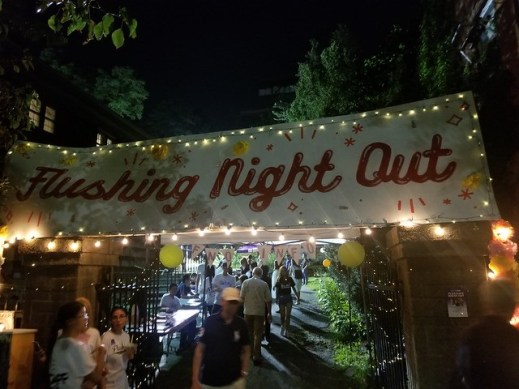
Queens is New York City’s largest borough and among its most well-known neighborhoods is Flushing. This weekend, local residents are showing off the neighborhood’s many attractions Saturday at FNO 2019: Flushing Fantastic.
FNO stands for “Flushing Night Out” as past events have been held at night, but this festival is going to run from 12 noon until 6 p.m. and is going to be at historic St. George’s Episcopal Church, right in the center of downtown Main Street a short walk from both the 7 train and the LIRR.
Flushing is known as a destination for Chinese cuisine, and people will come from all over to sample some of the great restaurants, food carts, or food court stalls that make this neighborhood unique. But there is much more than Chinese food, and the Greater Flushing Chamber of Commerce is promoting the neighborhood as an international melting pot, though admittedly one that is heavily Asian. I often point out to people that among the best dining attractions in Flushing are 24-hour Korean restaurants such as Kum Gang San and Noodle Flower, where you can barbecue an awesome assortment of meat right at your table at two o’clock in the morning if you are so inclined.
The Greater Flushing Chamber of Commerce also notes that the event is designed to give a boost to local businesses and entrepreneurs that are competing with large franchises. Downtown Flushing has seen a boom in construction of high-rise condominiums and the rising price of real estate has made life harder for small businesses throughout Queens and five boroughs.
“Flushing, NY is the crossroads of the world — where you can find amazing culture and people from around the globe,” the chamber says in its event notice online. “We want to celebrate the unique food, fashion, and music found here as well as help the small businesses and entrepreneurs who are struggling to make ends meet. Over the past decade, rising rents and major development projects have threatened to displace the small mom-and-pop stores who invested their blood, sweat, and tears into making our neighborhood prosperous.”
Flushing Night Out has been held at various locations, centered on the downtown area. The first one I attended was on the campus of Flushing High School, and it was a memorable event, even for cynics like me that hate crowds.
It was at my first Flushing Night Out that I was introduced to Karl’s Balls, a food stand of traditional Japanese takoyaki balls—those are octopus balls inside a doughy sphere that are cooked on an egg-shell like grill. Go to Karl’s Balls because it’s an ingenious name and you may never stop joking about wanting to put Karl’s Balls in your mouth. But all joking aside, the takoyaki balls are extraordinarily delicious and Karl himself—Karl Palma—is a celebrated chef who has been featured on the Cooking Channel among other accomplishments.
While Karl’s Balls may not be at this FNO event, there is going to be a smorgasbord of amazing food, from Ecuadorian cuisine to Japanese ramen to craft beer and gourmet ice cream. You have no excuse to leave hungry. The organizers require all the vendors there to have items that start at $5 or less.
FNO also features live music, crafts, and other cultural interests. This Saturday will feature Harmonyc Movement, a city-based dance troupe steeped in K-pop and Korean culture.
And at the Flushing Queens Macaroni Kid booth, they will be giving away protein bars for free (full disclosure, my wife Emily Griffin Sheahan runs our local Macaroni Kid web site and will be manning the booth at the event – tell her I sent you!).
Come to the Flushing Eco-Fest

Sustainability and the environment are not just for hippies anymore.
Although when you think about it, hippies were late to the game on wanting save the Earth. The greatest environmentalists in American history is most likely the 26th President of the United States and great New Yorker, Theodore Roosevelt. Roosevelt used the power of his Presidency to create national parks and other public lands. And when you think about it, accomplished hunters like Roosevelt are among the best environmentalists.
Ask yourself what would Theodore Roosevelt do? If he were still with us today, he would probably be bold enough to bicycle from Oyster Bay to the Flushing Quaker Meeting House (a trip of only 25 miles, an easy two hours for T.R.) and find common cause with the many diverse people working for the preservation of our natural world at the Flushing Eco-Fest on Saturday, March 23.
The festival is being organized by Flushing C.S.A. (Community Supported Agriculture), a local farm share group (full disclosure: our family is a member of the Flushing C.S.A. and my wife is a core member and Eco-Fest organizer) and being cohosted by the Flushing Chamber of Commerce.
The Eco-Fest is free and offers free workshops, eco-friendly kids’ crafts sponsored by Macaroni Kid, and a host of vendors with locally grown and organic goods. There will be well over a dozen vendors and groups there, each one is in some way working towards making things on the planet more sustainable.
There is guaranteed to be something to appeal to everyone. My personal favorites are some of the local food businesses such as Spice Tree Organics and Astor Apiaries. You will be doing something good for the environment when you attend, even if you just stick around to learn something about watersheds or how to compost or get a few cycling or energy-saving tips. There will also be environmentally-friendly soaps, home décor, seedlings, and baked goods for sale. And a raffle. Nothing is too small to do to make a difference.
You will also meet an interesting group of people there. Events like this can give you a great cross-section of this part of Queens. The Flushing Quaker Meeting House is the oldest, continually-used house of worship in New York City, and Flushing has several important landmarks in the cause of religious freedom in the U.S. Inside the Meeting House, you will be surrounded by history older than the United States. And whatever you think of the current trajectory of the U.S. or its politics, there is no disputing that this is an interesting time to be alive.
And it is a perfect time to increase your civic and conservationist involvement. Don’t let cultural stereotypes about environmentalists dissuade you from joining with those who want to keep our nation’s land strong. Everyone has a part to play.
Teddy Roosevelt promoted national greatness, and he understood that a nation that depleted its natural resources and did not invest time in strengthening its land and future could not sustain itself. In Flushing, people will gather and, consciously or not, help build on Roosevelt’s vision of a great America that treasures its natural resources and strives to be a unified community.
The joy of illegal fireworks
Growing up in Yonkers, New York, which borders the Bronx, the fourth of July was always a time for fireworks and fun. I would stay up as late as I could watching people light up firecrackers, Roman candles, bottle rockets, and other fare. I’d jump at the fearsome boom of M-80s. On the fifth of July I’d go outside to ride my bike and step into what looked to me like a war zone. Paper from expended fire crackers lined the gutters, leftover powder from unexploded ordnance glinted in the sun. One time I saw a metal garbage can that had been split in half and turned upside down by a blast of something, looking like a sad metallic banana peel.
When I first moved to New York City as an adult, I lived on 101st Avenue in Ozone Park, Queens. A few blocks down the street was famed Gambino Crime Family boss John Gotti’s old local headquarters, the Bergin Hunt & Fish Club. Gotti had been in prison for several years by that point, and the Mafia was a shadow of what it once was, but the Teflon Don had thrown big parties in Ozone Park every Independence Day and his presence was still looming large enough to draw a large police presence. I could not look out the window of my small studio on July 4th of that year without seeing the NYPD.
When my brother was visiting the next year, we managed to get onto the roof of the building I lived in. While we could see the fireworks off in the distance happening over the East River, it was much more fun to see the illicit explosions spreading it spider light over the skies of Ozone Park. The ensuing cat-and-mouse game of the firework lighters and the police added to the intrigue.
Years later, when I lived in Inwood in Northern Manhattan, I walked down to where Dyckman Street met the Hudson River, hoping to see fireworks of some capacity over the water. I was too far away from the official celebrations to get a good view of anything and I went home. But the volume of illegal fireworks being launched in Inwood was enormous, and I got a better show from my living room window than I could have had anywhere else.
I have been back in Queens for almost seven years now, this time in Northern Queens on the Flushing-Whitestone border.
Our co-op apartment building houses two addresses that do not connect except in the basement and on the roof. The roof is normally not accessible, but one of the buildings is without its elevator, so residents can take the elevator to the top floor of our side and cross over the roof.
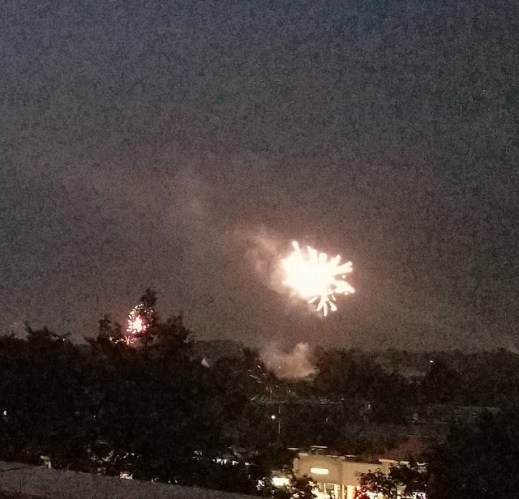
On the fourth of July the skies over New York City were lit with legal and illegal fireworks alike. With one girls falling asleep early, my wife and I took turns bringing our other daughters up to see what there was to see. We knew there was a lot going on in our neighborhood as the evenings leading up to the fourth had at least one or two substantial barrages of fireworks audible and in close range.
From all sides of the roof we saw fireworks in the distance. A string of lights on the roof added to the festive air. The official Macy’s show over the East River started up at 9 p.m., and other legal displays could be seen over some of the country clubs of Douglaston and other well-to-do neighborhoods. But the most compelling sights were the ones going on right over the tidy homes of Whitestone.
The fireworks would burst into a glowing flower of streaking fire and fade almost as quickly. “Where go?” asked my youngest daughter, pointing to where the colorful display had just been. Another family from the other side if the building was on the roof as well. “Happy Birthday America!” one little boy called out as the colorful bombs burst in air.
The Saturday after July 4th, our family visited friends for a celebratory party. There my older girls got to experience sparklers for the first time. They enjoyed holding the fizzing light, aware it could burn them but marveling at how pretty it was. It was what the older people and the big kids were doing, and they were glad to be involved in the tradition. I didn’t get to hold sparklers until I was in fifth or sixth grade, and my parents would not have allowed me to partake if I had asked them. I was at a neighbor’s house and the grown-ups were lighting off the bigger stuff, using a candle on the ground to help light things. When police sirens could be heard in the distance, someone would blow the candle out and we’d retreat to the dark shadows of trees near the house until the danger of being caught had passed.
Of course there are dangers to fireworks, and no shortage of stupid people who set them off dangerously and without regard to safety or consideration for others. But we can’t let stupid people ruin our good time. Just as we shouldn’t stop loving our country because stupidity is on the ascent in our leadership and public discourse, we shouldn’t stop loving the celebration because morons are in the mix. The idiots will be there until common sense or well-placed fireworks weed them out.
Colonists won their freedom with blatant opposition to oppressive laws and plenty of gunpowder. It’s that heritage of the outlaw patriot we celebrate with fireworks at this time of year. It’s a tip of the hat to our revolutionary history. May it never die.
The Benefits and Dangers of Being in a Forgotten Zone
It’s frustrating when you live someplace that’s not on the map. It is doubly frustrating when you live in one of the largest metropolises in the history of human civilization and you find your neighborhood has been dropped from the map.
This phenomenon is well-known to anyone who lives far enough out of the popular centers of New York City. Manhattan maps might end mysteriously somewhere above or below 125th Street, and many tourist-centered maps of Queens don’t venture much farther than Astoria or Long Island City—not including the airports, mapped separately. Staten Island may have this the worst, as the most popular destination of their borough for tourists is the Staten Island Ferry Terminal. Staten Island wears its “forgotten borough” hat with pride; respect.
Even the “Not For Tourists” map guide that includes Flushing for Queens stops a few blocks away from the building where I live. That’s too bad for the not-tourists, since there are delicious 24-hour Korean barbecue restaurants not even half a block from where the map ends.
Living in a lesser-known area of the city has a lot of benefits. One is cost of living and small rentals, not necessarily home prices. People pay a lot of extra money to live in a neighborhood that is popular or sounds impressive or hip. That’s why realtors have developed bogus neighborhood names that reference more popular areas. A few years ago, “East Williamsburg” was realtor shorthand for Bushwick, but now even Bushwick has become a popular destination for gentrifying newcomers. Maybe East New York (a higher-crime area not blessed with any in-crowd interest thus far) will be called “South Bushwick” or “Jamaica Bay Coast” or something ridiculous.
If you’re not in easy walking distance to a subway, consider yourself in a forgotten zone. The prices will be lower but the commuting to work in Manhattan will be long and miserable unless you’re able to take an express bus or railroad and pay the extra money for the honor.
Also, being in a neighborhood that is a best kept secret is a bit thrilling. I lived in Inwood for a little more than a decade, and while it was frustrating to have to explain where I lived for that long, it was nice to experience all that the far north end of Manhattan had to offer before people found out about it. Now Inwood has all the trappings of an “up and coming” neighborhood including overpriced rents.
One drawback to living in a lesser-known neighborhood is the fight for resources. The political calculus that determines how money is allocated is determined by political power and opportunity, and if your neighborhood doesn’t have the cache to woo the powers that be in City Hall, you may be out of luck.
Local Flushing and Whitestone parents are trying to rally support to keep a Parks Department children’s program located nearby – the Parks Department wants to relocate the program to Kissena Park, about three miles south. A group has organized Families for Bowne Park and sought the help of local elected officials and is even planning a Kids Rally for Bowne Park on June 1st.
Bowne Park is definitely off the radar. It has a nice playground and pond, even some bocce courts. While in the past this may have helped the park stay a quiet gem in a local neighborhood, its success may have led enough of the wrong people to take notice and decide to move the Parks Department children’s program.
I wish this group all the success in the world, and while we may not always want to struggle for neighborhood recognition, we’ll go to the mattresses to make sure our area gets respect.
Meeting Farmers in Queens, New York

In 2012, when Hurricane Sandy created shipping delays in the New York area, gasoline shortages arose quickly. Within the span of a week, 1970s-era gas lines formed on city streets. A cab driver I spoke with in the weeks after the hurricane told me he had woken up early that day and driven to Stamford, Connecticut to buy gas.
Now imagine if our food supply was so adversely affected. For this reason alone, it is a good idea to get food that’s grown closer to your home whenever possible. You want to live close to your most vital supplies, especially since we can’t all plant vegetable gardens in our living rooms.
Luckily, entire networks of local farms serve many large cities, and New York City has its own ecosystem of networks that allow residents to get their food locally – locally in this case being within 100 miles of the city.
My wife is one of the founders of the local C.S.A. (Community Supported Agriculture), Flushing C.S.A., and this Sunday they are holding a Meet the Farmer event at the Flushing Quaker Meeting House (the oldest continually used house of worship in the city – no joke, it dates back to the 1600s).
The central purpose of Meet the Farmer is to meet the farmer who grows the food for Flushing C.S.A. and other C.S.A.s in the city. But there will be a lot more. There will be local food vendors there and a free screening of Farmers for America, a documentary that explores the troubles facing our country’s local farms.
There is something for everyone at the Meet the Farmer event. You can peruse the historic site of the Meeting House between snacks provided by the local vendors. You can learn about the local farms that supply Organic produce and other goodies to networks within the five boroughs and beyond, and you can learn about larger issues facing agriculture in America today.
I often gave little thought to where food came from. I went to the grocery store when I needed and got whatever was the tastiest food that was easy to make. As a bachelor I lived off of egg sandwiches, cheeseburgers, and Chinese food. That was good living for a while, but that kind of thoughtless consumerism has its limits. My wife has had a much longer interest in agriculture and nutrition. When we met she was running a small health supplement store that had a lot of well-to-do clients. For a while she was a member of a C.S.A. that was not very close to her home, so she helped found the local one that we use to get our vegetables.
Living in New York, we are often far removed from rural life and agriculture is something alien, done in faraway places. But knowing where your food comes from and being part of a community that supports a stable foundation for supplying it is a good thing. In communities where there is dissipating cultural cohesion, people forge their own groups and find common ground where they can. It is helpful that they can do it to help other local communities and ensure their basic survival.
So come to Flushing and learn more about Flushing C.S.A., or find out what C.S.A.s serve your area. It is well worth the journey to Queens.
Science is usually our friend
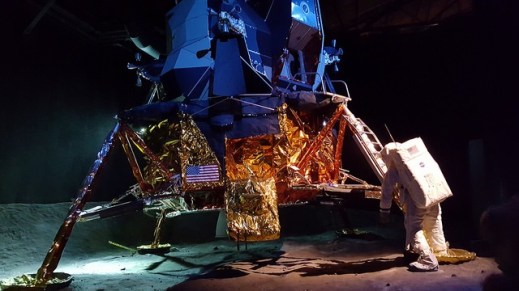
This weekend our family attended an event called the Queens SOUP that was hosted by the Greater Flushing Chamber of Commerce. The event raises money for a worthwhile community group and participants vote for a winning group from among four that make presentations for projects. My wife was one of the presenters for the Flushing C.S.A.
The winning group was the Lewis H. Latimer House’s Summer Tinker Lab. Lewis Latimer was a prominent African-American scientist who contributed greatly to the invention of the light bulb and was instrumental in the spreading use of electricity. His former home is a preserved historic site in Flushing. The Latimer House’s presentation consisted of a music demonstration that allowed children to use a circuit and a laptop to make music with basic household items.
Our twins love music and it was great to watch them thrill at the discovery of the circuit concept and to have that associated with music. We want our girls to join the Tinker Lab program when they are old enough. The relatively small grant that the Latimer House received was nonetheless a victory for science.
Earlier that same day, thousands of people marched around the country in a “March for Science,” protesting the current White House’s policies that labels climate change theory as either a hoax or exaggerated. The march also looked to show disgust with the general anti-intellectual attitude that many conservative establishment politicians have tended to embrace in recent decades. Science is great and is certainly worth of the reverence, but let’s take a look at what adhering to science means.
“Science” to me means the skilled application of learning through the empirical method of observation, experimentation, and theorization. It usually results in a consensus view among those who practice the scientific method.
Science does not abide by any values other than those used by those conducting those experiments. Dr. Jonas Salk, who discovered the polio vaccine, was a scientist. So was Josef Mengele, the Nazi doctor who conducted cruel experiments on victims at Auschwitz. They each made discoveries that advanced the causes of medicine, but they are rightfully not held in the same esteem by our civilization.
Science cannot be claimed as a mantle by any partisan cause. The people who “Marched for Science” this past weekend were embracing those scientific findings that supported their ideas. We may agree with those ideas, but we can’t ignore that these are values-driven at their core.
Science will ultimately thwart attempts to make it the show horse of any political movement. If the mastery of science is by itself our only measure, then J. Robert Oppenheimer should be on as many t-shirts as Neil deGrasse Tyson. He’s not. And like our politics, scientific consensus is subject to change. What passes for common sense today might be considered foolhardy balderdash in a few years’ time.
So let us embrace science at every turn and let our children know it is fun. But let’s not pretend that science is always our friend. It’s going to prove us wrong at some point and leave us with very uncomfortable conclusions. But living life means facing those awkward moments and making sure your kids are prepared to face them too.
For science!
Running for Flushing Bay
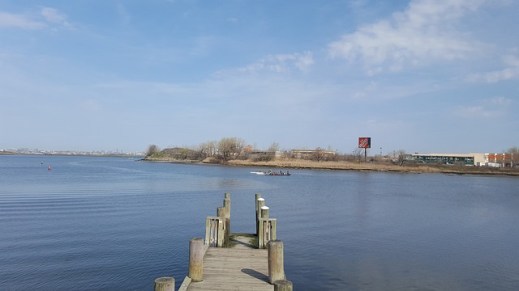
New York City has a myriad of opportunities to go running. Every weekend somewhere in the five boroughs you can find a race or a fun run to suit your needs.
Being an out-of-shape middle-aged office worker with more aspiration than perspiration on my calendar, I like these organized events because it means I’m going to get out the door on time and get a nice bit of exercise as I am striving to get myself into better shape.
So it was fortuitous that I learned of the Guardians of Flushing Bay 5k this past weekend. It is close to home and for a good cause, raising money to help the organization work for a cleaner and more accessible Flushing Bay.
Flushing Bay is a piece of waterfront that needs the cleanup help and is underutilized. It’s got a paved running path, benches to sit on, and even a boat launch and a pier, but not that many people use it and it’s not easily accessible. There is a marina there where people have their boats, but there is not a thriving waterfront that could be there.
There are a lot of improvements that could be made for cleanliness and accessibility, so it’s great to see the Guardians of Flushing Bay group start to organize. They took photos of all the runners gathered there to show support to local politicians and the run raised money to support their efforts. There’s no reason Northeast Queens can’t have an excellent waterfront as well.
My wife is a member of the Flushing C.S.A. (Community Supported Agriculture), a local farm share chapter that lets members order food directly from local farms. She set up an information table and sat our 10-month-old daughter there with her. She had a good number of people coming over and joining the mailing list. “Babies and puppies can sell anything,” she explained.
The run was well-attended but not a large gathering like you would find at one of the large Roadrunners events. It maintained a very helpful community spirit throughout. A large number of the participants were members of dragon boat racing teams that frequently practice in Flushing Bay.
My wife’s cousin, who runs 5k races frequently and has run the New York City Marathon and other marathons, joined us. She had a later start time than I did and fell and hurt her thumb, but still breezed past me.
I normally like to listen to music when I go running both to inspire me and drown out the sounds of my own wheezy breathing. I forgot to bring it this time. But the sights and sounds of Flushing Bay, of Queens waking up on a Saturday morning, were inspiration enough. There were also volunteers along the way offering encouraging words to fast runners and slow-pokes alike.
When I run a 5k, I make it a point to run the whole thing and not walk part of it. I may be slow but I want to be consistent and until I get in better shape I need to push myself to keep going.
It was a good day for the race as the weather was sunny but not too hot. During the run you could smell the briny essence of the Bay and see the pollution that washes up at high tide. You could also see the great promise of making better use of the esplanade and marina. The run took us from where Flushing Creek branches inland from the bay to within a few hundred yards of LaGuardia Airport’s Delta terminal and back.
When I approached the end of the run, a small crowd of volunteers and runners cheered me on. As tired as I was, the cheers and the sight of my two older girls standing just beyond the line encouraged me to pick up the pace a bit. I wheezed my way over the finish line and scooped up our three-year-olds and carried them back to my wife’s C.S.A. table.
As more runners finished and took advantage of the water, oranges, and bagels, some dragon boats appeared in the bay near the run and began racing one another. It was a pleasant end to a good event. We hope that the Guardians of Flushing Bay do this every year.
New York City driving madness

Police in my part of the city are looking for a driver that ran down a 76-year-old man on a bicycle and drove away. The man is in the hospital and there is video of the car believed to be involved.
I would love to say I’m surprised but I’m not [insert typical joke about Asian drivers here—the stereotype is generally true but other ethnic groups are much worse]. Driving is terrible here because people get away with driving like savages in New York and the police rarely do anything about it. A woman was killed by a hit-and-run driver in downtown Flushing a few years ago. A three-year-old was run down and killed not far away and the driver was barely given a slap on the wrist.
While the quality of driving in Flushing is awful I’ve found driving to be worse in other parts of the city. I noticed it is extremely bad in uptown Manhattan where I once lived and saw an incident that I think sums up driving in New York and the police’s lack of response to it perfectly.
I saw a cab driver make a left turn onto Broadway and he not only ran a red light, he didn’t have room to merge with drivers that had just made the light, so he was started driving on the wrong side of the road towards a police car! That’s right, the cab driver was playing chicken with a patrol car of New York’s Finest and essentially won since the police didn’t seem to notice or care. Think about it – you can run a red light and drive on the wrong side of the road in front of cops here and they won’t do anything.
It’s good that the police are at least drawing the line at hit-and-run attacks on elderly cyclists, but they likely could have prevented this if they took vehicle infractions seriously.
When my truck was vandalized late last year, I reported it to the police. Three officers showed up to tell me that there was nothing they can do since a sticker on a window was not considered vandalism for some reason. I was pretty sure that if I had stuck a sticker on the window of their car in full view of them that I’d quickly find myself riding in the back of their car. But I didn’t want to waste time arguing with them when I had to get to work getting the sticker off of my car (and I did it perfectly with no residue left—take that asshole sticker vandal; I haven’t forgotten about you).
I was pulled over once by the police while driving in Flushing. It was because I made a left turn at an intersection where turns were no longer allowed. The city has created a lot of these no-turning zones and it makes driving more difficult all over the city. I didn’t plow over any pedestrians or run a red light. I’ve seen charter busses make real illegal left turns against traffic and running red lights and not be pulled over at all. To their credit, the police did not ticket me when they pulled me over, but told me not to commit that infraction again.
I hope the police catch the animal that ran down an old man on his bicycle. I hope they throw the book at him (or her) and they never drive in New York again. I’m going to continue to be one of the last civilized drivers on the streets of our city. Being right is its own reward, sometimes its only reward.
Deep shame in the Queens bus game

I am convinced that living in areas not immediately within walking distance from a subway may save them from gentrification and cultural death. I am fortunate enough to live in one of those thankfully un-hip areas of the five boroughs. But while my neighborhood is still overpriced and overcrowded, it still retains some of its old-world New York charm and character.
But I rely on buses to get me to the 7 train that gets me to the 6 train that gets me to work. The 7 train and the 4-5-6 line in Manhattan are two of the most miserable and overcrowded subway lines in the entire system, which is quite an accomplishment.
But I’m lucky. I’m lucky I have a job that I can safely commute to. I’ve also learned some of the tricks of the trade that can at least alleviate my daily aggravation somewhat. One of them is catching a ride on the Q34 bus when I can.
The Q34 is my preferred bus. I can get on early enough to have a place to sit in the morning and if I take it home in the evening I can usually get a set as well. Because it’s a smaller line and its riders are usually from a middle-and-working class part of Queens, there is a greater degree of civility than on the other buses I could take. The Q44 goes from the Bronx all the way to Jamaica, Queens and is almost always crowded. The Q20 is a local version of the Q44 when it passes by my home, so it picks up all the angry people who couldn’t fit or who would otherwise be miserably stewing on the Q44. After you’ve been on the Q44, the Q34 feels like a VIP lounge with diesel fumes; it’s the Rolls Royce of regular-fare bus rides when it’s working properly.
But here is the catch: the Q34 is a rogue ghost ship during the evening commute. Somewhere in a dark alleyway in downtown Flushing there must be a gaggle of Q34 drivers spending their evenings gambling or drinking themselves into a stupor while what seems like one lone bus drives the entire route by itself, and slowly. If you get to Main Street and see no line for the Q34, forget it. Then again, I’ve done that only to see a near-empty one drive by minutes later.
Normally I know to jump on the line for the Q34 when I see that there is one at Main Street. If there are people waiting in any significant numbers, it means enough time has elapsed since the last bus arrived that the next one cannot be too far off. This bus stop is at the corner of Roosevelt Ave. and Main St. in Flushing, Queens, which makes it one of the busiest pedestrian intersections in the city if not the world. It’s also right outside a busy Duane Reade convenience store. The stop is on a stretch of street that hosts several other bus stops.
The line for the Q34 got so long that it doubles up upon itself like a large snake folding itself in half. Pedestrians bump into people waiting on line even when they try not to. Multitudes of buses roll down that section of Main Street, very few of them are Q34s.
And last week I achieved something that is rare even in the miserable world of Queens bus transit: I stood on line for the Q34 longer than it would normally take to drive the entire length of the Q34 route.
One reaches a point oftentimes of waiting for public transit that you want to give up in disgust and find another means to get going to where you have to be, but you’ve invested so much time in waiting that you refuse to budge. Damn it, I’m going to get my money’s worth and the MTA isn’t going to win this round! I found myself standing in the cold among the other miserable people waiting for the Q34 with this same mentality. I would enjoy a seat on the Q34 this evening if it was the last thing I ever did.
I have no right to complain, as I have other options for getting home in the evening. But many of the people who ride the Q34 do not have that option, and the underserved but route is all that stands between them and a pricy cab ride or a long walk home.
First World Problem of the Week: New York street parking wars
I was fortunate enough to be invited by some friends to join them at a restaurant on Long Island to watch some Ultimate Fighting Championship fights. There are better tributes one can pay to these great fighters than enjoying them beat each other bloody while stuffing yourself with chicken wings, but hey, we’ve got to start our own road to the octagon in our own way.
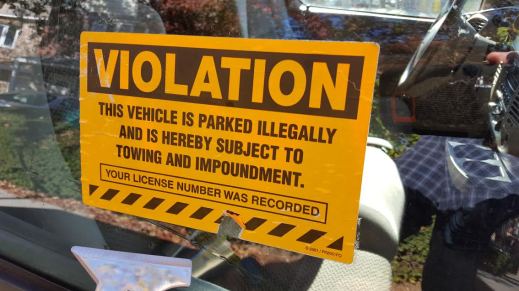
I went to where my beat-up pickup truck was parked on Willets Point Boulevard near Parsons Boulevard. I was shocked to see a sticker on the passenger’s side window.
VIOLATION
THIS VEHICLE IS PARKED ILLEGALLY AND IS HEREBY SUBJECT TO TOWING AND IMPOUNDMENT.
YOUR LICENSE NUMBER WAS RECORDED
New York City street parking regulations can be a Byzantine labyrinth of conflicting signs and notices, particularly in some of the more popular parts of Manhattan. Owning a car in New York City is a rare privilege and I am lucky I’m able to keep a car in the five boroughs, but it comes with a mountain of problems one must negotiate. Many of my fellow New Yorkers are horrible drivers. Parking in some parts of the city impossible and just about every non-millionaire who owns a car in New York has had their car damaged in some way without any justice or compensation.
In the more residential areas of Eastern Queens, the rules are normally much simpler. There are spots that are legal except for a window of time on a given weekday morning, when in theory a street sweeper will come and clean that section of street and curb. The Sanitation Department used to affix one of their infamous neon orange stickers on your car if you violate alternate side of the street parking.
In my neighborhood of Flushing bordering Whitestone, there are also some bus stops that may be legal on the weekends but then become illegal once weekday bus service resumes.
I was parked in a choice spot that was not in an alternate side spot. I’ve parked there repeatedly for years without incident. If any part of where I was parked was illegal, I would have received a parking ticket by now. This sticker was not a Sanitation Department sticker, not an NYPD sticker, nor any other kind of official sticker. Some asshole put it on themselves because they didn’t like that my truck was parked there.
I didn’t have time to peel it off, so I drove out to Long Island with the neon orange sticker screaming my alleged moral decrepitude to all the other drives of Long Island. I was the Uncle Buck of Flushing. I parked my truck in the parking lot of the bar/restaurant where I met my friends and hoped not too many people would notice the blazing orange sticker—the scarlet letter of parking scofflaws—besmirching the good name of all there at Hooter’s of Farmingdale to watch people pummel each other on pay-per-view.
That night, after watching Conor McGregor triumph without apology in his main event fight, I drove back home and found another parking spot on that same stretch of street. I didn’t want to tempt fate but no way will I let vandals determine where I park, and it’s convenient. Since it was near where the vandalism took place, it was convenient from the standpoint of reporting this matter to the law.
The next day I called my local police precinct and reported the crime. The officer on duty took my phone number and said officers would call when they were on the scene. A few hours later I got a call from the police and went to meet them where my truck was parked.
Three of New York’s finest were there to meet me. I showed them the sticker on the passenger window and noted that the truck had been parked completely legally on a public street only a few feet away from where it was not situated.
The police said they couldn’t report the vandalism as vandalism since there was no damage to my vehicle. I told them that this was indeed a crime, though not a serious one. That someone cannot just put stickers on someone’s property without their permission.
“It’s probably one of these property owners around here that don’t like you parking here,” said one of the cops.
I certainly didn’t expect them to assign their top detectives to this case or launch a task force to find the sticker vandal, but I at least expected them to report the crime, minor though it was.
Likely it was one of the homeowners that lives on that stretch of road. My neighborhood has quite a few very entitled homeowners who think they can claim portions of the public streets as their own parking domains. Some place traffic cones in front of their homes to claim parking spaces.
Being a homeowner doesn’t entitle you to claim public land. If you want to live on a street you own, become a millionaire and live on one of the private streets in Forest Hills.
After the police left, I got two cups of boiling-hot water, some paper towels and a scraper. I held the paper towels over the sticker while slowly pouring each cup over them, letting the hot wet towels sit for several minutes over the sticker and partially melt the clue holding the sticker onto the window. After it was softened up, I scraped the sticker off without any trouble.
Whatever jackass put this sticker on my truck surely thought I’d panic and try to scratch the sticker off my window like some kind of berserker. No such luck. I won’t let my First World Problems get the better of me, I’ll let the snotty haters in my neighborhood bask in the glow of pride that I have in my beat-up pickup truck.
RAMONES and the quest for Queens’ artistic respect

The Queens Museum is a site of pilgrimage for punk rock fans from all over the area thanks to its Ramones exhibit, which is open until July 31.
I made it there not long ago one weekend after seeing friends posting photos of their visits there over social media for the last several months. It is a fine exhibit, one long overdue in the borough that gave the pioneering punk rock band to the world. I made a point to wear my Norman Bates & The Showerheads t-shirt when I visited, because one great Queens punk band deserves another.
The exhibit is colorful and brief. It’s only two modest-sized rooms and a screening room. I went there with my family, which means that a good deal of our time was spent stopping our two and half year old twin girls from banging Tommy Ramone’s snare drum. We didn’t have time to really take all of it in, maybe we should have gotten a sitter.
But as rushed as our walk through the exhibit was, it was important to be there. Queens is often overlooked in the pantheon of New York City artistic greatness. But Queens has given the world not only the Ramones but Johnny Thunders, Run-DMC, Simon & Garfunkel and more. Queens doesn’t get the respect it deserves – all the outer boroughs carry with it that basic desire to poke their finger in the eye of the city being defined as Manhattan.
One thing that the contemporary adoration of the Ramones tends to obscure is that they were grossly underappreciated when they were a functioning group, at least here in the U.S. I remember going to see them in 1989 in Connecticut and they were playing at Toad’s Place in New Haven, an admirable music club but a small venue (it was a 21+ show and I had no fake I.D.). When I finally saw them in late 1995, they were playing a larger venue, but as part of a shitty alternative radio show, headlining but sharing the bill with the unworthy likes of Better than Ezra and Silverchair (the oft-hated Silverchair were actually very good to be honest).
Queens is fully embracing its Ramones fame. Murals of the Ramones now grace Forest Hills. There are plans to rename the intersection next to Forest Hills High School Ramones Way.
The Ramones who moved to the East Village in the 1970s could not afford to live there today. While the Joey Ramone Place street sign is the most stolen in the city, the area looks nothing like it did when the Ramones first played CBGB in 1974. The refrain is a familiar one: New York is no longer affordable to the artists who made New York’s art scene famous. The artists I know don’t talk about New York, they speak of Philadelphia, Buffalo, or Berlin. New York’s East Village is a victim of its own success in a lot of ways. I’m not ready to give up on New York just yet, but it’s easy for me to say that from Flushing.
To be a punk rock fan in New York City means to constantly wrestle with nostalgia. There is a rich history to celebrate, but nostalgia can be a trap as much as a motivator.
New York continues to produce great punk bands. You may have to travel farther away from Manhattan and the trendy parts of Brooklyn to see them, but great local bands, the Ramones of tomorrow, are playing somewhere in Queens today.
 Matthew Sheahan
Recent Comments