
Stopping by Buc-ee’s at 3 a.m.
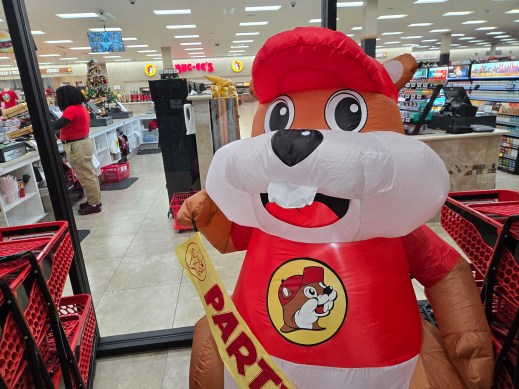
It was the early hours of a Sunday morning, and I was traveling with my band, Blackout Shoppers. We had played the Anarchy at the Arcade Festival at Super Rad Arcade Bar in Lynchburg, Virginia, and shared the stage with some amazing bands. It was great fun, but we had a long drive home and wanted to make it to a hotel to get some sleep.
Cruising along, I saw the sign of a beaver looming large over the highway, a bright beacon of road trip joy.
“Have any of you guys been to a Buc-ee’s yet?” I asked the rest of the band.
They had not.
“That changes tonight.”
I had visited a Buc-ee’s in South Carolina on a road trip to Georgia and back with my daughters. The chain has built a reputation as a bastion of largesse and Americana; I was not disappointed. We bought stuffed toys of Buc-ee the Beaver, the institution’s mascot, for my girls’ younger cousins, bought gas, and helped ourselves to a bag from a floor-to-ceiling wall of beef jerky. I made a point to stop by again on our return journey to New York.
My comrades wanted to buy beer, but as it was past midnight—technically Sunday morning—and would run afoul of Virginia’s blue laws, they were denied. I have not had any alcohol since early 2010, but I still hate these blue laws with a passion. My friends took it in stride; they still had beer and bourbon waiting for them in the truck.
We experienced the super clean Buc-ee’s bathrooms, which stand alone and set the standard for public restrooms; the rest of America has a long way to catch up.
At 3 a.m., Buc-ee’s is not the crowded madhouse during daylight hours. There is a camaraderie among people who are awake in those strange pre-dawn hours. Some are up early for work or in the middle of an overnight shift, others are on their way to a hotel after playing a crazy hardcore punk and metal show. There was a skeleton crew manning the place, but Buc-ee’s still ran with attentive precision. It lived up to the hype for my bandmates.
While Buc-ee’s has the bulk of its locations in Texas and has expanded into the Southeast, the chain may have plans for the Northeast. While traveling in Connecticut last summer, I saw a Buc-ee’s billboard on I-95 that informed drivers that the nearest Buc-ee’s was 700+ miles in the opposite direction. Would the company spend money on a billboard over one of the busiest highways in the country just to troll Northeasterners over not having Buc-ee’s? I contacted Buc-ee’s through its website to inquire of such designs. I have yet to hear back.
On my previous trips, I did not try the establishment’s famous brisket sandwich. In the spirit of early morning road trip adventure and punk rock excess, I splurged and emerged with another coffee and a brisket sandwich.
We stood outside, close to the bronze statue of Buc-ee the Beaver, a form of pagan idolatry befitting our gluttony in the early hours of the morning. I tore off pieces of my brisket sandwich and shared this feast with my bandmates. It was delicious.
Judge the livability of your city using the White Castle Index

At a proud moment last year, I won the Literary Open Mic competition hosted by my comrade-in-arts and Renaissance man Filthy Phill Lentz at The Cobra Club. I decided to celebrate my victory with a late-night snack before heading home. I drove to where my navigation system indicated was the nearest White Castle, only to find a construction site in its place.
It is at least the second White Castle to be purged from the popular and overrated borough of Brooklyn. The much-valued Castle in Williamsburg on the corner of Metropolitan Avenue and Humboldt Street was closed nearly two years ago to make way for more overpriced apartments.
Before I got married, I made sure my bachelor party ended with a visit to White Castle to cap off an evening of Yankees baseball, strippers and punk rock. When my band plays shows near a White Castle we are sure to stop by for some sliders on the way home.
I wouldn’t advocate eating junk food regularly, and I limit my White Castle visits to special occasions and balance with attempts at a healthy diet and regular exercise. But after a night of victorious effort, whether that be in producing great art, achieving a career or personal victory, or otherwise exerting yourself above and beyond the call, it is suitable to indulge with some excellent excess, and you should be able to safely do that in multiple locations around any major American city.
New York City has fallen behind in its White Castle Index, meaning that low-cost good food at all hours is increasingly unavailable. Williamsburg was once a haven for artists; it’s now home to the $150 doughnut. Williamsburg managed to strike it rich and still slide into the sewer.
I prefer White Castle, and I’d be happy to expound on its excellence both culturally and calorically, but there are other options that are similarly convenient and meaningful. Regionally there are many differences and the White Castle chain does not ready many parts of the U.S. But every region should have its own version of White Castle. Waffle House often fits the bill in many parts of the country. It is open 24 hours a day and has plentiful offerings of quickly made indulgent food at a relatively low cost (it might be useful to call this the Waffle House Index in the Southern U.S. I don’t know any Waffle House restaurants north of Pennsylvania). And diners are a great American institution that are being priced out of existence as well.
Everyone should be able to have an all-night restaurant that they can go to relax among their own kind (leaving it up to each person who counts as “their own kind.”)
If the all-night party isn’t available at an affordable cost, then something is wrong, and we are getting to the point in New York City where only the extravagantly wealthy can afford to live life to the fullest. That leads to a decline in the character and long-term viability of the city. Without strong, vibrant, working and middle classes, the cultural and physical rot of its society becomes evident very quickly.
The world’s best artists do not emerge from the pampered class that looks down their noses at the common people. The arbiters of taste and culture should not be people who’ve never waited tables, washed dishes, or dug a ditch. With fewer and fewer working Americans able to find a rewarding life in our urban centers, cities will cease to be engines of creativity and genius.
As goes the working class, so goes our city. Luckily, there are still numerous White Castles to be found in the outer boroughs. I’ll see you at one.


Recent Comments