
Legalize It, Then Criticize It…
 New York State may soon embrace medical marijuana. We’d be better off if the government legalized it outright. Why talk half-steps when other states have already made cannabis legal?
It was Tommy Chong who put it to New York via social media, saying that we were behind the high times. New York used to be the place that this kind of progress was launched, Chong mourned, now we’re catching up with Colorado and Washington.
Tommy Chong is right. Marijuana should be legal in all 50 states. It’s ludicrous that people are in jail for growing it or smoking it or having a big wad of it rolled into a cigar leaf or in a brownie or anal suppository or however else people are getting it into their bodies today. Legalize it.
The people have spoken. In times that it’s been put to a vote, voters support legalization of marijuana. Whether it’s medical marijuana, which is more widespread, or the outright legalization that we’ve seen recently in Washington and Colorado. But beyond that, even in places that still enforce draconian laws against the weed, marijuana use is very high (pun intended).
We are not far from the prohibition of marijuana being as antiquated and ridiculous as the prohibition against alcohol that started almost 100 years ago. That prohibition is rightfully considered a joke today, and our grandchildren will look down their noses at the outlawing of marijuana in the 20th Century. Rightly so.
So let us join our voices to the millions that already call for legalizing electric lettuce in New York. Let the City lead the way and hopefully the state will follow. Let the fifty states tax and regulate cannabis like they do tobacco and alcohol. The government can’t stop people from smoking it, so it might as well make a few bucks to help keep the roads paved.
But where there is support for legalization, let’s also support some healthy distrust of the marijuana industry. Wanting to legalize it shouldn’t stop us from criticizing it. Marijuana does not belong on a list of outlawed substances (if any do is another matter), but that doesn’t mean it belongs in our bodies.
There is a lot of awareness and opposition to genetically modified foods and the potential dangers they pose to people’s health. There’s a greater demand now for natural and organic foods made free from the use of dangerous chemicals or genetic manipulation. Yet none of this scrutiny is being applied to marijuana cultivation.
If you’re not willing to eat a plant that was grown with a genetically modified seed, then don’t smoke something that’s named for a Star Trek character. I’ll do what I can to avoid food made possible by Monsanto, but I’m also not going to smoke something named “Vulcan Mind Meld No. 6.” Do we really need to be a lazier, slower-witted country that eats even more junk food at two o’clock in the morning?
Let’s definitely legalize the chronic, but let’s also approach it with the same skepticism as we would any other element of big agribusiness. And that’s what marijuana is: big business. No one is selling weed out the kindness of their heart. Tobacco and alcohol companies are rightly treated with suspicion. The people hawking ganja are no more saintly.
Medical marijuana is great, but the overwhelming majority of people using weed are using it to get high for its own sake. They have every right to do that. But unless you have a serious medical condition, marijuana isn’t good for you. I want to live in a world where people are not persecuted for smoking a plant. But I also know that the world does not need more pot heads.
Let’s increase the sanity of the conversation. Marijuana legalization is the right thing to do. But let us embrace legalization of marijuana without having to embrace marijuana itself.
The Greatest Borough – a poem for the hearty literary types
 The first poem of the year has been posted on the Impolite Literature blog. The poem is entitled “The Greatest Borough” and it’s an homage to Queens, which I contend is the city’s greatest borough. You may disagree.
A Mayoral Lack of Horse Sense
 Several years ago, while visiting the tourist sites in Manhattan around the holidays with some family, we were walking on Central Park South after a stop at The Plaza. As we passed by the line of hansom cabs, my Grandmother remarked that she had never taken a horse-drawn carriage ride through Central Park. My father set about rectifying that at once, and a few minutes later they were on their way in a horse-drawn hansom cab.
My dad’s spontaneity and love for our grandmother was admirable and made the day more memorable. If he visits New York next Christmastime, he may not be able to take a hansom cab ride.
New York Mayor Bill de Blasio pledged, days before his recent inauguration, to do away with the hansom cabs.
Animal rights activists, including the predictable coterie of celebrity actors, have long denounced the horse-drawn carriages as manifestly cruel. They’ve been aiming to have the carriage rides outlawed for a long time.
De Blasio was inaugurated with much fanfare from his liberal supporters who are happy to see a Democrat in office once again.
But doing away with the horse-drawn carriages is foolish pandering to a lobby polluted with fringe players and the loss of a fine tradition and lots of jobs. Cruelty to animals is terrible, but animal rights activists are never too far away from taking a hard left turn to crazy town, and outlawing horse-drawn carriages is a fringe activist power-grab that a mayor is supposed to be wide enough to sidestep.
The New York City Police use horses regularly, and there are a few stables that offer horseback riding within the five boroughs. Space for horses is hard to come by in most of New York, but so is space for anything.
Being generous and assuming for the sake of argument that conditions for the horses are bad, the solution is not to outlaw an industry but to improve and regulate the care of the horses. It’s not wrong to use horses to pull carts. It’s OK to ride horseback and it’s OK to ride an elephant and a camel. There are lots of animals that are not suitable for riding, but horses are alright. This is actually common knowledge and the fact that there’s a serious debate over banning the industry shows how a more extremist animal rights community has been successful in framing the debate. Luckily the carriages won’t go without a fight.
What’s more, de Blasio is potentially putting hundreds of working-class New Yorkers, whose Teamsters Union endorsed him, out of work. For a politician who came into office on a platform of fighting for middle and working class New Yorkers with the nebulous pledge of ending “inequality,” putting hansom cab drivers out of work is the political equivalent of crapping in an inaugural ball punch bowl. Mayor de Blasio likely knows this, so hence the announcement during the holidays and before the hullaballoo of his inauguration.
There have definitely been drivers who overworked or abused their horses. One driver was even arrested for animal abuse when found to be working a horse that had an infected hoof. But the carriages are regulated and inspected and have been under significant scrutiny for years.
If we let animal rights activists start calling the shots, we’ll start on a slippery slope to becoming a city of pathetic vegetarian tree-huggers.
New York Things to Watch in 2014
 A New Year is almost upon us, and New York City will have lots of things going on, per usual. Here are some things to watch for, look forward to or get ready to hate in 2014.
New Mayor: Bill de Blasio is the first Democrat elected mayor in New York in more than 20 years. He managed to unite New York Democrats and ran a very smart campaign. He’s inheriting a shit show from outgoing Mayor Bloomberg in the form of multiple city worker contracts that have expired. Thousands of city workers have been working without a contract for years and they expect their liberal Democratic mayor to pay up and fast. De Blasio knows he can’t give his many supporters everything they want. He’s got to walk the tightrope of trying to hold together a liberal coalition that wants to increase taxes on the wealthy without scaring away the rich New Yorkers who provide the city’s much-needed tax base.
Super Bowl: The Super Bowl will bring more money to New York City, even though the game is being played in New Jersey at Giants Stadium or MetLife Stadium or whatever corporate behemoth blows a wad of cash to put its name on it by next year. Of course, the powers that be are hard at work making sure that the game will be expensive and less fun than your average Jets or Giants routing that normally takes place there. They have banned tailgating at the game, which is like banning praying in church.
Extended 7 Subway Line: The No. 7 subway line is scheduled to open in June 2014, but the authorities ran a special train just so outgoing mayor Bloomberg could ride it before he left office. It currently runs from Flushing, Queens to Times Square in Manhattan. The extension will run to 11th Avenue and 34th Street, near the Javits Convention Center. As a commuter who takes the 7 train every day to work, I loath this upcoming extension. The 7 train is a crowded clusterfuck of a subway line. Unless the MTA has a magic train fairy ready to plop massive double-decker trains on the line right before the extension opens, they are about to make a bad situation much worse. The silver lining is that it will make it easier for people to get to the Javits Center for conventions. But really, slow-moving tourists who don’t know where they’re going is not what we really need more of on our subways.
Fulton Street Transit Hub: On the good news end of public transportation grand openings in 2014, the Fulton Street Transit Hub in lower Manhattan may open in 2014. The Fulton Street subway station has been a maze of construction closures for close to a decade now, and some of the improvements are already evident. It has been delayed and scaled down from its original, more elaborate plans, but it will be a vast improvement.
Real Community Organizing: We’ll see more real community organizing in New York in 2014, and by community organizing, I mean citizens getting together outside of government institutions to do things for themselves. Most people think of community organizing as people getting together to petition for increased benefits or air grievances of one form or another. But as our fractured city and nation find official institutions continually lacking, more New Yorkers will see the wisdom in doing things for themselves. You’ll see more Community Supported Agriculture (not just for hippies anymore), more home schooling (not just for religious fanatics anymore) and the like. New Yorkers are resilient and inventive. That won’t change.
RIP Al Goldstein
 In June of 2000 I went to see Penn & Teller on stage at the Beacon Theater in New York. Being a big Penn & Teller fan, I bought tickets as soon as I could and got a really good seat for the show. When I was there, I was impressed that I was one row in front of Al Goldstein, editor of SCREW magazine and one of the people in my mind who embodied New York City better than anyone else.
Goldstein was dressed in cutoff jean shorts, hiking boots, and a red, white and blue sequined jacket. He had gorgeous woman on his arm that looked to be a 20-year-old porn star.
Years later I made a flier for the punk band I play in that featured Al with his middle finger extended, which was how he was often photographed. I emailed him a copy of the flier and he emailed me back saying it was wonderful. That made my day.
Goldstein was one of New York City’s great public personalities, one of the outspoken people who come to represent New York and its spirit. Much in the same way Ed Koch came to represent New York among the celebrated and in polite society, Al Goldstein represented the city’s gritty edge and its always sarcastic and sometimes obscene sense of humor. He was an overweight, cigar-chomping loudmouth who ranted against New York’s many annoyances as vehemently as he skewered the Philistines from both the left and the right. At the same time he never lost his sense of humor about himself.
We recently lost Al Goldstein. He died on Dec. 19 in a hospital and probably not under a pile of naked women like he would have preferred.
Growing up in New York, I would often see Goldstein on talk shows and news segments when he was often called upon to defend pornography. When I moved back to New York I was happy I could see his show Midnight Blue on cable access television. Al Goldstein was a ubiquitous advocate of enjoying sex for its own sake and being unashamed of it. He was overbearing and bombastic, but his case just made plain sense and went like this: Wanting to have sex is a very natural thing that has kept the human race going for millions of years, why be ashamed of it or think it is bad? I’m a man, why shouldn’t I enjoy looking at pictures of naked women? Pictures of vaginas in my magazine aren’t bad because vaginas aren’t bad. Fuck you if you don’t like it.
Do you enjoy looking at tits in magazines or on the Internet? Thank Al Goldstein. He had been fighting for the right to publish his magazine before it was cool. Those days are mostly behind us in America. Except for rare cases that continue to be egregious and terrifying for free speech, porn is everywhere now and the government can’t stop it. But our access to porn today is because of the efforts made by Goldstein decades ago, often at great personal risk. It’s hard to believe in these days of celebrated promiscuity that people could actually be threatened with jail for publishing naked pictures in magazines. Goldstein was one of the first to do battle for those freedoms and he did it years before more celebrated personalities like Larry Flynt.
Lawsuits and bad business decisions left him homeless and destitute. Penn Jillette, recognizing the debt Americans owe to Goldstein, often helped him financially. Later in life he did express regret for some of his excesses. He was estranged from some of his family. He admitted to his faults and realized his mistakes, but never wavered from the blunt personality that made him essential.
Al Goldstein embodied New York City not because he published pornography, but because he fought for his right to do it and lived a life that was bold and unapologetic.
A-Hunting You Should Go
 New York City has no legal places to hunt and it’s a good thing that we can’t start shooting geese in Central Park or pigeons in Prospect Park. Although one could probably bag a nice wild turkey in Inwood Hill Park if you’re patient enough, it would be a bad idea to take your shotgun on the A train.
But there are plenty of opportunities for city folk to get into hunting. I’m originally from the Big Apple, have been back in the five boroughs 15 years and I’m hooked on hunting for good now. There is fine hunting land upstate, on Long Island and in New Jersey and Connecticut.
Hunting is good for the environment and will get you fresh, free-range meat. I only became interested in hunting over the last few years. I would be hypocrite if I was willing to eat meat and wasn’t willing to go get it. If you’re willing to eat it, you should be willing to kill it.
But the first step to start hunting is to take a free hunter safety class, which you can do throughout New York City. I took both my gun hunting and bow hunting safety courses at different places in Queens.
There are gun ranges in every borough of New York City, so if you can get a gun permit (which takes some doing—New York City’s gun laws are unconstitutionally strict and permit costs can run higher than buying a firearm), you can practice close to home if you live in the Big Apple. But you can also borrow a gun or a bow from a friend who lives outside the city. I go to a friend’s place in Connecticut, which is near a state forest.
Hunting means you have to be alone in the woods with your cell phone off. You have to be very quiet and observe everything carefully. You will see notice things you haven’t noticed before and wouldn’t notice if you were hiking, camping or fishing. It requires mega amounts of patience, of sitting or standing very still for hours at a time in hopes of seeing a deer.
I went two years of hunting without getting anything and coming heartbreakingly close to taking deer. That was hours every day for several days in a row, getting lost and coming out of the woods empty handed but still loving it.
My first year, I was in a perfect position on an elevated ridge when two large deer walked by. When you first see deer that you have a chance to get, your adrenaline soars and your heart pounds furiously and you can hardly get the animal in your sites. I had a great shot on one of the deer and I was following them along. At the last second I stepped on a twig and the two deer bolted, their fluffy white asses taunting me as they ran away.
The next year, I again had a great spot when three deer walked almost directly in front of me. When I moved ever so slightly to get a good shot on one, they spotted me. One of them screamed (deer can scream and sound like the Muppet Beaker) and my chance was lost again. I didn’t see another deer the rest of that season, and got lost in the woods, three times. It was still fun.
And this year I made plans well in advance and was in the woods on the first day of the season. I was in a good position and I saw a deer only about a half hour into legal hunting. I shot at it twice, convinced I got a kill shot, but had only lightly grazed the beast. Hours later, after a fruitless search for a dead deer that wasn’t, I was confident that my day was over and was content to laze and doze on my old ridge from my first year.
Later on, early in the afternoon, at time when deer are not usually active, two more came to me. I managed to get off a solid shot on a small button buck. It went down quickly and I gave it extra time to die. I saw where he fell and waited 15 minutes. I found it, feeling proud and sad at the same time.
My good friend Steve, who got me into hunting, helped me greatly and without his help I would have come home empty handed again. He was hunting nearby and came to help and take my photo with the deer. He showed me some of the finer points of field dressing and soon I was ready to go.
The deer looked small, but didn’t feel very small while I was dragging it out of the woods. In a few days I’ll return to Connecticut and collect a hefty box of delicious venison from a butcher. Our freezer will be full for at least the first part of the winter. And I can’t wait to go back next year.
Our Rich Mafia Life
 News from Long Island has come in that John A. Gotti son of the more famous Mafia boss and a one-time Mafia boss himself, was stabbed on Long Island. He survived the attack.
Gotti Jr. told the police he was stabbed while breaking up a fight between two strangers. Police find that about as believable as him being stabbed by a unicorn.
When I first moved back to New York, I worked at JFK airport and found a place in Ozone Park, on 101st Avenue near Woodhaven Boulevard. A few short blocks away was the Bergin Hunt and Fish Club, which had served as John Gotti’s Queens headquarters before he became head of the Gambino Crime Family.
The fact that we were close to a place of Mafia lore was a selling point.
“You’ve heard of John Gotti?” the real estate agent asked.
“Yes,” I said. Who hadn’t?
“Well his club is right down the street. People know not to mess around here.”
Gotti had been in prison for years by then, but there were still plenty of wise-guy types around. There were still old men playing cards in the Bergin Hunt and Fish Club when I would walk by. It is long gone now.
Gotti’s headquarters for the time he was the big boss was in Little Italy, the Ravenite Social Club, is now a shoe store. Only the tiled floor remains. John Gotti died in prison, ravaged by cancer, a shadow of the feared “Teflon Don” he was in the 1980s.
For better or worse, New York loves its Mafia heritage. There are tours in Little Italy featuring famous assassination sites. I love it too, no doubt. I was glad to walk by the Bergin Hunt & Fish club and gladly bragged to friends that I was in John Gotti’s neighborhood.
But really, when you get right down to it, the Mafia is bullshit.
We like to imagine the Mafia through the lens of “The Godfather,” the quintessential mob film that popularized the genre and made mobsters look good. It’s a great film. Anyone who doesn’t love “The Godfather” deserves to sleep with the fishes. But “The Godfather” is an accurate portrayal of Mafia life as much as “Star Wars” is an accurate portrayal of the space shuttle Challenger disaster.
The real Mafia is not a collection of earnest Vito Corleones living the American dream, it’s a gaggle of the worst grease ball Goombahs you can imagine but with guns and money. The real Mafia isn’t keeping your neighborhood safe, it’s stealing your car and shaking you down for protection money.
A few years ago I read the book Underboss by Sammy “The Bull” Gravano, who was John Gotti’s lieutenant who eventually turned on him and testified against him. Gravano’s memoir, like anything else told by a career criminal, can’t be taken at face value, but it describes a life not of dapper dons but of sleazy thieves and thugs, always looking for new ways to make money, usually by stealing from others in some way. A piece of shit thief in a tailored silk suit is still a piece of shit thief.
Save the Tourists (and Airbnb)
 Tourists: No other form of life on the New York sidewalks and subways is more simultaneously loved and despised. We love that they are here spending their money and enjoying the wonderment of our city while we hate how they slow us down with their clueless wanderings and slow gait unfamiliar with the pace of city life.
New York needs tourists. Tourism is a central part of the city’s economy and messing with the flow of tourists to New York is effectively kicking the Big Apple squarely in its big balls.
So the New York State Attorney General’s office threatens to throw cold water on this essential industry with its subpoena of Airbnb’s New York State records.
Airbnb is a web site that connects visitors with private hosts who rent out private rooms or apartments, usually for significantly less than hotels cost. The N.Y. Attorney General’s office claims that the platform is being abused by people operating illegal hotels and avoiding hotel taxes.
I did a quick search for hotel room rates in New York City for the first week of March 2014. Prices are higher around the holidays in November and December and the second week of March might see abnormally high rates for people coming for the St. Patrick’s Day Parade. This study was unscientific, and there are web sites like Priceline.com and others that can help you find discounts.
Starting with a non-luxury, well-known hotel chain, the Marriot Marquis in Times Square charges an average of more than $360 per night for one room for two adults with no children. That jumps to more than $430 per night if you want such luxuries as a sofa bed in your room. A Marriott on East 40th Street got a rate of $206 per room.
Going to the cheaper hotels, Days Inn offered a rate of $131 per night on 94th Street. The chain charges $95 per night to stay at their hotel at JFK Airport. Nothing at JFK Airport is worth $95 a night unless it comes with a free strippers and cocaine.
A similar search on Airbnb gets you $175 a night for a room near Times Square in Manhattan and as low as $57 per night near JFK. The offerings were scattered and not as numerous to put too much of a dent in the hotel business, judging by the search I did on the web site.
No doubt there are people using Airbnb who are running illegal hotels outside of the legitimate regulation of the law, but there is a way to differentiate between these groups and the people making a few extra bucks renting a room to budget-conscious tourists. And about 90% of the Airbnb hosts are people renting out rooms in the homes they live in.
For whatever its faults, Airbnb is American capitalism and New York ingenuity at its best. Even with the abuses as they are the city and state gain more than they lose by enabling more tourism. The money tourists don’t spend on hotels they spend on Broadways shows, Yankee games, hot dogs and hookers. Let them.
Standing Strong on Pier 17
 Fried food is the last thing I need to eat, but I needed to eat at a seafood restaurant at the South Street Seaport just to give them my business.
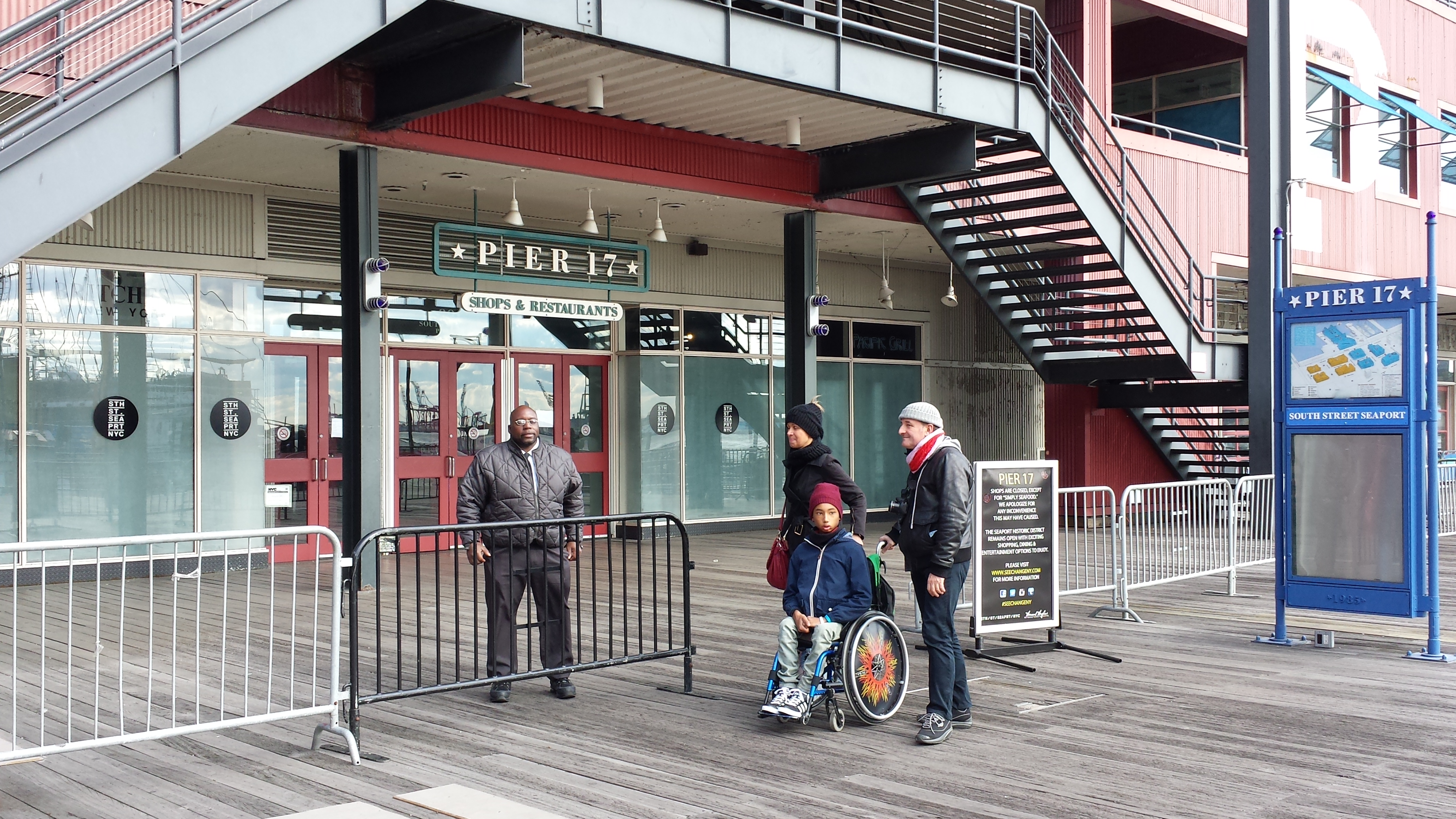
As I approached the Pier 17 mall, I found it surrounded by barricades with the only entrance guarded by a security guard turning people away. He admits that the restaurant is open, but calls it a “café” when it clearly is not.
“I understand there’s one restaurant still open inside,” I said to the guard, who was discouraging someone from entering.
“Well it’s not a restaurant, it’s a café. If you want to check it out it’s on the third floor.”
The restaurant that remains open among dozens of empty storefronts is called ‘Simply Seafood’ and it’s clearly a restaurant like any other food court restaurant in any food court, only this one is the only business left in a large three-level mall at the South Street Seaport.
The restaurant is the lone holdout in a large mall that a developer is trying to tear down. They have a lease and expect it to be honored. The landlord has used illegal and very underhanded tactics to try to remove them, such as locking the doors to the mall and reporting that the restaurant had closed, and is still using dirty tricks today. With shady developers normally getting away with their violations of private property rights in the name of economic development and the city normally either turning a blind eye or helping out in with corrupt deals, the urge to score one for the little guy is immense and well worth the price of fried shrimp.
Howard Hughes Corp. owns the property and wants to build another, fancier mall there. I would hope that if Howard Hughes were alive today he’d throw a jar of his collected urine at the people running this namesake corporation. Howard Hughes didn’t need to harass small business owners; he flew airplanes and banged Katherine Hepburn.
Security guards pace the otherwise empty mall eyeing customers suspiciously. There are bathrooms open on the second floor, but otherwise the mall is a ghost town of abandoned stores, makeshift barricades, ‘No Trespassing’ signs and caution tape.

Despite the best efforts of the rent-a-cops, people continued to come for seafood. The restaurant’s struggle with the landlord generated publicity that has brought some people; it’s why I was there. The allure of touring a mostly-abandoned place brings more, and hopefully the chance to stick it to a real estate Goliath will bring more. New Yorkers can’t help but respect and admire the people who fight for their rights even against overwhelming force.
New York landlords are notorious for their unscrupulous behavior. The price of real estate is so high and both the expenses and potential profits so huge, a hold-out tenant can cost an owner lots of money. In the case of a prime commercial real estate in New York’s tourist-heavy downtown, developers stand to lose millions of dollars if they have to maintain a mostly abandoned building for the next seven years.
A small group of tourists asked the men working why they were the only business still open at the mall.
“We’ve got a lease,” said one of the men. “We’ve have a lease until 2020.”
I had a lunch of friend shrimp and fries. What made it such a delicious meal was helping a determined small business stick to their guns.
As I left the mall, the security guard at the entrance was turning away another group of potential customers, wrongly calling the restaurant a café. But not everyone was turned away, many continued through and moved on to give the restaurant their business, and I hope Simply Seafood is there for a very long time.

Beavers, Vultures and Lemmings in East New York
 Famous street artist Banksy is currently in New York City leaving works of art here and there, and spectators are flocking to see these pieces.
Recently he painted a picture of a Beaver on a wall in East New York, a Brooklyn neighborhood bordering Queens that is known for being dangerous. Art gawkers dutifully went there to view the piece, and local East New York residents promptly went about robbing these art tourists, blocking the view of the graffiti art meant to be public and charging people $20 to view it.
It’s to be expected that street criminals will look to make a quick buck off of less-than-streetwise tourists, what makes this latest hustle more bothersome is that it’s won approval from the very class of victims most likely to be taken by the scam. The Gothamist blog called the street thugs “savvy” and many commentators thought that since white people dared to go there to view some art, then they were serving some worthy cause to be ripped off by the locals. I disagree.
Robbery is robbery, and feeling you have a right to rip people off because they’re not from your neighborhood or they don’t look like you is no reason at all. What’s more reprehensible is the multitude of self-hating “enlightened” white people thinking this is a good thing or that local East New York residents have a right to a life of petty crime because of their race or their station in life.
Let the local residents capitalize on the Banksy art legitimately. Set up a food cart there or make picture postcards of the art. There are real ways to make money that don’t involve thuggery and intimidation.
And as for the sorry state of East New York, it wasn’t street artists from England or art enthusiasts from Manhattan who made East New York the way it is today. There are people there who can do better; let them. But treat street hustlers like the low vultures they are.
Cyclist Jerks from Hell
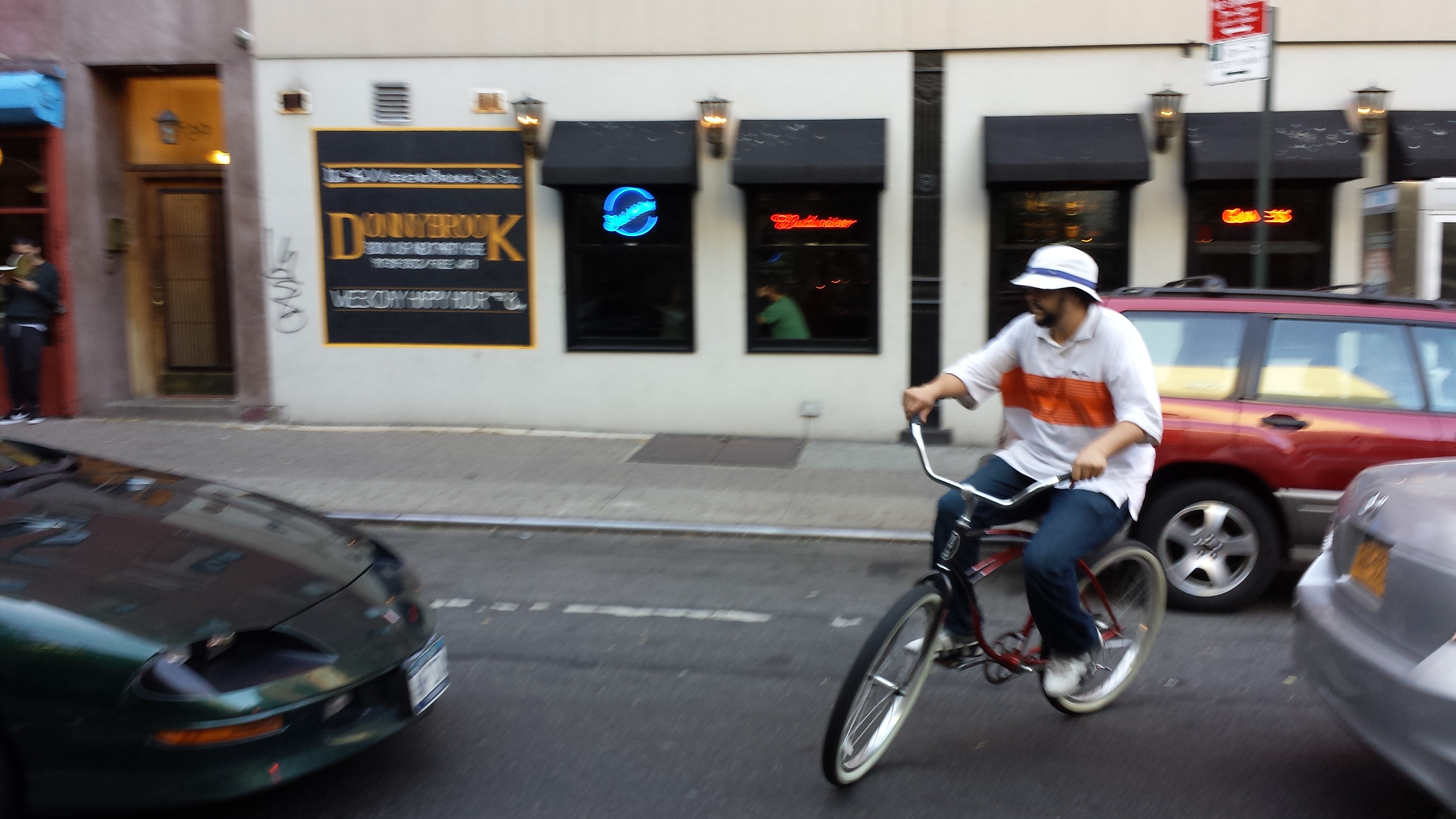 One fine morning as I was about to cross a street in lower Manhattan and go to work, I had barely stepped off the curb when I heard the thin chimes of a bicycle bell. I looked to see a cyclist moving towards me.
“Get out of the bike lane,” sneered the cyclist as he pedaled past me.
Not only were we not in a bike lane, he was going the wrong way down a one-way street. I stood there flabbergasted as he rolled by. A few seconds later, I heard him ring the tinny bell once again from farther up the street.
That incident pretty much encapsulates much of the New York bicycle situation. A very large segment of the cycling population not only regularly violate all laws of traffic and common sense, they have an entitled attitude about it. They want all the rights of an automobile owner and none of the responsibilities of sharing the road.
Let me iterate that I am not against cycling or cyclists. I have many friends who enjoy riding bicycles and if I didn’t live 16 miles away from work, I’d gladly consider riding a bicycle to and from work. It’s good exercise, better for the environment and all that jazz. When I was a youth I rode a bicycle constantly and terrorized adults and other children with it whenever I could. I’m all in favor of bike lanes, bicycle parking and even the bike sharing programs that are finally starting to take shape in the Big Apple.
A good rule of thumb for cyclists is: If I can’t do it with a car, don’t you try it with a bicycle. That does not apply to keeping the bike in your apartment and walking it on sidewalks etc. If I drove my truck on a sidewalk, ran a red light and then drove the wrong way down a one way street, I’d expect to be arrested for reckless driving. Just because you can do less damage with a bicycle doesn’t excuse you from riding it recklessly, and the Big Apple is sick with reckless cyclists.
Walk the streets of New York and without fail you will see cyclists do one or more of the following routinely: running red lights; riding the wrong way down one-way streets; riding on sidewalks; passing traffic on the right, even passing cars making turns. It’s without fail. If a motorist is making a right turn and I try to pass them on the right, I’d be the biggest jerk in the world, yet a cyclist will yell and pound on a vehicle to protest their imagined “right” to be a reckless idiot. I’ve seen it happen.
They operate on the theory that they are an endlessly persecuted minority and thrive on being the victims of ignorant motorists, homicidal drivers and overzealous police.
In many cases cyclists are treated unfairly. Every cyclist I know has a litany of horror stories that involve being struck by car, hassled by the police or confounded by ignorant pedestrians. People that I know have been the victims of aggressive motorists who think they own the road, and I’ve had to break myself of the habit of prematurely stepping into the street before I have the right of way.
But bicycle culture has given us another urban horror that the city doesn’t need, that of a cyclist every bit as entitled and boorish as the most reckless motorist or thuggish pedestrian.
Witnessed one night on Stanton Street on New York’s Lower East Side: A van was driving the wrong way down this one way street. Next to the van was a man on a bicycle, yelling at the driver of the van for driving the wrong way while also driving the wrong way.
“You’re both going the wrong way,” I said to the man.
“I can do that faggot!” he called to me as he bravely sped away on his bike. Actually he can’t; cyclists have to obey the same rules of the road as cars. And unless he’s just won the Tour de France, a grown man in bicycle shorts has no business calling anyone a faggot. But more to the point, riding the wrong way down a one-way street is especially odious in New York, where pedestrians are accustomed to looking only one way before crossing a street because so many streets are one way. Yet many cyclists do this all the time and think nothing of it.
Many of the cyclists are good people trying to escape the dual hells of public transit and city driving. I can’t blame them for wanting the freedom to move in a city that is so often confining. But having a smaller carbon footprint doesn’t absolve you from the rules of the road or the precepts of human decency.
Happy Summertime, New York
 New York in the summer is for oppressive heat and simmering anger, for being tempted with the sights of more female flesh while blanketed with heat and the sweaty intrusions of more people.
City life is a trial of patience and suffering in the summer. Concrete and blacktop absorb and reflect the heat, exhaust fumes are trapped by tall buildings, and everything in the city is hotter than everywhere else. Cramped onto subways and buses, we bristle at the sweaty touch of others, suffering further in one another’s vulgar heat.
Summer tests everyone’s patience. The heat and humidity magnify the unending slights and annoyances that are the fuel of city angst. The unavoidable heat and its sweaty unpleasantness works to erode our patience and our souls boil over with anger and white-hot rage almost daily.
The sad realization of summer hit me just yesterday while I stood waiting for the 7 train in Flushing. The 7 train is populated mostly by Asians with sharp elbows who scramble for seats that they’ll only sit in for about 25 minutes at most and are less comfortable than standing. I prefer to stand so I can read the paper and not fight for a seat. But like other subway lines, the 7 train is a strange beast that operates on its own whims and curses its riders with frequent malfunctions. I was jolted to the realization of summer while standing and waiting for the subway at Main Street, which is underground – most of the 7 line is above ground. “Signal problems” caused a delay in subway service, and there was little to do but stand motionless and suffer as the platform became more crowded and sweat soaked through your clothes.
Summer in the city has its fun moments. It’s sometimes nice to stay in the city while everyone else is away, especially Labor Day weekend to end the summer season. New York is forever populated with young women and the degeneration of our society has dictated that popular fashion becomes more and more revealing with each summer season.
But at some point, you must leave New York City for at least 48 consecutive hours every summer in order to preserve some shred of sanity. Being baked in a concrete, glass and body odor oven for three and a half months will make even the strongest person go mad.
I’m going to Connecticut to light off explosives with a few good friends and then to California where I will try to trace the steps of Henry Miller and light bonfires in tribute to John Steinbeck and the ghosts of Portuguese whalers. But I shall return soon to our sweat-soaked city to grab it by the throat once again.
 Matthew Sheahan
Recent Comments