
The touching holiday story of the Crack Whore Santa

One evening at Blackout Shoppers’ band rehearsal, our drummer at the time, Mickey Fingers, was recounting a story of his apartment being robbed.
He worked in broadcasting at the time and was working midnight shifts. His roommate had been out drinking heavily at bars and had brought home a woman of ill repute with the intention of carnal indulgences. The roommate, however, passed out drunk and the woman burglarized the apartment. She had ransacked the place and taken numerous valuables. Mickey gave the drunkard roommate his walking papers and was shortly rid of him.
Mickey ran through a catalog of what she had stolen: expensive cameras, high-end electronics, books, DVDs, and a plethora of CDs had vanished in the hands of the larceny-prone harlot. It was an immense amount of property, beyond the capacity of one person to haul off by themselves.
“How did she carry all of that stuff out of your apartment?” I asked.
“She took pillowcases from my bed, filled them up with my stuff, and walked out of there like some kind of Crack Whore Santa.”
The Crack Whore Santa never left our imaginations after that. Not long after Mickey Fingers departed from the band, we recorded a song called “Crack Whore Santa” and asked him and his son to come in to the studio and record an introduction to the song. His son was five years old at the time. It is preserved for posterity on the recording:
“OK, so who don’t we want to see for Christmas this year?”
“Crack Whore Santa.”
“And why not?”
“Because she took Daddy’s things!”
[Together:] “Crack Whore Santa! One, Two, Three, Four!!”
Mickey Fingers recovered from the theft of his property and lives in Westchester with his wife and children. Despite having played in Blackout Shoppers, he is gainfully employed and lives a productive life. The drunken roommate managed to turn his life around—the next time Mickey Fingers saw him he appeared sobered up and in a stable relationship.
And Blackout Shoppers continue to play music inspired in part by such absurdist comedies of life. We are playing Otto’s Shrunken Head on Saturday, Dec. 20th and “Crack Whore Santa” is on the set list.
Book rescue in Queens and its vortex of unknows

I was cleaning out my motor vehicle, disposing of a handful of parking meter receipts that accumulate on the dashboards of cars in large American cities. As I deposited my trash in a receptacle, an open book nearby caught my eye.
Someone had dropped or thrown a book, and it had landed open against a curbside trash shed outside a co-op. It was an odd place to see a book, and it looked like it was thrown from a moving car or dropped out of bookbag that was being kicked down the street. I retrieved it.
The book, “Who Put This Song On?”, by Morgan Parker, was in good condition considering its rough treatment. Upon inspecting the book further, it bore a label on its back cover that read “FLUSHING HIGH SCHOOL LIBRARY.”
Flushing High School is a mile away from where I found the book. I made a note to return it. No book should be homeless, and someone may be looking forward to reading that, or may not be able to afford whatever fine may be levied for losing it.
A host of possibilities flooded my mind regarding how the book came to rest upon the sidewalk a mile away from its library home. Did someone steal it and try to throw it in the trash bin? Was a student carrying this when they were attacked by a kidnapper or serial killer, and the page was open to a passage that would reveal the whereabouts of the victim or give a clue as to the motive of a brutal killing? Am I now a suspect in a kidnapping or murder that has not been made public yet? Or will I be considered a cringeworthy thief, found with a book stolen from a local high school?
I made it my mission to return the book as soon as it was convenient, lest I be unwittingly caught up in these mysteries, but more likely, that the book can continue to be enjoyed by students. I was prepared for whatever grilling I would receive when I brought the book back—I can explain my fingerprints on the book were from finding the book, not stealing it or doing anything untoward to whatever student checked it out.
I set about my task taking a public bus to the high school, arriving in the afternoon after classes were over for the day. I tried to look as assuming and non-threatening as possible while carrying a book clearly geared toward young women.
Flushing High School is on a nice green campus surrounded by the dense vertical sprawl of downtown Flushing, Queens. It’s an oasis of beautiful architecture and calm grass and trees amid the rapid overdevelopment of a city fueled by commerce without a thought for beauty and cohesion. I hope it fights to the death to stay the way it is.
My returning the book was anticlimactic. I stepped into the front entrance of the school and handed the book to a school safety officer behind a desk, who thanked me for returning it. I walked out of school and enjoyed the walk home, having done my good deed for the day and rescued a book from oblivion.
Lessons of strength from September 11
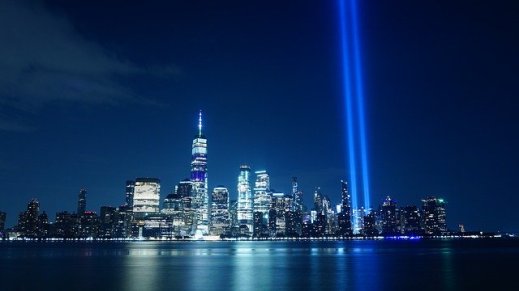
For New Yorkers who were out of town on September 11, 2001, the horrors of that day were accompanied by a feeling of horrific impotence. I was at a conference for work in California, and I was awake in time to watch the North Tower collapse on live television. I could do little but make phone calls to make sure some of my family who lived and worked in lower Manhattan were still alive (they were).
There is no way to fathom the extent of the loss the world suffered that day; our city and country (and world) have never been the same. But there are positive lessons we can take from that day that give us strength in the face of lingering darkness:
New York City will be here forever, and our Gotham can survive anything. In my lifetime alone, New York City has survived bankruptcy, riots, the worst-ever terrorist attack on U.S. soil, an East Coast blackout, and a deadly global pandemic. “Tough” doesn’t begin to describe New York. New Yorkers are both tormented and inspired by our city every day, but we love it and will defend it to the death.
Americans will rise to the occasion, no matter how dire or dangerous the mission. The heroism of the passengers of Flight 93 and the sacrifices of the first responders and others who helped people to safety during the attacks is an enduring legacy that gives us hope in dark times. The blood of revolutionaries and pioneers still courses through our veins. At times of our worst traumas come opportunities for greater good, and the mettle America showed in the wake of the attacks is alive and well.
Everyone has a role to play, and life is too important to sit on the sidelines. The heroes of the September 11 attacks include not only the first responders and the Flight 93 passengers, but the train and ferry operators who got people to safety, doctors and nurses who tended to the wounded, and even everyday people who did whatever they could. Those kinds of opportunities to be a part of making our city, country and world better are still present. Don’t be a spectator.
Take a moment to remember those that we have lost. Remember, too, the resilience and character of our city and country—qualities that carried us through and continue to endure.
New York’s most punk band leaves the stage
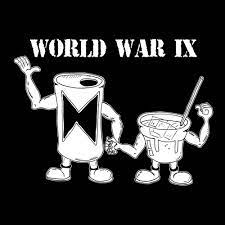
In the early 2000s, I picked up a copy of the punk rock newspaper The New York Waste, and paged through the show listings, record reviews and other articles. I came across a comic strip, ‘Last In Line for the Gang Bank, the GG Allin Story,’ a comic biography of late punk rock musician GG Allin.
GG Allin was a legendary punk rock performer known for his obscene and violent performances. His posthumous notoriety has grown in recent years but at the time his legend was more restricted to a smaller circle of punk rock die-hards.
Holy shit, I thought, someone is writing a comic-strip biography of GG Allin’s life and that is the coolest thing ever!
I read this comic strip religiously in every issue of the New York Waste. At the bottom of every comic in a small banner or border was a web address that looked somewhat cryptic. Unable to resist, I fired up my large desktop computer at home (this was several years before smart phones became publicly available) and visited the web address to find it was for a band called World War IX. Their guitar player, Justin Melkmann, was the man behind the GG Allin comic.
Based on the strength of this awesome comic alone, I made a mental note to see World War IX play at the earliest opportunity.
I first saw the band play at CB’s Basement, a smaller, downstairs venue attached to the legendary CBGB’s. They were the kind of raw, no-frills garage punk rock that I can never get enough of. They brought a loud punk sound with catchy tunes and, importantly, a sense of humor.
After their set, I found their guitar player, Justin, and told him that I liked his comic, and that World War IX was playing great music. I was in the process of getting my band Blackout Shoppers off the ground and we promised to stay in touch.
Fast forward a few months, and Blackout Shoppers and World War IX were playing shows together frequently, and the first recordings that Blackout Shoppers ever had for sale was a split 7-inch record with World War IX called ‘Larceny Armageddon,’ playing off the names of our bands.
People have been arguing over what constitutes “punk” since 1975. If you ask 100 punk rock fans for a definition of punk, you will get 100 different answers. We can agree maybe on two key attributes that make a band punk: an aggressive, often purposely offensive style of rock, and a base level of honesty with its fans and the general public.
Many punk bands try to act as if they are completely above the fray, that because they play this style of music they exist on a higher moral plane than those that play more lucrative genres. I can tell you first-hand that punk musicians harbor all the same egos and insecurities that the rest of the rock world has. As much of a joy as it is to play music, there comes a time in every band member’s life when they look at other bands and say to themselves, “Why can’t we have what they have?” or otherwise questions or gripes about their position in the entertainment industry food chain.
World War IX has a case for being New York’s punkest band of the last few decades. It played a raw, aggressive punk rock style that evolved but never mellowed, and it was very honest with its fans. Especially as told through Justin’s comics, World War IX narrated its own journey with all the pitfalls and aggravations that come with keeping a band afloat for years. Lineup changes, issues with drugs and alcohol, job worries and marriages and the weight of the world that is crushing at times have all been illustrated with humor, grit and ultimately gratitude.
As World War IX embraced its creativity, I had the opportunity to share the stage with them as a member of Blackout Shoppers and other bands, and I also had the chance to play villains in several of their music videos for Cutlass Supreme, Carrera con el Diablo and Bender Royale. I cannot think of an instance when I had a bad time at a World War IX show, or had a bad time with a member of World War IX.
I felt great joy when my friend Philthy Phill became their singer. A super-creative soul who has embraced the arts of writing, stand-up comedy, and music while surviving in New York, Phill was a natural choice when the band was looking for a singer once more. It was a sign that the forces of the world had brought on a confluence of punk rock perfection when Phill was on the mic. His departure from New York is what got Blackout Shoppers back on stage and playing again regularly after a few years on semi-hiatus.
Phill was replaced on singing duties by Johnny C., previously of the band Citizen Blast Kane. A few years later, World War IX decided to call it quits. There wasn’t any big drama or dispute over money (there is no money in punk rock!), but there comes a time when a band just feels it has run out of road and needs to move on and do other things. That time came for World War IX, and the band decided last year that they would play a final show this January at Otto’s Shrunken Head.
World got out that WWIX was breaking up and having a final show. People from all over the country made plans to fly to New York for the event. The band invited all their former members to return to play one last time. Most importantly, Philthy Phill would be coming in from Indiana.
The night arrived for World War IX to say a loud farewell. Otto’s was packed and first on the stage was Cash Bribe, featuring WWIX bass player Brian Jackson on bass. Cash Bribe kicked things off with hardcore fury that blended old school Black Flag with heavier distortion and more metal-sounding riffs, truly a modern hardcore band building on gritty, guitar-fueled punk.
All but one of Dr. Ex and the Break-Ups are World War IX alumni, and Dr. Ex took the stage next to play classic garage rock with a more punk rock treatment; imagine Question Mark and the Mysterians after an all-night drug orgy with The Kinks. The jean jackets, white-frame sunglasses, and keyboard-infused rock set them apart from the rest of the night’s entertainment.
Philadelphia’s Loafass was next, and beer flew everywhere as things were getting heated up. Loafass brings a funk-influenced punk-hardcore sound and their work is a testament to the longevity of music that is made with the intention of having a good time. Loafass has been around for more than 25 years; and they are the same intense fun they were when I first saw them in 2003.
My band Blackout Shoppers were next, and before we started, I mentioned to the audience that while the four of us as a band have nearly 200 years of bad decisions under our belts, one of the soundest decisions any of us have ever made was befriending World War IX. “World War IX, you are the best, we are Blackout Shoppers.”
Then it was time for World War IX to take the stage. What followed was a chaotic masterpiece of a punk rock sendoff. It was a loud, demented family reunion that was extremely energetic and sweaty, and amazingly raucous fun. The songs were delivered with the kind of energy punk rock is famous for. It was a sweet relief to see one of my favorite bands of all time go out with a the kind of impressive roar that its history deserved. World War IX left the stage a battered, beer-soaked mess. It left the New York punk scene better than it found it. We are grateful for having been there to listen.
Quarantined for Christmas
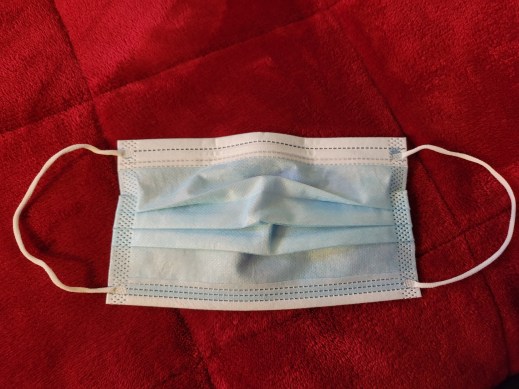
New York is aglow in holiday glory. Within walking distance of my home are houses and apartment buildings adorned in beautiful lights and holiday displays. Midtown Manhattan is deluged with the stunning accoutrements of the holiday season, and parts of the outer boroughs and the suburbs have homes that take yuletide cheer to new heights.
And New York and the world are in the throes of another pandemic surge. Despite being vaccinated and still generally cautious, I’m quarantined in the bedroom of my apartment as Christmas approaches, testing positive for COVID-19 for the second time this year. The whole family had it in February, luckily the rest have tested negative. I’m sequestered in my bedroom and my 10-day Coronavirus quarantine ends two days before Christmas.
This is the second holiday season in a row, at least here in the Northeast, that has been disrupted by this global pandemic, and I share in the fatigue of constant waves of variants, surges, and arguments over masks and vaccines. The COVID pandemic has become a pathetic Greek alphabet soup with everyone going through the motions until the next surge or the next new variant.
For most of the country, COVID doesn’t impact daily life until it does. A few months ago, hospitals in Georgia were so flooded with unvaccinated COVID patients that one of my stepbrothers had a tough time getting non-COVID-related hospital care he needed. The Delta variant surge failed to convince the population that won’t get vaccinated to get vaccinated. Much of the U.S.A. is already mentally past the pandemic, and rightly or wrongly, looks at our continued precautious and inoculations as a form of cultural snobbery.
Getting COVID a second time is frustrated, as I’m doing things by the (often changing and hastily re-written) book. I am fully vaccinated and have been going to places in the city that require full vaccination. I had a few cold symptoms and some general weariness, nothing I thought could not be knocked out with more rest and vitamin C. Then a coworker I had seen recently informed me he tested positive for COVID, so I took a home test that came back positive. The rest of the family got COVID tests at a clinic and tested negative.
I went online and scheduled a COVID test at a local clinic.
Arriving early to check in for my 1 p.m. appointment, I waited behind a woman boasting of her position as a pharmacist and carrying on an extra-long and unnecessary conversation with the desk attendant at the clinic; she kept asking the same questions and laughing and looking at the growing line behind her for some kind of validation and camaraderie. “I fill Z-Pack prescriptions all the time…”
The desk clerk was very patient and kept telling her they couldn’t register any more walk-in patients; there were people who had been waiting there since 10 a.m.
Once the verbose pharmacist moved on, I gave my name and my insurance card and ID, and signed my scribble on an electronic pad without seeing any version of what I was signing—the clerk told me what it was and to be honest, I rarely read these documents anyway—and I was told I would be called when my time comes.
I waited in my car for 45 minutes before I had to go back inside to use the restroom. While I was waiting for the restroom, more people showed up, looking for COVID tests. One man said he had driven in from Long Island, that this was the fourth clinic he had visited today, and that one clinic had told him to arrive at 4 a.m. He was going to travel soon for the holidays and needed travel clearance.
My call finally came, and I got my test in the forms of swabs up the nose; not as intrusive as the one I had in February, we’ll count that as progress. The doctor came in a few minutes later with my results. He was thorough but harried; he had seen about 50 patients before I got there and would see at least that many more before he left for the day. He confirmed my home test and gave the information I needed. I was soon on my way home, walking through a small crowd of people who had arrived at 3 p.m. to try to put their names on the new walk-in waiting list.
This isn’t the holiday season we wanted; we were supposed to be through this by now. When the initial outbreak happened in early 2020, we thought the upcoming spring and summer would spell an end to the lockdowns. After all, this wasn’t 1918, we have advanced technologically very much since then. But human nature does not change, and a deadly combination of partisan theatrics, bureaucratic ineptitude, and general boorish ignorance have kept this going.
I’m not sure what relief 2022 will bring. I have lost count of the number of times that I thought we were on our way to being done with the Coronavirus pandemic. I’ll remember to be thankful for the good health that I have—my symptoms are mild, and I will be through it before Christmas.
I’ll look ahead to the New Year with hope and the resolve to keep living life, no matter what the world puts in the way. See you there.
Happy holidays.
Hellish punk anthems for a decidedly sinful New York

This Halloween season finds New York City in a state of awkward transition to whatever post-pandemic world will eventually be shaped by the COVID outbreak, which continues to strut and fret its prolonged hours on the world stage.
Our city, the epicenter of the Coronavirus outbreak, is setting a template for recovery and establishing post-pandemic standards that make sense. It’s still a struggle in a lot of ways. Companies are struggling to hire enough workers to keep business going, while also struggling with return-to-office plans for a workforce that does not want to work in an office five days a week. “The Great Resignation” continues to churn as companies compete for workers at all levels and even entry-level positions can become bidding wars.
Public transit is far from being able to handle a return to normal. Our transit system was falling on its face before the pandemic, now bus and train routes are regularly canceled for lack of drivers and train operators. Crime and quality of life continue to be a persistent problem.
New York has always been a place where sin is welcomed and the need for law and order is informed, if not restrained, with the libertine permissiveness that has characterized our Gotham since Dutch times. But there is a need for balance. A law-abiding person should be able to walk down the street with an open can of beer, they shouldn’t be stepping over piles of homeless people and their rancid detritus on every corner, or robbed or worse on their way home from a night out.
New York has reached an imbalance; the tolerance for the night life and marijuana has been accompanied by a very real and dangerous rise in real crime. People find themselves being robbed by criminals that a few years ago would not have been back out on the streets from their previous arrest.
But amid this tumult, New York is working to return. While people are understandably in no hurry to return to offices, people want music, and theater, and art, and even want to watch sports teams like the New York Jets. These regular joys have been forcibly dormant by a historic pandemic, and should return with a historic vengeance.
So good news comes this Halloween season with the return of Green Hell, New York City’s Misfits cover band that has entertained dozens of people since 2004 (full disclosure: I have served as Green Hell’s bass player since their second show in 2004, giving me more rights to claim “Original” membership than Doyle of the Misfits). Green Hell has two shows lined up on Halloween weekend: one at Manhattan’s excellent Otto’s Shrunken Head and the other at The Shillelagh Tavern in Astoria Queens.
Misfits songs are fantastic anthems for any Halloween, and it feels very fitting that our modest band of middle-aged punk rockers get the band back together as the Coronavirus is (hopefully, for real this time) on its way out. They are fun to sing along to and not difficult to learn how to play. And no matter what nonsense the “Original” Misfits get into, these songs have stood the test of time.
Green Hell was last seen in 2016, and two members who live far out of town are braving the skies to fly back to New York for two shows. In true Green Hell tradition, we will have time for only one rehearsal, and in true Green Hell tradition I can guarantee that absent of someone’s on-stage death, we will play a tighter set than the Misfits.
We’ll be in excellent company both nights with some of the best bands one could hope to share the stage with, and I will not be satisfied until Green Hell singer Marc Sucks shouts “Fuck the MTA” with Shillelagh owner Russ.
New York continues to suffer the effects of a global pandemic and domestic neglect. This Halloween, as it resists both the death dirge of disease and the growing savagery of its streets, it will have the sounds of raucous horror punk rock to voice its orgiastic rage against an uncaring world.
Whoa!
Vaxxed to the max

We’re approaching the end of the biggest global pandemic in more than a century, and New York is ready to dive into Spring and Summer with renewed fervor.
Much of America is reopening prematurely, with some states flouting mask mandates and common sense the way they have for the past year and a half.
In New York City, Mayor de Blasio declared we would be fully reopen on July 1, which is about eight weeks from now. Not to let a deadly pandemic stand in the way of a pointless pissing contest between awful lame-duck officials, New York Governor Andrew Cuomo is hoping for a full state reopening before July 1.
People can’t wait to do normal things again and I can’t blame them. Recently, a large free concert was held in Tompkins Square Park featuring popular New York Hardcore bands Madball and Murphy’s Law. It was a crowded and largely mask-less affair, with the usual mosh pit and stage diving and a crowd that would not have been able to socially distance within the confines of Tompkins Square Park and still see the stage. Videos of the concert were shared widely online and there was a lot of heavy criticism of the event. No way were any reasonable COVID protocols observed, and in a group of that size at this stage its unlikely that there was a 100% vaccination rate among participants.
The Parks Department gave a permit for this event, and then declared it was investigating it and pulled permits from upcoming shows. I’m not sure who the Parks Department would investigate besides itself—it gave a permit for the event and then was shocked that people actually showed up for it after a year devoid of public concerts. The most rudimentary Google search would have informed the powers that be that these are popular bands, and this was likely to have a large turnout.
And worse, the upcoming concerts that the Parks Department canceled are likely to be smaller events with greater likelihood of social distancing.
But despite this malarkey, this is a good sign. It means we’re in a transitional period and moving back to a time when having public gatherings and concerts will be commonplace again. People are aching to make music again, yearning for the New York City Spring and Summer of outdoor drinking and music and fun.
Living in Eastern Queens and having a car made things easier to schedule, and my wife used the TurboVax Twitter feed to learn of openings at SUNY Old Westbury, and she let me know. Within a few minutes of her telling me, I had my appointment, though the time slots all near hers had been filled and I had to go hour later. Still, I grabbed it.
The early days of the vaccine rollout were rough, but by early April things were running very smoothly in New York. I was seated and ready for my shot within a few short minutes of arriving at the mass vaccination site. When I returned for my second shot three weeks later, I was given the dose even faster.
It’s been two weeks since my last shot, and I’m vaxxed to the max and ready to rock and roll. I’m still making up indoors and keeping one ready if I get close to people outdoors. And honestly, I’d like to stay six feet away from everyone else forever.
But life won’t stop and clawing our way out of the pandemic means getting vaccinated and keeping with some of the habits we developed during the past year. It’s gotten easier to do.
Get vaccinated, you filthy animals.
Dispatches from the Secret Playground

Thanksgiving came and went with still much to be thankful for in New York, at least for my family. While a second or third Coronavirus raged through the city, our immediate family remains healthy and those in our larger family circle that have been ill have recovered.
Everyone in our family has food in their stomach and a roof over their head. Even before COVID-19 rampaged through the world there were billions of people who could not say that much, and that’s getting worse now. I am gainfully employed and have not been sick and have more than enough food; I am thankful.
New York perseveres, but suffers a crisis of confidence. While we were the first place in the U.S. to see widespread COVID infection and death, we were the first to “flatten the curve” with social distancing and masks. Now we’re having a critical relapse with a spike of infections. Schools closed, now are reopening again in a swift reversal of policy. Crime continues to surge.
And all the while, we see thousands of our fellow New Yorkers not taking their own lives seriously. A Hasidic group worked secretly to arrange a large indoor wedding, sans facemasks, and was given a slap-on-the-wrist fine. I go food shopping and see people who can’t wear a facemask properly going about their business in blissful, entitled ignorance.
Yes, we’re not supposed to be judgmental during these difficult times, but this pandemic has revealed just how many of our fellow human beings are unfit to breath the same air.
Having children in a city apartment can be trying during good times; it has been especially trying during this extended pandemic. What we have though is a place we call the secret playground. It’s not really a secret playground, but a little-used playground in a neighboring co-op that we’re not really supposed to use. The old fogeys that run the board where we live did away with the playground for our building years ago, so to use a local playground is to be an automatic scofflaw.
But I take my girls to the secret playground as often as I can. There are rarely other children playing there, so I can let my kids take down their facemasks, if our family is alone. Usually a few residents will walk through on their way to and from their homes, and we’ll put our masks back up as they come through; they are still almost always more than six feet away. It is an oasis that the unseasonably warmer November weather has given us access to and I don’t want to let a single good weather day go to waste as we endure another lockdown.
Sometime next year, we will hopefully begin adapting to a post-COVID world, and some things we will want to stay the same. I’m not alone in hoping that the world remains one where we’re given more personal space and take extra steps to reduce indoor crowds and make spaces safer, with better ventilation and more protections. These are good ideas outside of pandemics.
And therein lies the appeal of the secret playground: it is a respite from the current world and a model for how to best rebuild when we emerge from our currently dismal state. We cannot live in a bubble world, but we can look at our better adaptations of today to keep our joy and our priorities in line with where we need to be.
The courage to chase dreams

A high school friend of mine worked as a successful lawyer for roughly the past two decades. He won a great ROTC scholarship in high school. While in the U.S. Army, he went to law school. After serving in the U.S. Army’s Judge Advocate General Corps, he worked as an attorney for the Department of Defense before going into private practice law.
But change has come. My friend gave up the life of an attorney to chase his dream of being a radio D.J.
“Because terrestrial radio is such a big thing now,” he joked.
Today commercial radio is a ghost of its former self while music streaming services dominate music landscape. But people still do make a living as radio D.J.s, why shouldn’t he? He took classes at a local broadcasting school and has managed to cobble together an income from various sources—a few nights hosting a lotto drawing here, running a bar trivia night there, he’s not homeless or starving.
Another friend also took a similar plunge, working in comedy and going for broke. Show business is a brutal and heart-rendering business that leaves some its most earnest and talented people out in the cold. My buddies have no illusions they face an uphill battle, and I couldn’t be more proud of them.
I yearn for the courage that my friends have shown.
I moved back to New York for several reasons, but one of them was to seek fame and fortune and become a great American writer. We writers are a hopeless romantic lot, even those of us that like to paint ourselves as curmudgeons. Even the most anti-social hermit scribbling away in obscurity harbors dreams of being the stuff of book covers and bookstore postcards someday. Any writer that tells you they do not dream of somehow writing themselves into immortality is a liar. Like all artists, we hope our work will live after us and testify to the improbable infinity that we lived.
One of the problems with creative people is that many of us spend more time dreaming and pondering than working at our craft in a way that is productive. We have overly romanticized notions of what our craft is, that it somehow exists in a sphere outside of the normal marketplaces and human conditions. Crash landing into the realities of business and the arts is a hard thing, but the worthwhile things are always hard.
I am in the same boat with so many hopeful others. My dreams have tempered a bit. I will settle for not being the next Jack Kerouac or William Faulkner, but I still hope to make a living creatively, by doing work that is creative, artistic in nature or at least taps into my talents to write about things that I find legitimately interesting.
I am very lucky in the life that I have. I have a great family and group of friends; my health is good; I can say with confidence I will go to bed tonight with food in my stomach and a roof over my head. And yet, there is the dream I must still chase. I’m not low on ambition, but on direction and focus.
Despite all the reasons to be jaded and negative, I live with the confidence in my own creativity and the ability of New York to feed our greatest ambitions. Wish me luck and hard work.
A journey through the MTA’s lost and found
Earlier this summer, I arrived home late on a Friday night—late these days meaning after 8 p.m.—and was taking things out of my pockets after a long day. When I reached into my right front picket, I came to the realization that I did not have my wallet. My stomach tied in knots and I cried out in frustrated desperation. I knew it had been in my pocket; there would be no deus ex machina miracle of finding it in my bag or in another pair of shorts.
I knew that it most likely fell out of my pocket on my commute home. I had just gotten off the express bus—this bus was still on the road and someone could radio the driver! I immediately picked up my smart phone and dialed 311 for citywide information. The 311 operator would be able to connect me to the right person. The 311 operator transferred me to 511, which is the information number for the Metropolitan Transportation Authority (MTA).
After a few more transfers, I spoke with someone I was told could help me. I gave them all the information I had. I was on a QM20 bus and was picked up from 6th Avenue and 42nd Street in Manhattan at approximately 8:40 p.m. and was dropped off at Union Street and 26th Avenue in Flushing, Queens at approximately 9:30 p.m. This driver was probably still on their route and with the information I had given them someone should be able to get in touch with the driver ASAP!
But no such luck. The person on the other end of the line said they could not do anything unless I had the bus number. Without the bus number, they could not contact the driver. Seems a bit ridiculous. If this had been a more serious situation and people’s lives depended on finding the bus, there would have been a catastrophe.
I was asked to call back the next day after the bus had gone back to the depot and the driver may have turned in the wallet. It was a small wallet, one that held only cards. I was not out any cash, unless someone was going to town with my debit card.
I started to call credit card companies and my bank to have holds put on cards.
The next day I called the depot. Nothing.
I called back the next day, and called back later in the day again. Nothing still.
I went through with canceling and replacing my credit cards and ATM card and replacing my driver’s license.
By Monday, there was no funny business on my cards and new ones were on the way. I printed out a temporary driver’s license and ordered a new card wallet that came with a money clip. My card wallet needed replacing anyway, and this was a chance to pare down the stuff I carried with me everywhere.
A few weeks later, the same day my new driver’s license arrived in the mail, a notice from the MTA Lost & Found arrived in the mail.
“An article which contains your name and/or contact information was found and turned in to the MTA NYC Transit Lost Property Unit,” the notice began. It instructed me to report to the unit’s office at the 34th Street subway station at 8th Avenue in Manhattan. If I did not claim my property by Nov. 3, “it will be deemed to have been abandoned and you will have forfeited your right to claim it.”
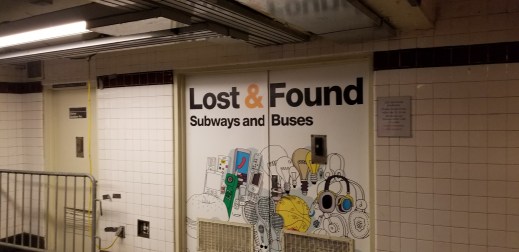
The next day I brought that notice and my newly replaced driver’s license to a hidden-in-plan-sight pocket of the 34th Street subway station in Manhattan. It took some searching and asking to find the lost and found office, which is beneath the tracks of the A, C, E subway lines and without any signs leading you there except in the immediate vicinity. It’s within the subway system, so if you arrive by some other means or exit the subway before you find it, you’ll have to spend another subway fare to reach it or get a helpful MTA worker to let you in.
A small sign points the way to a set of double doors painted in celebration of the many objects found in our transit system. The office is open odd hours—and completely closed weekends and holidays, a travesty in a system that runs 24 hours—but luckily is open until 6:30 p.m. Wednesday and Thursdays.
Inside is a small room with a very low ceiling. I’m five feet eleven inches with my shoes on, and if I had extended my arm fully above my head I would have punched a hole in the drop-down ceiling. There is a metal bench to sit on, a small counter to stand and fill out paperwork on, two old-looking computer terminals, and a thick window above a pass-through door through which one may conduct business with the MTA workers on duty.
I arrived as a worker emerged from another set of doors to hand someone some paperwork, and she took my notice and ID and disappeared in to the bowels of the lost and found. The woman who was there spoke to someone at the window and was told to check back about her property later. She left and another woman arrived to ask if a book she lost on the subway was found. She was told no and to check back later; she left. Another man arrived and looked through his paperwork to check on a claim, and while he was speaking with someone another woman arrived to check on some property she had reported missing.
A worker arrived at the thick window with my wallet. It was a different worker than I had given my notice to; it was a rotating staff of workers answering questions and handling forms. He told me to sign my name on another form and write my address the same way it appeared on the notice in the mail. He opened the door to the silver box under the window and placed a clip board inside, and when he closed his door I opened mine and filled out the form.
A minute later, the same exchange reunited me with my wallet. It looked a little worse for wear, but nothing was missing. Everything was there: my license, my ATM card, my MTA MetroCard, even the coupon for a t-shirt at the zoo. I excitedly took an inventory of my wallet while my fellow transit visitors looked on amazed.
“You give me hope,” said the young woman sitting on the bench, hoping her property would be returned.
I thanked the worker and wished the other people in the office good luck, and went back out into the bustling station. For me, lost and found had worked out well.
Thank you to the Good Samaritan on the bus who turned in my wallet, and the series of honest MTA workers that made it possible for me to get my property back. For me the stars aligned this time.
The proud refuge of Doc Holliday’s

A few weeks ago, my band was fortunate enough to be asked to play music in Tompkins Square Park. The four of us arrived punctually (an impressive feat for an old-school punk rock band like ours).
The sun was blazing but standing in the shade brought sound respite. Having consumed copious caffeinated beverages in transit, I headed for where I knew the public restrooms were located.
The men’s room was locked. A nearby restroom was marked for use only by children. It was also locked. Park workers admonished men looking to use the boys’ restroom, and referred people to the closed men’s room even after being told it was locked. A Parks Department employee told me to use bathrooms at a nearby Starbucks or 7 Eleven, and acted as if she were doing me a favor.
Nearby on Ave. A and 9th Street, there was not a Starbucks or 7 Eleven in sight. Doc Holliday’s was open though.
Even though I long ago left the drinking life, I had the good fortune to drink at many of New York’s most excellent bars before I did. Doc Holiday’s is one of the East Village’s surviving dive bars that did not sell out or lose its character, and has stayed the same quality dive bar that it was meant to be.
As the name implies, Doc Holliday’s could be called a country bar. While by that measure it could easily be lumped in with other “country” bars such as the now-defunct Hogs & Heifers, it’s a bit more subdued and nowhere near the same kind of tourist mecca. It may be a far cry from where David Allen Coe would drink (if anyone knows where David Allen Coe goes to drink when he’s in New York, please tell me), but it’s the closest thing to a country dive bar surviving in the city today.
When a cheesy movie came out about rival bar Coyote Ugly in 2000, Doc Holliday’s celebrated the fact that its name was not associated with such a flop. They had several drink specials and posted scathing movie reviews of Coyote Ugly on the walls of the bar.
For a while when I worked in SoHo, I would bring coworkers to Doc Holliday’s for beer—after the after-work beers we had at work, of course, and it never disappointed me then. I would be one of the last of my party to depart, stepping strongly buzzed into the bright twilight of a New York Friday night, ready to conquer the world some more.
About 10 years later, when I decided to leave the bogus “secret restaurant” located in Crif Dogs rather than take off my hat, I went to Doc Holliday’s where friends were waiting. Three boroughs and many, many drinks later, I made it through that night with few memories but few regrets.
But now I was returning to Doc Holliday’s as someone gone from the drinking life nearly a decade, a frustrated park goer unable to find a decent bathroom. Would I be welcome back to this hallowed place where I had spent so much quality time in the past?
The bartender was chatting with three people at the bar and the place was otherwise empty. There was no crowd to blend into if I pretended to be a customer. She looked to me, expecting me to order a drink. I decided to come clean and admit I was there just to go to the bathroom. I explained my situation to the bartender. Could I use their bathroom?
The bartender told me yes and thanked me for asking. I walked back to where the bathrooms were to find that Doc’s had done some remodeling and the restrooms were not in a state of filthy disrepair. By dive bar standards the new men’s room was pretty luxurious. I left a five-dollar bill on the bar in my way out and got a friendly smile.
I returned throughout the day and was warmly greeted. It was good to be welcome and enjoy the dive bar scene again. Even removed from the drinking life, our bars are cultural markers that can offer a guide to the state of society. Doc Holliday’s confirms there are some pockets of righteous goodness left in our city.
FNO Flushing Fantastic, daytime festival edition
Despite the popularity of some parts of Brooklyn, our collective dialogue around New York City remains excessively Manhattan-centric. New Yorkers will still say “the city” when they mean Manhattan, even though the five borough boundaries of our city have been in place since 1898.
And New York City is so large that telling people what borough you are from will not cut it. No one actually from Manhattan would introduce themselves as being from Manhattan unless they were in a very borough-specific conversation. Each of New York City’s boroughs is a tapestry of neighborhoods, and it is these neighborhoods that are the lifeblood of life in NYC.
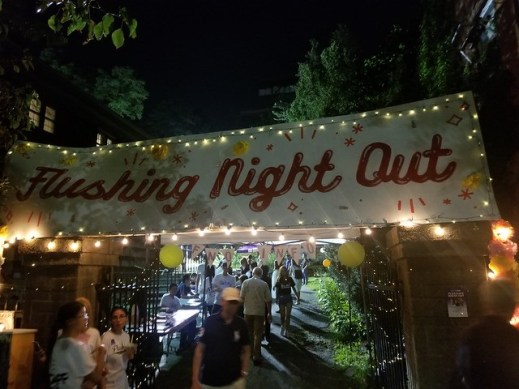
Queens is New York City’s largest borough and among its most well-known neighborhoods is Flushing. This weekend, local residents are showing off the neighborhood’s many attractions Saturday at FNO 2019: Flushing Fantastic.
FNO stands for “Flushing Night Out” as past events have been held at night, but this festival is going to run from 12 noon until 6 p.m. and is going to be at historic St. George’s Episcopal Church, right in the center of downtown Main Street a short walk from both the 7 train and the LIRR.
Flushing is known as a destination for Chinese cuisine, and people will come from all over to sample some of the great restaurants, food carts, or food court stalls that make this neighborhood unique. But there is much more than Chinese food, and the Greater Flushing Chamber of Commerce is promoting the neighborhood as an international melting pot, though admittedly one that is heavily Asian. I often point out to people that among the best dining attractions in Flushing are 24-hour Korean restaurants such as Kum Gang San and Noodle Flower, where you can barbecue an awesome assortment of meat right at your table at two o’clock in the morning if you are so inclined.
The Greater Flushing Chamber of Commerce also notes that the event is designed to give a boost to local businesses and entrepreneurs that are competing with large franchises. Downtown Flushing has seen a boom in construction of high-rise condominiums and the rising price of real estate has made life harder for small businesses throughout Queens and five boroughs.
“Flushing, NY is the crossroads of the world — where you can find amazing culture and people from around the globe,” the chamber says in its event notice online. “We want to celebrate the unique food, fashion, and music found here as well as help the small businesses and entrepreneurs who are struggling to make ends meet. Over the past decade, rising rents and major development projects have threatened to displace the small mom-and-pop stores who invested their blood, sweat, and tears into making our neighborhood prosperous.”
Flushing Night Out has been held at various locations, centered on the downtown area. The first one I attended was on the campus of Flushing High School, and it was a memorable event, even for cynics like me that hate crowds.
It was at my first Flushing Night Out that I was introduced to Karl’s Balls, a food stand of traditional Japanese takoyaki balls—those are octopus balls inside a doughy sphere that are cooked on an egg-shell like grill. Go to Karl’s Balls because it’s an ingenious name and you may never stop joking about wanting to put Karl’s Balls in your mouth. But all joking aside, the takoyaki balls are extraordinarily delicious and Karl himself—Karl Palma—is a celebrated chef who has been featured on the Cooking Channel among other accomplishments.
While Karl’s Balls may not be at this FNO event, there is going to be a smorgasbord of amazing food, from Ecuadorian cuisine to Japanese ramen to craft beer and gourmet ice cream. You have no excuse to leave hungry. The organizers require all the vendors there to have items that start at $5 or less.
FNO also features live music, crafts, and other cultural interests. This Saturday will feature Harmonyc Movement, a city-based dance troupe steeped in K-pop and Korean culture.
And at the Flushing Queens Macaroni Kid booth, they will be giving away protein bars for free (full disclosure, my wife Emily Griffin Sheahan runs our local Macaroni Kid web site and will be manning the booth at the event – tell her I sent you!).
Punk rock in Tompkins Square Park

This coming weekend two free punk rock shows will be held in Tompkins Square Park in New York City’s East Village.
The shows commemorate the Tompkins Square Park riot of 1988, when police clashed with squatters, homeless and others that had been camping out in the park. Accounts of that night very but few dispute it involved widespread police brutality. Police lined up on the street for an extended period of time before moving into the park, and they were subject to sustained abuse by activists that did not want them there and saw them as agents of a landlord-controlled city that (to this day) lets property go abandoned rather than occupied while working people struggle to pay rent.
The riots were one of the first instances of widely-publicized videos of reported police misconduct thanks to the efforts of East Village video archivist and neighborhood stalwart Clayton Patterson. His videos showed police covering their badge numbers and chasing down protesters and beating them without arresting them. “Little brother is watching big brother,” he told Oprah Winfrey.
The 30-plus years have done a lot to change the East Village. Tompkins Square Park is no longer a homeless encampment or open-air drug market; it is now a safe place you can bring children. The abandoned buildings and art spaces that were abundant in the late 1980s have been replaced by high-end restaurants and expensive homes. The story is the same throughout the city.
It would be useless to pretend the East Village is the same, but it would be a disservice not to commemorate a scene that produced great art. Even if the crucible that created an esteemed body of art is long gone, the art does not get thrown away. I’m happy that feudal Italian city states no longer wage war on the Italian peninsula, but the art that survives from this period is among the finest in the civilized world.
The scene may be over, but the art endures. So let it be with punk rock. Though please don’t think that punk rock is over or that new generations don’t have the same legitimacy as the old-timers that were there when New York was a shithole. There are excellent bands playing in the city today, comprised of young people who were not born yet in 1988, and they are as punk rock as anyone else.
And the East Village is still a home for punk rock. The Bowery Electric, located a short distance away from where CBGB once stood on the Bowery, still hosts great punk rock shows. Niagara, which his located where punk rock club A7 once stood, has started booking hardcore punk concerts there regularly again.
And free punk rock still reigns in the park. Full disclosure: my band Blackout Shoppers is scheduled to play the free punk rock show in Tompkins Square Park this Sunday, Aug. 4, with The Voluptuous Horror of Karen Black, Hammerbrain, Porno Dracula (one of the greatest band names ever, but please don’t Google them at work), Jennifer Blowdryer Soul Band, Ruckus Interruptus, and Young Headlight. Saturday the 3rd hosts the first of the two-part series with Disassociate, the Nihilistics, Rapid Deployment Force and more.
Blackout Shoppers have been rehearsing and sounding good, even judging by my overly critical, curmudgeonly ears. We don’t play as often as we used to and it’s a blast when we can get together and play a show. It was touching when people came out to see us last year when we bid farewell to Philthy Phill of World War IX. We don’t want to wear out our welcome, but we are playing more shows this year than we’ve played more recently and it feels good to be out there being loud.
See you in the park this weekend.
Blackouts in a changed New York
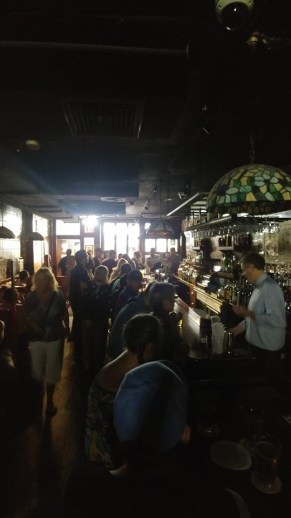
This past Saturday I noticed a friend posting on social media from the dark interior of one of Hell’s Kitchen’s finer dive bars, Rudy’s.
“Uh-oh. Power’s out. Better drink all the beer before it gets warm.” That was the caption accompanying a photo of business as usual on a busy Saturday night at Rudy’s. There was never a lot of interior light there to begin with, so one had to take her word for it that there was a blackout.
A little while later, a message from work indicating a “Code Red” situation—the company’s building in Times Square was without power and this was a problem. I scrambled to join the emergency communications line, only to be told there were enough people working on this already, I could drop.
News reported that the West Side of Manhattan and a significant portion of midtown were dark. This was a major event though it was small potatoes compared to previous New York City blackouts. It was short-lived as well. By 10 p.m. power had been restored to much of the affected areas, and my employers’ building in midtown had power again but was still waiting for electricians to arrive to make sure everything was up and running.
The cause was not immediately known and Con Edison does not have a great track record of accountability when these things do happen. Several years ago, a significant portion of Astoria, Queens was out of power for an extended period of time. Sadly, an outage in Manhattan generates greater news coverage and more intense scrutiny.
New York City suffered a blackout exactly 42 years ago to the day of the one this past Saturday. On July 13, 1977 a blackout hit New York City and was the scene of widespread looting and arson.
Seventeen years ago this August marks the anniversary of the 2003 blackout that darkened a significant swath of the Northeastern United States. I was downtown getting ready for a late night of editing at work and wound up taking a 12-mile walk home over almost the entire length of Manhattan. Although incidents of looting were underreported, they were indeed rare and the peaceful evening rush hour and dark night was a testament to the transformation that had happened in the years since 1977.
Even after walking 12 miles to get home in crumbling shoes that blistered my feet, I walked around my neighborhood of Inwood in Manhattan, amazed at the peacefulness of the city at such a time. People played dominoes in the moonlight near the Dyckman Farmhouse, and the sound of steel drums and street parties filtered up from blocks away.
Power outages serve as a barometer of where New York resides along the lawlessness spectrum. Are we close to widespread chaos or will the line hold during a night in the total dark? The Manhattan blackout of July 2019 showed we are holding the line for now.
It was a relief to find that New York has not regressed to the point of making our blackouts more of the 1977 variety. But that question will always linger in the back of New Yorkers’ minds, and maybe we should get to a point that it shouldn’t be there at all. How much has to be done to create that city, that country, that world, and will we ever get there? And what is being done to make sure that we don’t lose power during critical summer months?
A relieved city needs those answers.
 Matthew Sheahan
Recent Comments