
Book rescue in Queens and its vortex of unknows

I was cleaning out my motor vehicle, disposing of a handful of parking meter receipts that accumulate on the dashboards of cars in large American cities. As I deposited my trash in a receptacle, an open book nearby caught my eye.
Someone had dropped or thrown a book, and it had landed open against a curbside trash shed outside a co-op. It was an odd place to see a book, and it looked like it was thrown from a moving car or dropped out of bookbag that was being kicked down the street. I retrieved it.
The book, “Who Put This Song On?”, by Morgan Parker, was in good condition considering its rough treatment. Upon inspecting the book further, it bore a label on its back cover that read “FLUSHING HIGH SCHOOL LIBRARY.”
Flushing High School is a mile away from where I found the book. I made a note to return it. No book should be homeless, and someone may be looking forward to reading that, or may not be able to afford whatever fine may be levied for losing it.
A host of possibilities flooded my mind regarding how the book came to rest upon the sidewalk a mile away from its library home. Did someone steal it and try to throw it in the trash bin? Was a student carrying this when they were attacked by a kidnapper or serial killer, and the page was open to a passage that would reveal the whereabouts of the victim or give a clue as to the motive of a brutal killing? Am I now a suspect in a kidnapping or murder that has not been made public yet? Or will I be considered a cringeworthy thief, found with a book stolen from a local high school?
I made it my mission to return the book as soon as it was convenient, lest I be unwittingly caught up in these mysteries, but more likely, that the book can continue to be enjoyed by students. I was prepared for whatever grilling I would receive when I brought the book back—I can explain my fingerprints on the book were from finding the book, not stealing it or doing anything untoward to whatever student checked it out.
I set about my task taking a public bus to the high school, arriving in the afternoon after classes were over for the day. I tried to look as assuming and non-threatening as possible while carrying a book clearly geared toward young women.
Flushing High School is on a nice green campus surrounded by the dense vertical sprawl of downtown Flushing, Queens. It’s an oasis of beautiful architecture and calm grass and trees amid the rapid overdevelopment of a city fueled by commerce without a thought for beauty and cohesion. I hope it fights to the death to stay the way it is.
My returning the book was anticlimactic. I stepped into the front entrance of the school and handed the book to a school safety officer behind a desk, who thanked me for returning it. I walked out of school and enjoyed the walk home, having done my good deed for the day and rescued a book from oblivion.
A death in Whitestone

A mile and a half from where I live, at the same intersection where I’ve used the ATM countless times and taken my children for numerous fast food happy meals, a man was killed outside a bar after being punched in a fight.
A 35-year-old-man punched a man 20 years his senior. The older man fell to the sidewalk, striking his head; he was pronounced dead at Flushing Memorial Hospital soon afterwards.
The local news media picked it up because the assailant who has been charged with assault in the case is a New York City firefighter. Even though the person he stuck was dead, he walked out of jail a few hours later—New York City’s revolving door of justice works its magic. He claimed to be acting in self defense.
Whitestone is a more suburban area of New York City. It has a downtown area like that of a village you would find on Long Island or in Westchester County, and most neighborhoods consist of single-family homes. The affluent Malba area of well-heeled mansions is part of Whitestone.
While it does not have the cultural cache of Manhattan or the trendy panache of Brooklyn, I take heart on knowing that the Parkside Lounge a half mile away from me puts on great punk rock shows, and that Dee Dee Ramone once lived in Whitestone. It also has nice parks, good public schools walking distance from our home, and
There are many nice features of Whitestone, Queens, but it’s also a place where you will wonder how so many wretchedly stupid people manage to live in nice houses and drive expensive trucks. There is a bogus working-class posturing on the part of upper-middle class people here, a vociferous ignorance that cannot be excused by poverty combined with a shallow cultural posturing that consists of thickly pantomiming stereotypical New York mannerisms. Because they live within the boundaries of the five boroughs of New York City, they think they need to size everyone up for a fight even when they are buying groceries.
When you love something, its faults drive you all the crazier because they blemish something you cherish. That is one of the reasons why this death outside of a bar in one of the outer boroughs is more troubling besides being literally closer to home.
Though I left the drinking life more than a decade ago, I cannot deny the good times that they have given me and the central role they still play in cultural life. It was in a dive bars that I helped form punk rock bands, got ideas for poems, traded quotes from “Repo Man” with both financial journalists and bouncers. Dive bars are the respite that people have needed from their daily grind for decades, and dive bars in the outer boroughs is where you can find the soul of New York City trying to drink off its last hangover. I don’t know if they have good punk rock shows at juice bars and I’m not going to find out.
I remember being alone and living in New York City on my own for the first time and meeting a friend from work at the Wee Pub in Ozone Park one Saturday night and it was a rambling joy that made me feel like I was home. Years later, I met up with friends and toured all the dive bars we could fine in Hell’s Kitchen. I’ve spent countless hours in some of the seediest drinking holes in the city and regret not a minute of it.
So, if we’re ruining dive bars, we are ruining life. Our civilization will not function if people don’t decent, affordable places to drink.
New York City will survive and thrive again. If anything be sacred, let it be our dive bars.
Shakedown at the warehouse club

There was shopping to do and we had to get the kids out of the house.
If you have a car in New York City you are one of a privileged few. You can blaze a trail of adventure and wanderlust across the land. Or, you can simply drive someplace where it is a little less crowded to do your shopping, avoiding the hordes that clog your local stores for the slightly less overstuffed shopping experiences of the suburbs.
Pro tip for current and future parents: IKEA stores have a free indoor play area called “Småland” where they will babysit your kids for free if you are in their store.
This past Sunday we headed to Hicksville for the chance to look again at a couch we may want to buy from IKEA and to do our bulk shopping where it was slightly less aggravating.
The drive had put our children to sleep and my wife and I enjoyed listening to Joan Jett’s greatest hits and catching up on adult conversation while our three blessed hellions slumped in their child seats. We decided to get some of our shopping done while they napped. I headed to BJs.
BJ’s is not as fun as it sounds. It’s not an emporium of fellatio but rather a warehouse club like Costco or Sam’s Club. Showing your BJ’s card only wins you the pleasure of buying in bulk.
The BJs in Westbury, Long Island, was a lot less crowded than the one we usually visit in College Point, Queens. I found the things I needed easily. I got in line at one of the self-checkout lanes as going to one of the other lines means an incredibly long wait behind people whose shopping carts are filled to the brim with bulk items.
The woman is taking too long looking over everyone’s cart and there is a line forming just to get out of the store.
The only question I’ve ever had facing this security check in the past is if one of my daughters asks me if this person is going to draw a Mickey Mouse on our receipt.
The woman looks at my cart for what seems like an extended period and then circles the number of items on my receipt. She says there is a problem, something about me having too many items in my cart. Her English is poor, and I ask what is the item that wasn’t scanned. She points to the checkout area, and I think she wants me to go back there but I want to understand this problem and solve it quickly. I’m not going to scan every item again or stand on another line if the store is bringing up the issue. I keep asking what the problem is and what’s not right, and I get no answer. The woman leaves me there and starts checking other customers’ receipts. A chubby woman mumbles something under her breath at me as she walks by, but not loud enough to hear.
The receipt women with broken English calls someone else over. He checks my receipt. He counts the items in my cart. He checks the receipt again; he counts the items in my cart again. People keep passing by and looking at me. I stay stoic.
The young man now checks the UPC numbers on every item against my receipt. He’s moving more things around in the cart and checking off each item on the receipt.
“The tomato sauce,” he says before scurrying off. “The tomato sauce.”
The receipt checking lady has forgotten about me. Her backup left me standing there with my marked-up receipt and no recommendations. I don’t bother to check his work; I just want out of there. I put the tomato sauce aside and walk out the door. No one stops me. I’m free but without the tomato sauce we wanted to buy and with precious time wasted.
Westbury BJ’s: 1, Polite New Yorker: 0.
I had traded the aggravation of weaving your way through crowds of clueless shoppers to being shaken down by store security and singled out as a potential shoplifter. While this was annoying it could have been so much worse. People who forget to scan the groceries on the bottom shelf of their shopping cart have been accused of shoplifting and had their careers ruined. The store employees could have called the police.
I made it back to my van without further delay. The children were awake. We moved on to our next adventure.
Skynet at the Stop & Shop

“Can we see the robot?” one of our daughters asked.
“Sure,” my wife answered.
We were finishing up lunch and I had mentioned I wanted to briefly visit the Stop & Shop to look for something. I had no idea this outlet near our home employed one of those grocery store robots I had seen mentioned online ubiquitously. These slim, monolith grey towers on wheels are outfitted with large googly-eyes as one would a child’s craft. I had heard they were being installed in more and more stores; friends had posted photos of them at their local supermarkets. I had yet to see one in action.
The shopping center at Linden Place and the Whitestone Expressway in Flushing is a zone of cluttered chaos and the logical effluvium of the overcrowded eyesore of the streets nearby. Forgotten New York rightfully calls this part of Flushing “Queens’ Crappiest” for its lack of aesthetics, complete disrespect of historic buildings, and utter incompetence of the design of residential buildings. The shopping center was not long ago filled with crater-like potholes. It has a check cashing establishment and was for a time frequented prostitutes that served truck drivers. I try to avoid this shopping center because of the traffic alone—it’s either accessed by a busy highway service road or a two-lane street that is often busy. My kids love the McDonald’s that is there for some reason; perhaps I have already failed as a father.
The Stop & Shop there is a last refuge of desperation when we are looking for groceries that aren’t found elsewhere. Now I also wanted to see the grocery store robot. These robots are named “Marty.” Stop & Shop supermarkets have deployed them in more them in more than 200 stores to look for spills and hazards. According to Mashable, each robots costs $35,000 and weighs 140 pounds. Also, these robots don’t clean up anything, but just alert people nearby to the fact that there is a mess.
I went looking for the one item I hoped they had: a specific popular baby food pouch that serves as a healthy snack for our youngest daughter. I headed for the baby food aisle while the rest of my family made a bee line for the back of the store where they spotted the robot.
The baby food section was the same mess it was at my last visit and was without the food pouch I was looking for. I scoured again and looked behind every box and envelope to no avail. The robot had not spent enough time in this aisle.
My excited daughters came to get me to show me the robot, which was making its way across the back of the store from where they had first met it near the deli. They ran after it and my wife and I followed.
When my children ran up on the robot again, it seemed to pause to allow us all to gawk at it. Bored shoppers accustomed to the googly-eyed rolling cyborg went about their shopping.
“Hi Marty!” my children thought this thing was great. Maybe you could put googly eyes on a giant steaming people of crap and children will find it convincingly anthropomorphized into a cute friend and want to take it home. The robot slowly moved away from us, not interacting with anyone other than moving out of our way and appearing to look at us with its false, plastic, and unblinking eyes.
New York City seems like a poor choice to send Marty. Our supermarkets are too crowded, and our people in need of work is always plentiful. Also, New Yorkers are more skeptical of gimmicks like this. While little kids got a kick out of Marty the robot, most adults are put off by it.
The supermarket robot is not the coming incarnation of Skynet, the computer system that becomes self-aware and plunges the world into a nuclear holocaust in the Terminator films. It’s pretty underwhelming by itself.
The truly troubling issue with the increasing use of robots is not that technology is marching forward and machines are doing jobs people want to do. It’s that people no longer want to act like people as much anymore.
If society functioned well, customers would report a spill to an accessible employee, who would easily see to it that the spill was cleaned up, or the store would employ enough cleaning staff to make it a pleasurable experience. Instead we’ll gawk at a machine and be on our way.
We are spurning human contact in favor of technology-driven convenience because our human interactions have plunged in quality. That’s not the fault of the machines, that’s our fault.
A journey through the MTA’s lost and found
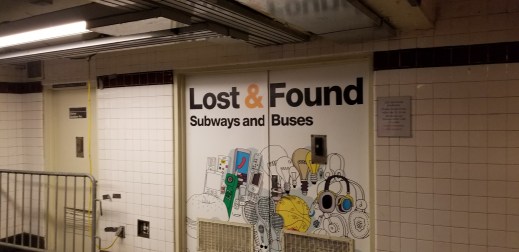
Earlier this summer, I arrived home late on a Friday night—late these days meaning after 8 p.m.—and was taking things out of my pockets after a long day. When I reached into my right front picket, I came to the realization that I did not have my wallet. My stomach tied in knots and I cried out in frustrated desperation. I knew it had been in my pocket; there would be no deus ex machina miracle of finding it in my bag or in another pair of shorts.
I knew that it most likely fell out of my pocket on my commute home. I had just gotten off the express bus—this bus was still on the road and someone could radio the driver! I immediately picked up my smart phone and dialed 311 for citywide information. The 311 operator would be able to connect me to the right person. The 311 operator transferred me to 511, which is the information number for the Metropolitan Transportation Authority (MTA).
After a few more transfers, I spoke with someone I was told could help me. I gave them all the information I had. I was on a QM20 bus and was picked up from 6th Avenue and 42nd Street in Manhattan at approximately 8:40 p.m. and was dropped off at Union Street and 26th Avenue in Flushing, Queens at approximately 9:30 p.m. This driver was probably still on their route and with the information I had given them someone should be able to get in touch with the driver ASAP!
But no such luck. The person on the other end of the line said they could not do anything unless I had the bus number. Without the bus number, they could not contact the driver. Seems a bit ridiculous. If this had been a more serious situation and people’s lives depended on finding the bus, there would have been a catastrophe.
I was asked to call back the next day after the bus had gone back to the depot and the driver may have turned in the wallet. It was a small wallet, one that held only cards. I was not out any cash, unless someone was going to town with my debit card.
I started to call credit card companies and my bank to have holds put on cards.
The next day I called the depot. Nothing.
I called back the next day, and called back later in the day again. Nothing still.
I went through with canceling and replacing my credit cards and ATM card and replacing my driver’s license.
By Monday, there was no funny business on my cards and new ones were on the way. I printed out a temporary driver’s license and ordered a new card wallet that came with a money clip. My card wallet needed replacing anyway, and this was a chance to pare down the stuff I carried with me everywhere.
A few weeks later, the same day my new driver’s license arrived in the mail, a notice from the MTA Lost & Found arrived in the mail.
“An article which contains your name and/or contact information was found and turned in to the MTA NYC Transit Lost Property Unit,” the notice began. It instructed me to report to the unit’s office at the 34th Street subway station at 8th Avenue in Manhattan. If I did not claim my property by Nov. 3, “it will be deemed to have been abandoned and you will have forfeited your right to claim it.”
The next day I brought that notice and my newly replaced driver’s license to a hidden-in-plan-sight pocket of the 34th Street subway station in Manhattan. It took some searching and asking to find the lost and found office, which is beneath the tracks of the A, C, E subway lines and without any signs leading you there except in the immediate vicinity. It’s within the subway system, so if you arrive by some other means or exit the subway before you find it, you’ll have to spend another subway fare to reach it or get a helpful MTA worker to let you in.
A small sign points the way to a set of double doors painted in celebration of the many objects found in our transit system. The office is open odd hours—and completely closed weekends and holidays, a travesty in a system that runs 24 hours—but luckily is open until 6:30 p.m. Wednesday and Thursdays.
Inside is a small room with a very low ceiling. I’m five feet eleven inches with my shoes on, and if I had extended my arm fully above my head I would have punched a hole in the drop-down ceiling. There is a metal bench to sit on, a small counter to stand and fill out paperwork on, two old-looking computer terminals, and a thick window above a pass-through door through which one may conduct business with the MTA workers on duty.
I arrived as a worker emerged from another set of doors to hand someone some paperwork, and she took my notice and ID and disappeared in to the bowels of the lost and found. The woman who was there spoke to someone at the window and was told to check back about her property later. She left and another woman arrived to ask if a book she lost on the subway was found. She was told no and to check back later; she left. Another man arrived and looked through his paperwork to check on a claim, and while he was speaking with someone another woman arrived to check on some property she had reported missing.
A worker arrived at the thick window with my wallet. It was a different worker than I had given my notice to; it was a rotating staff of workers answering questions and handling forms. He told me to sign my name on another form and write my address the same way it appeared on the notice in the mail. He opened the door to the silver box under the window and placed a clip board inside, and when he closed his door I opened mine and filled out the form.
A minute later, the same exchange reunited me with my wallet. It looked a little worse for wear, but nothing was missing. Everything was there: my license, my ATM card, my MTA MetroCard, even the coupon for a t-shirt at the zoo. I excitedly took an inventory of my wallet while my fellow transit visitors looked on amazed.
“You give me hope,” said the young woman sitting on the bench, hoping her property would be returned.
I thanked the worker and wished the other people in the office good luck, and went back out into the bustling station. For me, lost and found had worked out well.
Thank you to the Good Samaritan on the bus who turned in my wallet, and the series of honest MTA workers that made it possible for me to get my property back. For me the stars aligned this time.
FNO Flushing Fantastic, daytime festival edition
Despite the popularity of some parts of Brooklyn, our collective dialogue around New York City remains excessively Manhattan-centric. New Yorkers will still say “the city” when they mean Manhattan, even though the five borough boundaries of our city have been in place since 1898.
And New York City is so large that telling people what borough you are from will not cut it. No one actually from Manhattan would introduce themselves as being from Manhattan unless they were in a very borough-specific conversation. Each of New York City’s boroughs is a tapestry of neighborhoods, and it is these neighborhoods that are the lifeblood of life in NYC.
Queens is New York City’s largest borough and among its most well-known neighborhoods is Flushing. This weekend, local residents are showing off the neighborhood’s many attractions Saturday at FNO 2019: Flushing Fantastic.
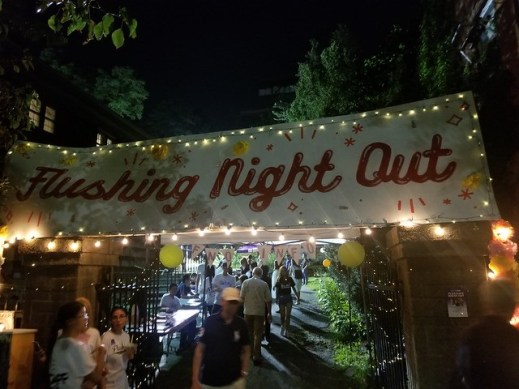
FNO stands for “Flushing Night Out” as past events have been held at night, but this festival is going to run from 12 noon until 6 p.m. and is going to be at historic St. George’s Episcopal Church, right in the center of downtown Main Street a short walk from both the 7 train and the LIRR.
Flushing is known as a destination for Chinese cuisine, and people will come from all over to sample some of the great restaurants, food carts, or food court stalls that make this neighborhood unique. But there is much more than Chinese food, and the Greater Flushing Chamber of Commerce is promoting the neighborhood as an international melting pot, though admittedly one that is heavily Asian. I often point out to people that among the best dining attractions in Flushing are 24-hour Korean restaurants such as Kum Gang San and Noodle Flower, where you can barbecue an awesome assortment of meat right at your table at two o’clock in the morning if you are so inclined.
The Greater Flushing Chamber of Commerce also notes that the event is designed to give a boost to local businesses and entrepreneurs that are competing with large franchises. Downtown Flushing has seen a boom in construction of high-rise condominiums and the rising price of real estate has made life harder for small businesses throughout Queens and five boroughs.
“Flushing, NY is the crossroads of the world — where you can find amazing culture and people from around the globe,” the chamber says in its event notice online. “We want to celebrate the unique food, fashion, and music found here as well as help the small businesses and entrepreneurs who are struggling to make ends meet. Over the past decade, rising rents and major development projects have threatened to displace the small mom-and-pop stores who invested their blood, sweat, and tears into making our neighborhood prosperous.”
Flushing Night Out has been held at various locations, centered on the downtown area. The first one I attended was on the campus of Flushing High School, and it was a memorable event, even for cynics like me that hate crowds.
It was at my first Flushing Night Out that I was introduced to Karl’s Balls, a food stand of traditional Japanese takoyaki balls—those are octopus balls inside a doughy sphere that are cooked on an egg-shell like grill. Go to Karl’s Balls because it’s an ingenious name and you may never stop joking about wanting to put Karl’s Balls in your mouth. But all joking aside, the takoyaki balls are extraordinarily delicious and Karl himself—Karl Palma—is a celebrated chef who has been featured on the Cooking Channel among other accomplishments.
While Karl’s Balls may not be at this FNO event, there is going to be a smorgasbord of amazing food, from Ecuadorian cuisine to Japanese ramen to craft beer and gourmet ice cream. You have no excuse to leave hungry. The organizers require all the vendors there to have items that start at $5 or less.
FNO also features live music, crafts, and other cultural interests. This Saturday will feature Harmonyc Movement, a city-based dance troupe steeped in K-pop and Korean culture.
And at the Flushing Queens Macaroni Kid booth, they will be giving away protein bars for free (full disclosure, my wife Emily Griffin Sheahan runs our local Macaroni Kid web site and will be manning the booth at the event – tell her I sent you!).
Fireworks and the American life

Last Wednesday thousands gathered in Fort Totten Park in Bayside, Queens for a fireworks display. The event had all the makings of potential disaster by modern metrics. Thousands of diverse people crammed into a limited area and jockeying for space to get a good view. A little league soccer team was wrapping up practice as people took their places in the expanse of green field between portable toilets and a row of food trucks. Bounce castles entertained children before the fireworks started and people took what they thought were the best positions to view the show as they waited for the sky to get dark enough.
The fireworks started promptly and a roaring whoop went up from the crowd as fireworks lit up the sky. New Yorkers cheered enthusiastically for this celebration of our War of Independence. When it was over, the crowd made its way out of Fort Totten without incident, or at least any major ones.
From parts of Fort Totten you can see the glitter of the Manhattan skyline and be inspired by the nighttime majesty of the Throgs Neck Bridge lit up. It is a marvel how New York holds itself together while the country seemingly tears itself apart. Gotham is as rife with division as everywhere else: New York City gave us both Donald Trump and Alexandria Ocasio-Cortez.
The greatness of New York serves as a microcosm of America. We see all the same issues in New York first, and the city, rightly or wrongly, serves as a template for how the rest of the country can navigate its problems.
The Fourth of July brings us down to Earth, reminds us of how American we are. It is popular to look upon outward signs of patriotism as right-wing or quaint, but if you believe America is for everyone and that patriotism is expansive and great, then join the celebration. The freedom we have was purchased in a bloody war, several actually.
The land we are on we do not claim by divine right. Every inch of America was fought over. We waged war on France, Great Britain (twice), Mexico (twice), Spain and countless Native American nations to get the current borders of the United States. July 4th celebrates the birth of our nation, a hard-fought war for Independence that was in effect our first civil war. When the war started it was not a foregone conclusion that we would win. The patriots who signed their names to the Declaration of Independence knew that the document would serve as their death warrant if the war didn’t go their way.
The Battle of Brooklyn was one of the bloodiest fights in the history of the American Revolution, and the war would have ended had Washington not been able to retreat to Manhattan. The British held New York for most of the war, but the city has signs of the American Revolution everywhere. The first woman who took up arms for America, Margaret Corbin, fought at the Battle of Fort Washington in Manhattan.
Some are fatalistic and see America as it is headed now as intrinsically doomed. There is no cultural coherence to sustain us through these times, they say, and new communities and nations will rise out of what is now a crumbling empire. But New Yorkers have bridged these divides in the crucibles of ambition and creativity. We are strong when we demand truth and strength, and turn to leaders not afraid to speak honestly and make the right enemies. We can do that in America as a whole if we are willing.
Let the American Revolution be our call to action today.
The mystery commuter on the QM20 bus

For about a year and a half, I have commuted to and from my job in Manhattan using an express bus, a more expensive but comfortable coach bus run by the Metropolitan Transit Authority.
Most of the bus drivers who drive these buses hustle to get us through traffic and make good time getting into Manhattan from the Eastern reaches of Queens. A meek or extremely defensive driver is going to fail at driving and express bus, and fail hard.
And that’s been happening recently in the early morning on the QM20 line. One driver I have not seen but only heard about, an older gentlemen, is a slow-paced driver that is content to hang in the slow lane of early rush-hour traffic while his passengers fret about reaching work on time. I have spoken with people who have stopped riding the 6:45 bus because they cannot get to work on time if they ride it. In fact, the 7 a.m. bus routinely reaches Manhattan sooner.
Because the driver of the 6:45 a.m. bus is such a pathetic slowpoke, passengers that used to take that bus now flood to the 6:30 bus. There are now at least three times as many passengers waiting at the bus stop for the bus I take, which means the other stops are all more crowded as well. I used to be able to find a seat all to myself with regularity, now it’s nearly impossible.
Yet still people insist on putting their bags on seats, even knowing that they’ll have to move them at some point. It’s a gamble on their part, they’ll possibly get the seats to themselves if enough passengers decide not to ask them to move. I usually make it a point to make these rude people move their bags, though if they are an exceedingly large person then I will often pass them by because I’m a large person also and then we’re both crammed into our seats seething and miserable. There is one rude fat bastard on my bus line who does this without fail and sits in corpulent luxury every day.
Sometimes I’ll choose people who are polite and thin because I’ll have more room. There’s a man who uses his time on the bus to sketch drawings and I feel camaraderie sitting next to someone interested in the arts, even if I never talk to him.
This past Monday however, there was a mystery man and I felt I had to sit next to him. By mystery man I mean someone who had a black wool hat pulled down all the way over his face. This was not a ski mask (aka balaclava), but just a hat that normally sits on top of the head and over the ears. He had it pulled down all the way over his face, so that his head was just one monolithic orb of woolen darkness.
I was appreciative of the aesthetic and felt a kinship to it. I often wear a ski mask when I perform in bands, and have enough ski masks at home to clothe a paramilitary battalion for a decade. So I sat next to this man. He was a bit spread out but I managed to get comfortable enough and read the news on my work phone. I didn’t want to see the man’s face, wanting his mystery to be kept for all eternity or at least until the weather was warmer and one would have to be psychotic to wear a winter cap. But no, soon after we rolled into Manhattan the man woke up and pulled up his hat revealing the countenance of a middle-aged commuter.
I don’t know where the man departed the bus. I got off at my usual stop at Herald’s Square and made my way downtown, hoping to engage with more of life’s mysteries as the day wore on.
Come to the Flushing Eco-Fest

Sustainability and the environment are not just for hippies anymore.
Although when you think about it, hippies were late to the game on wanting save the Earth. The greatest environmentalists in American history is most likely the 26th President of the United States and great New Yorker, Theodore Roosevelt. Roosevelt used the power of his Presidency to create national parks and other public lands. And when you think about it, accomplished hunters like Roosevelt are among the best environmentalists.
Ask yourself what would Theodore Roosevelt do? If he were still with us today, he would probably be bold enough to bicycle from Oyster Bay to the Flushing Quaker Meeting House (a trip of only 25 miles, an easy two hours for T.R.) and find common cause with the many diverse people working for the preservation of our natural world at the Flushing Eco-Fest on Saturday, March 23.
The festival is being organized by Flushing C.S.A. (Community Supported Agriculture), a local farm share group (full disclosure: our family is a member of the Flushing C.S.A. and my wife is a core member and Eco-Fest organizer) and being cohosted by the Flushing Chamber of Commerce.
The Eco-Fest is free and offers free workshops, eco-friendly kids’ crafts sponsored by Macaroni Kid, and a host of vendors with locally grown and organic goods. There will be well over a dozen vendors and groups there, each one is in some way working towards making things on the planet more sustainable.
There is guaranteed to be something to appeal to everyone. My personal favorites are some of the local food businesses such as Spice Tree Organics and Astor Apiaries. You will be doing something good for the environment when you attend, even if you just stick around to learn something about watersheds or how to compost or get a few cycling or energy-saving tips. There will also be environmentally-friendly soaps, home décor, seedlings, and baked goods for sale. And a raffle. Nothing is too small to do to make a difference.
You will also meet an interesting group of people there. Events like this can give you a great cross-section of this part of Queens. The Flushing Quaker Meeting House is the oldest, continually-used house of worship in New York City, and Flushing has several important landmarks in the cause of religious freedom in the U.S. Inside the Meeting House, you will be surrounded by history older than the United States. And whatever you think of the current trajectory of the U.S. or its politics, there is no disputing that this is an interesting time to be alive.
And it is a perfect time to increase your civic and conservationist involvement. Don’t let cultural stereotypes about environmentalists dissuade you from joining with those who want to keep our nation’s land strong. Everyone has a part to play.
Teddy Roosevelt promoted national greatness, and he understood that a nation that depleted its natural resources and did not invest time in strengthening its land and future could not sustain itself. In Flushing, people will gather and, consciously or not, help build on Roosevelt’s vision of a great America that treasures its natural resources and strives to be a unified community.
Year of the Pig

This week begins the Year of the Pig according to the Chinese zodiac calendar. All New York City public schools are closed for the celebration. There will be a big parade in downtown Flushing this weekend and there is no shortage of family-friendly events in the city to celebrate.
We commonly called this Chinese New Year but that has dropped out of fashion and Chinese New Year is now called Lunar New Year. Koreans and other Asian cultures celebrate this as the New Year, not just the Chinese. But the Chinese originated this festival. Sure, it’s set by the lunar cycle, but so are Jewish holidays. If Chinese New Year is Lunar New Year, then so is Rosh Hashanah.
Chinese New Year is a holiday that’s quickly moving out of its original ethnic boundaries, like St. Patrick’s Day or Cinco de Mayo. Chinese New Year is an opportunity to sample some compelling Chinese cuisine and light of firecrackers if you have them.
It’s a shame that celebrants in New York City cannot legally set of fireworks for the Chinese New Year. The Chinese invented gunpowder, damn it, they’ve earned the right.
In our house, the upcoming holiday was a reason to feast. My wife made delicious Coca-Cola Pulled Pork sandwiches on the eve of the Lunar New Year. They have the day off from classes and received some decorative paper lanterns from their school.
People born in the Year of the Pig are said to be intelligent, well-behaved, and artistic. They are among the calmer signs of the Chinese zodiac. It’s the sign we need for the world we have now. Some enlightened refinement and well-mannered artistry would go a long way to improve the state of things.
The pig is the last of the 12-part cycle of the Chinese zodiac, owing to legend that it was the last animal to arrive at a gathering summoned by the Chinese emperor, or by Buddha, according to a different legend. It is a stout animal known for its intelligence. In the United States, feral pigs that have escaped from pig farms are amazingly adept at surviving in the wild and can grow to enormous sizes.
There are five different versions of the Year of the Pig, based on the different elements (metal, water, wood, fire, earth). This is the year of the Earth Pig. It is the least fanciful and most real of the elements – our planet in its rawest form, the pure soil that is the basis for our lives here. It’s where we grow our food and the patch of land we seek to keep and defend.
So take whatever pleasures you can in this Year of the Pig. Survive and thrive no matter what slop is thrown your way. You owe it to yourself.
Happy Chinese New Year.
The rewarding solitude of night driving

This past weekend I went to run some errands and found that our family minivan’s battery had died. Add it to the ‘last thing I needed’ list. We are lucky enough to be a two car family, and while I thought we had jumper cables in our other car, it turns out we did not. I was spared the opportunity to make myself look extra useful or electrocute myself.
I had to wait until after our older children were in bed before I could call AAA and have our car’s battery tended to. That took longer than I thought, and I wound up paying cash for a new battery. We needed it and I know my wife would not have time to go to a garage this week.
I set out on a drive to get cash from the ATM after using all that I had on me to pay for the new car battery. Some of us have become so accustomed to using credit cards or debit cards for just about any purchase over $20, that our trips to our bank’s ATM are infrequent.
Sunday night after 10 p.m. is a quiet time in the Western world. My part of Queens, New York, is a residential area where people are enjoying their last hours of family and freedom before the grind of the workweek picks up again.
Driving alone at night is one of life’s pleasures I used to enjoy more frequently. I had a car in the latter part of high school and through college, and taking long drives was a time I could enjoy solitude and productive daydreaming (even at night) and listen to music. Long walks and runs fulfill this need in city life, but the lure of the open road can’t be duplicated on foot so easily.
It is interesting to see who else is also on the road, what other strangers are enjoying the quiet time to be out and about while most of the nearby world is cloistered in their homes for the night. Drivers are not rushing to get everywhere as much and there’s a modicum of civility that you don’t find during daylight hours.
Sunday nights in particular, are fun times to get out. You can see this with drinking too. With Monday morning looming, not too many people are at the bars, and Sunday night at the bar was a great guilty pleasure during my drinking years.
Cruising down Willets Point Boulevard, few other drivers were on the road. I had a few errands to run and made some lucky green lights, with few others taking up lane space around me.
I got to my bank and went to use the ATM—the machine was giving out only $1, $5, and $100 bills because our financial institutions are losing their basic competencies. No mind, I set out again to drive to the next closest branch, just a mile or so away. Francis Lewis Boulevard is in the middle of repaving, and a big stretch of road has been milled down to a rough, striated surface. It was rough driving where normally it would be smooth; each manhole felt like driving over a pitcher’s mound.
I reached the next branch of the bank, only to find it was no longer there. Banks are closing branches as more people do all their banking online. I made an illegal U-turn and headed back towards home, stopping at a gas station to feed quarters to an air pump to refill two of our van’s tires. This gas station was a full service gas station, and the attendant stood in his booth, waiting for someone who needed gas. Good for them for being open late on a Sunday,
My business done, I returned home, listening to music and enjoying the quiet streets of Queens before the deluge of the workweek arrived.
College Point discovery: The Poppenhusen Institute

It was a Saturday and we were looking for something family friendly to do with the kids.
For a long time, I studiously avoided anything deemed “family friendly” as it was either specifically for children like ‘Sesame Street’ or something that was toned down and devoid of any of the reality-driven spice of life. But my time as a parent has changed my view and definition.
For us, “family friendly” doesn’t mean for something sanitized or dumbed-down, it means we want to be able to find a place to change a diaper. We are not afraid of adult content corrupting our children except in extreme examples; we’re afraid of adult content boring the crap out of our children.
Case in point: we looked up local events on our local Macaroni Kid and found an Oktoberfest nearby. You wouldn’t normally think that an Oktoberfest celebration would be a place to take children, that it would be nothing but loud, beer-soaked hipsters being dramatically unaware. And maybe in Brooklyn that would be the case, but the Poppenhusen Institute of College Point, Queens proved that wrong. We live not too far from this institution, which is 150 years old now. A center for German culture, it’s evolved to become a lot more without losing sight of its original cultural mission.
College Point is somewhat of an out-of-the-way place by New York City standards. There’s almost a small community village feeling to it as its small businesses have thrived. Driving down 14th Street, where the Institute is, the businesses of College Point Avenue recede and the street is a bit narrower and more residential, until you get closer to the water, where more industrial businesses are. The Poppenhusen Institute is bordered by businesses but in an area which is still largely residential. It’s got a fenced-in property (another bonus for bringing small children) and is a magnificent building that dates to 1868.
Being the day of the fall equinox, the weather was perfect for the outdoor event, which was held in the shaded back yard of the Institute. Decorated with blue and white balloons, we paid $18 admission and that included a lot of free entertainment and an area of games for kids. There was free face painting for children and prizes as well.
On site was an award-winning artist, Brian Lipperd, painting portraits. He produced a great portrait of your youngest daughter and touched it up when she smeared it. This artist formerly worked as a portrait artist in Florence, Italy and has had other prestigious residences around the world and will be teaching art classes at the Poppenhusen Institute. You think they have awesome portrait artists at Chuck E Cheese? Think again.
The Institute was once a village community center for College Point, it even served as a local sheriff’s station and still has two small jail cells that housed town drunks or other minor miscreants. It was the site of the first free public kindergarten in the United States. It has a magnificent performance space as well as an exhibit of early Native American life of the area.
The food was affordable and we bought hot dogs for the kids and my wife and I enjoyed some bratwurst, as it was an Oktoberfest and that felt like the right thing to do. There was traditional German music and men in lederhosen and women in traditional German dresses performed dances. My wife came in second place in a beer stein holding contest, winning a nice beer stein filled with beer.
The Poppenhusen Institute holds painting classes for children and has numerous performances and things worth doing. It is well worth the trip to College Point to visit this cultural treasure.
RIP Big Bertha, New York City’s punk rock pickup truck
When I moved to New York City to live as an adult more than 20 years ago now, one of the things I most looked forward to was being able to live without a car. The 10 years of being a car owner had been miserable. My first car broke down a lot and was finally consumed by flames in an engine fire. I replaced it with a 15-seat passenger van I purchased from an inebriated redneck in the back woods of Northeast Georgia. The van also broke down a lot. The drive shaft fell off on Highway 285 in Atlanta and I give it to charity in hopes of getting a tax write-off rather than try to sell it.
But time and life circumstances change, and six years ago my then fiancé and I decided to get a vehicle together as we were building our new life. I was playing a lot of punk rock shows at the time and we needed something affordable but that would carry a lot of musical equipment as well as be suitable for camping and hunting. We couldn’t afford much, but we managed to find something that fit the bill and was reliable at an affordable price: a full-length pickup truck that we named Big Bertha.
The name was an homage to my then-finance-now-wife’s great grandmother Bertha. It was also an alliterative reference to Blue Betty, an ill-fated blue van that I came to possess for several months and was able to use for only one punk rock show. Driving a barely-functioning van from Suffolk County to Brooklyn while having to shift into neutral at every stop to keep it from stalling out is a harrowing experience that builds character. How that van made it as far as it did is a miracle. We were never able to get it working and eventually sold it for scrap metal and got $300 for it, which didn’t fully cover what I had spent to insure it.
Big Bertha performed flawlessly for every punk rock show, every camping trip. When my wife and I went on our honeymoon, we drove Big Bertha to Maine. A missed highway exit took us through Lowell, Massachusetts, where we stopped by to visit Jack Kerouac’s grave (“You don’t look like typical Kerouacers,” the woman at the cemetery office told us, which we took as a compliment). When my wife was pregnant with twins, she found it convenient to use the truck. When our twins were born, Big Bertha enabled us to take our offspring home from the hospital safely.
Perhaps the greatest immediate benefit was ease of getting to shows with equipment when playing music. When my band Blackout Shoppers came home from playing Philadelphia and needed to blast some classic Whitesnake to the hipster-infested Lower East Side, Big Bertha had the power. When we did a short tour with Two Man Advantage, Big Bertha took us through the bitter cold. I somehow managed to park the nearly 20-foot truck in the East Village when we opened for Joe Coffee and 45 Adapters at Bowery Electric.
Driving and parking in New York City is not easy. It is especially difficult to do with a large vehicle. Where we live in Queens makes owning a car a bit easier, as street parking is possible and there are residential streets with more available parking than other places. Owning a vehicle as large as Big Bertha would be impossible in Manhattan and more popular parts of Brooklyn.
Our punk rock pickup truck persevered, until it didn’t. Its transmission, which was never 100%, began to decline rapidly over these last months. When I attempted to drive it to see SLAYER at Jones Beach, I had to quickly change plans and use the family minivan for the trip.
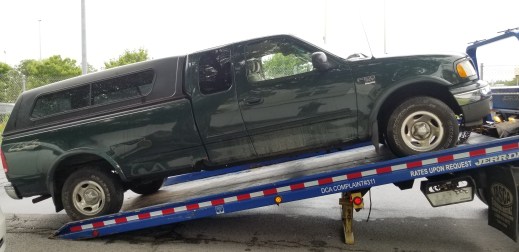
We had Big Bertha towed to our mechanic and the prognosis was not good. Bertha’s transmission was gone and it would be costly to replace. She had taken her last ride and it was on the back of a flatbed pickup truck.
Luckily, our friend Amy Jackson happened to be looking for a buyer for her Jeep Grand Cherokee, and we could not find a better person to help replace our truck. Amy is a photographer and adventurer. When a friend of hers was seriously ill a few years ago, she quickly organized and produced the Gentlemen of Punk Rock calendar to raise money. She accepted our offer and will be using the money to fund her trip to Antarctica. Amy Jr. will be part of our family and while she will never have the enormous presence of Big Bertha, she will be a lot easier to park.
Like many aspects of city living, owning a car is tougher here than elsewhere, but we find our ways to make it work. A decade ago I never thought I would own a vehicle again, and now I have two vehicles registered in my name. Wish us, Amy, and Amy Jr. good luck and smooth travels.
Bidding a hellacious farewell to SLAYER

Big Bertha the pickup truck was not herself. My vehicle was over-revving, lurching, and I smelled something burning. I was afraid she wasn’t going to make the trip to Jones Beach. I picked up my friend Javier from downtown Flushing and headed back home, where we were able to use the minivan. Javier helped me take out the car seats to make room for Beast and Sid, and we headed back to downtown Flushing to pick them up. We got a late start, but we weren’t going to miss a minute of SLAYER.
Slayer has embodied the best of thrash metal for nearly four decades. Coming to the world in the early 1980s California, it mixes the rapid-fire, unrelenting aggression of hardcore punk with the guitar virtuosity of more traditional heavy metal.
Over the years, Slayer has become easy shorthand for aggressive music that rejects any and all self-indulgent niceties or attempts to soften its image. Years ago I was dating a woman who was destined to soon break up with me. Even though I was coming off a long period of unemployment I shelled out to treat her to a performance of Handel’s ‘Messiah’ at Carnegie Hall. One of my biggest regrets of that time was not screaming “SLAYER!!!” in the famous venue between movements. I would have enjoyed the performance much better and it would have brought that relationship to a quicker and more merciful end.
I’ve had the good fortune to see Slayer several times, including with the definitive lineup that included Jeff Hanneman before his untimely death in 2013 and drummer Dave Lombardo. “No Jeff, no Dave, no thanks,” was a refrain that some Slayer fans abided by in these later years, and I hadn’t seen them since Lombardo was fired in 2013 after disputes over money.
For whatever reason—and maybe being in the same band for nearly 40 years is reason enough—Slayer is calling it quits. If you needed another reason to pay to see Slayer again, this was it. They even patched things up with Dave Lombardo.
So on we rolled out to Long Island to see Slayer’s final show in the New York City area. Opening for these godfathers of metal were other excellent thrash metal veterans Anthrax and Testament along with Napalm Death and Lamb of God. The name of the concert venue there changes every few years to that of a different corporate sponsor, but everyone just calls it “Jones Beach.”
Jones Beach can be lacking as a concert venue. Even though I quit the drinking life long ago, it is an outrage that the amphitheater only allows alcohol in one restricted area with no view of the stage unless you pay even bigger bucks as a VIP. And the prices on concessions are ridiculously inflated. While I had enough cash in my pocket, I was not going to pay $5.50 for a bottle of soda that costs $2 elsewhere. Six dollars for a hot dog? No thanks.
But Jones Beach gets good shows. A lot of the big concert tours don’t come to the five boroughs. I asked the peanut gallery of social media why this is. The two biggest concert venues within the five boroughs—Madison Square Garden in Manhattan and the Barclay’s Center in Brooklyn—share space with sports teams for much of the year, so there are fewer concert dates available. Also, the city is more expensive and so much of a logistical nightmare it is easier to go elsewhere.
Forest Hills Stadium is a great place to see a concert. I saw The Who there a few years ago and it was a great show. It’s intimate for a stadium and it has the kind of food and craft beers that both younger and older crowds enjoy. That venue tends to more mellow acts (Van Morrison, The B-52s with Culture Club, Imagine Dragons) because it’s in a residential area and the people who own homes in Forest Hills probably aren’t very interested in listening to live thrash metal at 9 p.m.—their loss.
Whatever the drawbacks of Jones Beach, the Slayer show rocked. All the opening bands were good; no one disappointed. And Slayer played the best kind of farewell show they could have played. They closed with ‘Reign in Blood’ and ‘Angel of Death’ and then thanked the crowd for supporting them.
Someday we can hopefully make it easier for bands like Slayer to play within the city limits of our beloved Gotham more frequently. Music, and New York City, deserve it.
 Matthew Sheahan
Recent Comments