
The savage madness of New York City Pre-Kindergarten

Having children in New York City means a life of deadlines and bureaucratic navigation. While every child is guaranteed a public education, it takes immersion into byzantine administration in order to ensure your offspring can access the best schools available, and the grapevine is full of horror stories and cautionary tales of kids being sent far from home to sub-par schools.
My wife and I are waiting to hear where our older girls will attend preschool. Universal Pre-K started several years ago and it’s free to all kids the year they turn four years old. We are lucky in that we live in an area that has good local schools. A lot of younger couples have kids and then find themselves racing a clock to get to a better neighborhood in or out of the five boroughs that has suitable education choices.
I am blessed with a great asset in making sure my kids get into a decent Pre-K: my wife. She was the one who did the research and learned how to traverse the absurdist labyrinth of rules and applications (e.g.: applying to only one or two schools won’t work, if you do that, the system will automatically fill in the other choices for you, so your attempt to limit the choices may backfire big time). She figured out which ones were closest and had good ratings, and came up with a list of preferences that will mean our older girls are likely to be in a good place.
The schools we applied to include both public and private schools close to where we live that run public Pre-K programs.
One of those public/private Pre-K schools is a place called Holy Mountain. This school does not have any religious affiliation that we can discern. It has a mostly Asian student population, but so do most schools in our area (we live in Flushing, Queens, an area known for its large Chinese immigrant population; it has a large Korean population as well).
But the name Holy Mountain will always first make me think of the 1973 Alejandro Jodorowski film, The Holy Mountain, which I first saw projected onto a wall during a punk rock show many years ago. It is an art film filled with strange and bizarre images, even watching the trailer many years later is to step away from reality for a few minutes. One of the most well-known and memorable images of the film include a parade of crucified dogs that have been skinned and disemboweled.
So now whenever my wife and I discuss Pre-K for our kids and we note that Holy Mountain was one of our top choices (it’s nearby and it has high ratings with a Montessori-based teaching style, so what if it has a weird name), all I can think about is my older girls parading down 31st Road in gas masks while carrying crucified dogs.
This week, the results came in: and our girls will be headed to Holy Mountain in September. Mutilated canine parade, here we come! I now need to watch that film again. I’ll have to find a time when the rest of my family is asleep, as I am the only one in my household who has this big a taste for eccentric cinema.
We are lucky to live in an area where such services are available within walking distance. For the value it returns, no investment in public education can be too big.
When you become an indifferent monster

I was at a conference for work where people were going to be talking about important things that could affect my job, the line of business I work for, and the company I work for. I had to be there for certain speaking panels and a regulator’s speech. I had to take copious notes and report on what was said. I needed to be there to talk to any journalists that might be asking questions of our company’s executives.
I work in corporate communications. I like to think I’m good at my job, or at least have a good work ethic and honestly try to do my best. It was after lunch and I was loading up on coffee to make sure I stayed alert. Since I had consumed enough caffeine to give an elephant a heart attack, I really wanted to try to get to the restroom between two panels that I had to be present for.
To my luck, the program at the conference added an extra speaker between these sessions and I saw this as my chance to head to the bathroom. As the conference organizers asked us to stay for this speech, I was darting out of the conference room to get to the men’s room.
Outside the auditorium, closed-circuit televisions were broadcasting what was happening inside, and I saw that I had walked out on a young teenager who was recovering from a horrible form of cancer. People in the lobby watched the young man on television recount his struggle to live a normal life while fighting a horrible disease.
I stopped for a minute to listen, feeling like the worst kind of corporate monster for walking out on the most heartfelt talk of the entire event. But nature, and my need to be back in time to take notes on the next panel, called, and I continued with my plan and made it back to the auditorium with just enough time to not miss the required discussion.
Cody Strong for a Cure is a charitable organization that helps support children with cancer and their families and raises money to fund research into pediatric cancer. I missed a brief talk by the inspiration for the charity, Will Cody, who is thankfully in remission after being diagnosed with Acute Lymphoblastic Leukemia two years ago.
After priding myself on having good priorities and not being blinded to the truly important things in life, I had become the indifferent monster I had always despised. I consoled myself in that I had already donated to the charity raffle at the event, using all my raffle tickets on the prize for a free trip to a Rangers game (I didn’t win).
There are times when life gives you a punch in the gut that reveals how unimportant so much of what we think about is, and our carefully tended self image comes crashing to the floor in a jumble of jagged shards. This was one of those times. No matter what was said or done at the conference that affected my job or the company I work for, none of it amounts to jack shit compared with a child stricken with a terrifying illness.
I stayed up late that night typing up my notes for work, and I have no idea how many people read them. One of my colleagues said I did a great job with them, but they will always be stained with a dark self-knowledge. At some point in our lives, we see a side of ourselves that we despise.
A Punk Rock Anniversary

Mike Moosehead is the hardest working man in punk rock, and this weekend he’s playing shows with five different bands. Four of those bands are playing a special show to commemorate his and his wife Xtene Moosehead’s 10th wedding anniversary. The two are both punk rock bass players, though Mike plays guitar quite a bit also.
The Cobra Club in Brooklyn is the venue where the show will be. It is in a now-trendy area of Brooklyn where the remnant industrialization means a greater chance to find parking if you are driving there.
Full disclosure: I’m playing guitar in Beer Drinking Fools, the opening band of the night that features Mike on bass. The name of the band pretty much gives you the story: songs about beer. But there are some really great songs not directly related to beer that make me love Beer Drinking Fools long after I left the drinking life. Songs like ‘Work Sucks’ and ‘Let’s Get on Welfare’ offer common anthems for anyone frustrated by the standard dirge of working life. And even if you don’t drink, ‘Drinking 40s on the Subway’ is a great homage to the spirit of freedom that makes life worth living.
The second band playing that night is a special guest, and the name of the band will not be announced in advance. I happen to know what band this is and I can say first-hand that they will be in keeping with the spirit of local New York punk and hardcore with a sense of humor and chaotic stage performance.
Skum City features Mike on guitar and Xtene on bass. They started this band in 2007 and played their first show in 2008. Some former members are going to be coming back to play, and it will be a great time. Skum City blends old school punk rock with West Coast style early era hardcore. If you are looking for down-tuned grunge music to fall asleep to, look elsewhere.
Mike is also a guitar player for World War IX. World War IX was a band I learned about from reading their founding guitar player Justin Melkmann’s biographical comic strip of G.G. Allin in the New York Waste. They have been friends and comrades for years and they made my punk rock dreams come true when the inspiring Renaissance man Philthy Phill became their lead singer. I have had the honor to play some villainous characters in a few of their music videos. Who will they proclaim to be the King of the King of the King of Beers? I’ll have to find out (will not be me).
Headlining the night is Philadelphia’s Loafass, a band I have loved since I saw them open for Murphy’s Law on St. Patrick’s Day in 2003. Their lead singer, Fish, was the officiant at my wedding. Few bands are able to harness the sense of humor that punk music requires as well as Loafass. If a ramshackle jalopy with Pennsylvania license plates careens across the highway in front of you in a blaze of marijuana smoke and empty beer cans, the band playing on that car’s stereo is Loafass.
The show is only $5 dollars and requires you have an ID that says you are 21 or older. Mike and Xtene have put together a great show and the longevity of their band and marriage is a testament to the notion that making great music together can make a lot of people happy. I hope to see you there.
Doktor Kaboom Drops Science on the Queens Theatre

Queens Theatre in Flushing Meadows Corona Park is not one of the park’s better-known attractions. The iconic Unisphere gets much more attention, and the Queens Zoo probably sees a lot more foot traffic, but the Queens Theatre is a lesser-known gem in the large park.
This past weekend it was the sight of a recent performance by Doktor Kaboom, a comedic science performer who has a family-friendly show that targets impressionable young children and works to give them a love of science.
The good Doktor, with his spiky blond hair and thick faux-German accent, looks and sounds like the love child of Guy Fieri and Angela Merkel (who has a PhD in Physics), but he’s actually a native of North Carolina who lives in Seattle and found a way to combine his love of comedy and science.
The whole family went and we were lucky enough to have extra tickets for a friend and his daughter. The Queens Theatre mainstage theater seats 472 and the rows are on a gradient generous enough to provide decent viewing from all angles.
After a brief introduction, Doktor Kaboom took the stage and we were on our way. The entire show is geared towards children, working to spark an interest in science and there’s no better way to do that than to show them that science allows you to make a mess. Using a catapult to try to help a young volunteer from the audience catch a piece of banana in his mouth, the bit had the stage littered with banana pretty quickly and it was good fun. I vowed to never feed my children bananas the same way again, but I’m not sure I am going to be able to build a catapult fast enough to realize this dream.
One of the best parts of the show was when the good Doktor implored the kids there to have confidence and faith in themselves. He said that at a previous show a 10-year-old kid said that he was a failure, even though he was a bright young man who could speak three languages. That base level of self respect is sadly missing from a lot in our society.
Unfortunately, some basic theater manners are also lacking. The Doktor had to remind the audience to refrain from using mobile phones, which is Theater Manners 101. Lack of civility as well as a dropping aptitude in the sciences are general signs of societal rot and sad to see, but at least there’s one guy out there fighting the good fight. That guy wears old-fashioned goggles, a bright orange lab coat, and shoes with flames painted on them.
But that didn’t slow down the show. There is a lot of safety instruction in the Doktor Kaboom show, even though the worst you may be exposed to is high-velocity banana and some soapy residue. He manages to use some optical illusions to trick your mind in ways that even jaded adults will find fascinating, and he takes time to explain what is happening in terms that children can understand. There are also plenty of under-the-radar jokes for adults as well.
There were no loud explosions as the Doktor Kaboom name might imply, but fear not. The show is well worth the time and has a big impact.
The continuous triumphs of raising girls
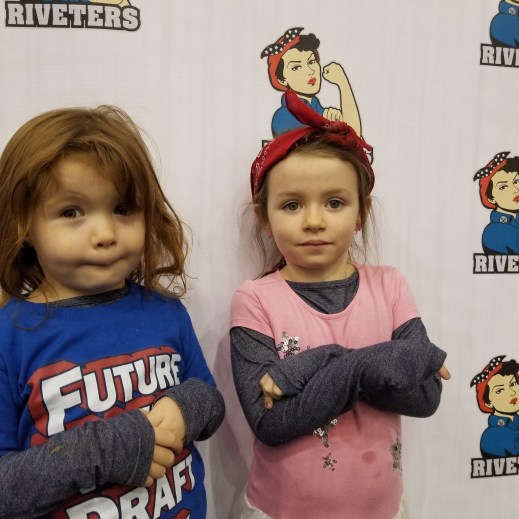
I was driving my three girls home from the Queens Botanical Gardens and as I merged onto a highway overpass that would take us home, our van overlooked some athletic fields where several teams were playing soccer.
“Daddy, do girls play soccer?” one of my three daughters asked.
“Yes, of course,” I said.
“Then I want to be a soccer player!” she said
“Yes, me too!” one of her sisters chimed in.
They expounded on their plans to dominate the sport of soccer. I reminded them they could play both soccer and hockey and they agreed that they could excel at both sports.
What struck me about this conversation was not my girls’ enthusiasm for soccer, but that they thought, at their early age, that they could be limited because they were girls. It was heartbreaking that in just over four years, they could conceive of being constrained in what games they play.
It was an interesting discovery that before they were three years old, my daughters craved representation of females in media; they were very conscious of what characters were in front of them. Most cartoon characters are boys, and the female characters in most popular children’s television are either princesses or fashion-obsessed mice. There are some notable exceptions (Dora the Explorer and Doc McStuffins), but even in cartoons with some positive female role models, they are usually a small part of the larger action.
This is one of the reasons my wife and I bring our girls to professional women’s hockey. The Metropolitan Riveters of the National Women’s Hockey League have been a must-see for our family. Besides being a fun sport to watch, women’s professional hockey, by the very fact of its existence, provides an invaluable service for the parents of girls. Our daughters can see women held in high esteem and being celebrated for hard work in their chosen field.
While my wife is a stay-at-home Mom for now, she is active in local civic affairs and has a leadership role in her local Community Supported Agriculture Group. We like to think that we don’t avoid the facts of life but present the world as honestly as possible, but there is no reason our girls should think that there are limits to what sports they can play.
There are efforts underway to have more portrayals of girls in various roles in different media, not just in hockey, but in all of life. People are making their own books, controlling their own art.
A former co-worker who has daughters older than mine said that girls are more likely to drop out of playing sports when they reach age 10; she noted that her oldest daughter made it through that age with her love of sport intact. It was a relief.
While hockey for me is a more interesting sport than soccer, I’m happy to have my girls interested in soccer. It is an easier concept to teach. Everyone knows how to kick a ball and run after it; hockey requires players to be proficient ice skaters to play.
I’m cautious about pushing hockey on my girls too hard, not because I really care if they play hockey, but I’m determined that they remain interested in playing sports.
So yes, girls play soccer and much more. Let it always be so.
There is no such thing as too many books

“The reader, the booklover, must meet his own needs without paying too much attention to what his neighbors say those needs should be.”
—Theodore Roosevelt
“We need to make books cool again. If you go home with somebody and they don’t have books, don’t fuck them.”
― John Waters
When I first moved back to New York City as an adult, I made it a point to make regular pilgrimages to The Strand to stock up on books. There was no way I could manage to leave there without several bags of books.
My small studio in Queens had two windows that looked out over a bus stop on 101st. Avenue and Woodhaven Boulevard. One of those windows was home to my air conditioner, the other window became my extended library. I already had a hutch bookcase filled with books but as my trips to The Strand and other bookstores multiplied, I needed more space for my books. Soon I was picking up plastic milk crates I found on the street to use as bookshelves. Then I acquired more milk crates, and soon had to double-stack books in them. More than once I found a great deal on a classic book at The Strand and bought it only to find that I already had that book at home.
When I moved to new apartment a few years later, I had space for actual bookshelves and bought four of them. They were quickly filled.
No longer single and free to binge at bookstores, my wife and I are now in the process of trying to make more space in our apartment for our family of five. That includes making more space in our living room, which currently houses most of our books. It is not an easy task.
It is not easy to part with books, nor should it be. Each book is an adventure waiting to happen, to give away a book without having read it is to deny a future possibility, a potential new thrill or idea. To turn away from books is to turn away from inspiration, from moving dreams and a new way of looking at life. Books are the lifeblood of the soul, and the building blocks of a civilized society.
Some purists may not forgive me for trying to adapt to the confines of space in our urban environment and using a Kindle. I know, I know: there is no substitute for the printed page, and the satisfying heft of a hardcover tome cannot be replicated by any electronic device. I agree. But as a commuter it is helpful to be able to read things with one hand, and while I would love to fill every spare inch of wall space in my apartment with shelves full of books, my kids need space to sleep and play. The Kindle has been a great evolution in the reading life if you can adapt to it. Some die-hards will not have it and I understand. If space and convenience were not factors, I’d be there.
But I have not given up printed books altogether. I will buy printed books when I can and use the Kindle as much as possible as well.
My collection of printed books will continue to grow, albeit a bit slower than in my bachelor days. My children are growing up in a home with plentiful books. They already love reading and if I fail in every other aspect of life, I have already achieved great success there.
The Riveters Bring the Championship Home

New York has another championship to brag about. The Metropolitan Riveters are the National Women’s Hockey League champions. They played for the NWHL’s Isobel Cup this past Sunday.
It was a packed Barnabas Health Hockey House for the final game between the Riveters and the defending champions Buffalo Beauts. The game sold out and was probably oversold, but it happens. We got there about half an hour before the game and by the time we got to the stands there was not a seat to be had. There was a strong contingent of dedicated Buffalo fans there taking up a large area of seating near the visiting bench.
The place we usually go to find seats was completely filled. There was additional seating added on the top walkway of the stands but those were all reserved. But we were directed to the other side of the rink where there were chairs and open space against the Plexiglas. This actually worked out better. Parents pulled chairs up closer to the rink so their kids could stand on the chairs and get a good view. There was also more room for kids to move around and we didn’t have to struggle to keep them sitting or to stop them from kicking people in the back as is an issue with the general admission bench seating. Also, we were closer to where the Riveters emerge from the locker room, allowing our girls to give fist bumps to the team as they made their way to the ice for each period.
The camaraderie among fans that pervaded the season was still in full effect at the final game. We stood with other die-hard Riveters fans and it was great to be closer to the action.
Taking young children to sporting events is a hectic undertaking. One has to keep an eye on the kids at all times, which is not easy when you’re watching a fast-paced championship game.
The game’s one goal was scored in the first period by Alexa Gruschow, who made an amazing diving play that showed why she was named the NWHL’s Most Valuable Player of the season. At one point in the first period, Riveter Madison Packer was down on the ice after being checked from behind by one of the Beauts. This earned Buffalo a 10-minute misconduct penalty on top of a two-minute penalty for hitting from behind. It was no matter though, Packer was back in the game in the second period. Later in the game I saw Harrison Browne take another cheap shot from behind from Buffalo.
We discovered a doll with wings that was close to the media backdrop for the Riveters. With it was a note, claiming the doll was Izzy, who had come from Buffalo to stay with her favorite team but needed the Riveters to retriever her cup. A witty good luck gesture, and it took several readings aloud of the note and the explanation to keep my girls from playing with the doll or going in search of its owner. I tasked them instead with making sure the doll was not disturbed. Someone did move the doll to a more prominent location, but the note, and the good mojo, stayed with the Riveters Nation.
As the final seconds ticked down in the third period, the excitement was palpable and when the final buzzer rang the team piled on starting goalie Katy Fitzgerald. This is the team’s first Isobel Cup championship.
While they currently play in Newark and have forged a partnership with the New Jersey Devils, who now have an ownership stake in the team, the Riveters are a product of New York City. They played their inaugural season in Brooklyn at the Aviator Sports and Events Center at Floyd Bennett Field in Brooklyn. They began as the New York Riveters and I still have a hat bearing that name.
The Riveters have made great progress as a team and brought new fans to women’s hockey and the NWHL. We can say we were there to see them win their first championship.
The Riveters can win it all
Last year I took my two older daughters to see the National Women’s Hockey League Metropolitan Riveters play two games against the Boston Pride. It was a blast and made us committed Riveters fans.
This coming weekend, the Riveters will be competing in the championship game against the Buffalo Beauts. We will be there to see them play for the Isobel Cup, the NWHL’s championship trophy (named for the Isobel Stanley, daughter of Lord Fredrick Arthur Stanley for whom the NHL’s Stanley Cup is named for).
It has been a great season for the Riveters, and they had a long winning streak that lasted late into the season. The family and I have been to all but one regular season home game, and we traveled to Stamford to see the Riveters pull out a thrilling overtime win against the Connecticut Whale.
We have a regular place that we like to sit for games and it’s near a group of dedicated fans who often ring cowbells. There is Dmitry, a superfan who was the first that I can remember ringing the cowbell – he offered to let one of my girls ring it at the game in Connecticut. There are a few others in the growing cowbell contingent. Also near us is Manpuku the Puppy and his human companion, both dressed to impress. We’ve also sat next to Kelsey Koelzer’s mother a few times and chatted with her about the team. My older daughters have given hugs to Rebecca Russo.
We make a point to bring our daughters to see these games because it’s important that they see women in sports. Even at a very young age girls crave representation in what they see. So much of our culture presents women is nonsense, and the NWHL allows us to go to events where young women are the center of attention in a very positive way.
And it has been a joy to watch the hockey. Madison Packer’s smooth and aggressive style of play is a thing of beauty – she will circle around, almost as if she’s leisurely skating around the rink, and then wind up exactly where she needs to be, taking control of the puck against the boards or winding up in front of the net to score. And I have never seen a player hustle down the ice like Harrison Browne – breaking away ahead of everyone else to drive to the opponent’s net.
This past Sunday, the Riveters shut out the Whale 5-0 to earn their first trip to the final game.
The only team to beat the Riveters so far this year has been Buffalo, who have been playing very well and are the defending champions.
The NWHL has been gaining momentum with every season. This season, the Riveters entered a partnership with the New Jersey Devils, which took a part ownership of the team (that hurts as a Rangers fan but if it’s good for the Riveters, so be it), and the Buffalo Beauts were purchased by the company that own the Buffalo Sabres NHL team. And the cause of women’s hockey was given another great boost this year with the U.S. women taking the gold in the Pyeongchang Winter Olympics.
The final game is at the Barnabas Health Hockey House in Newark, New Jersey and it’s easily accessible via public transportation. There is ample, affordable parking if you drive. If you like hockey, you won’t be sorry to be there for this big game.
Meeting Farmers in Queens, New York

In 2012, when Hurricane Sandy created shipping delays in the New York area, gasoline shortages arose quickly. Within the span of a week, 1970s-era gas lines formed on city streets. A cab driver I spoke with in the weeks after the hurricane told me he had woken up early that day and driven to Stamford, Connecticut to buy gas.
Now imagine if our food supply was so adversely affected. For this reason alone, it is a good idea to get food that’s grown closer to your home whenever possible. You want to live close to your most vital supplies, especially since we can’t all plant vegetable gardens in our living rooms.
Luckily, entire networks of local farms serve many large cities, and New York City has its own ecosystem of networks that allow residents to get their food locally – locally in this case being within 100 miles of the city.
My wife is one of the founders of the local C.S.A. (Community Supported Agriculture), Flushing C.S.A., and this Sunday they are holding a Meet the Farmer event at the Flushing Quaker Meeting House (the oldest continually used house of worship in the city – no joke, it dates back to the 1600s).
The central purpose of Meet the Farmer is to meet the farmer who grows the food for Flushing C.S.A. and other C.S.A.s in the city. But there will be a lot more. There will be local food vendors there and a free screening of Farmers for America, a documentary that explores the troubles facing our country’s local farms.
There is something for everyone at the Meet the Farmer event. You can peruse the historic site of the Meeting House between snacks provided by the local vendors. You can learn about the local farms that supply Organic produce and other goodies to networks within the five boroughs and beyond, and you can learn about larger issues facing agriculture in America today.
I often gave little thought to where food came from. I went to the grocery store when I needed and got whatever was the tastiest food that was easy to make. As a bachelor I lived off of egg sandwiches, cheeseburgers, and Chinese food. That was good living for a while, but that kind of thoughtless consumerism has its limits. My wife has had a much longer interest in agriculture and nutrition. When we met she was running a small health supplement store that had a lot of well-to-do clients. For a while she was a member of a C.S.A. that was not very close to her home, so she helped found the local one that we use to get our vegetables.
Living in New York, we are often far removed from rural life and agriculture is something alien, done in faraway places. But knowing where your food comes from and being part of a community that supports a stable foundation for supplying it is a good thing. In communities where there is dissipating cultural cohesion, people forge their own groups and find common ground where they can. It is helpful that they can do it to help other local communities and ensure their basic survival.
So come to Flushing and learn more about Flushing C.S.A., or find out what C.S.A.s serve your area. It is well worth the journey to Queens.
New York Becomes a Windy City

Years ago I was meeting with two men from Chicago for work. I noted that the downtown financial district of Manhattan can get very windy, as breezes come in off the harbor and are funneled down the streets by the tall buildings.
I asked how the downtown area of New York compared with Chicago. It didn’t. It could get windy here, they agreed, but in Chicago the wind had once dislodged a large window pane from a tall office building, and the loose piece of glass had cut a person in half. I haven’t been able to confirm this story anywhere, but it didn’t sound like these guys were trying to bullshit me.
This story came to mind recently as New York was hit with extreme winds amid a storm that couldn’t make up its mind. I set out to work in a rudimentary rain storm. A few hours later, I looked out the window of my building to see snow blowing sideways and obscuring much of my normally pleasant view.
The snow turned to rain when I stepped out of the office during lunch time. Large snowflakes flecked my umbrella as I made my way to my bus stop in Herald Square. None of the snow was really sticking in Manhattan. The wind was bothersome but I did not have an idea of the scope of the problem.
Arriving home from work on Friday via commuter bus, traffic to the Whitestone Bridge was backed up at least one mile, with the backup spilling onto service roads; we later learned that tractor trailers and busses were banned, and heavy restrictions on the number of cars crossing imposed. As cars turned right up a local street near my building to try to steer around the traffic, a felled tree forced them to make a U-turn and plunge back into the gridlock. A few days later, the tree was still blocking half of the road and felled tree branches still littered lawns, sidewalks and streets.
The video of a truck being blown onto its side on the Verrazano Bridge began circulating over the weekend. Upstate on the Tappan Zee Bridge (no one calls it the Mario Cuomo Bridge) at least two tractor trailers were blown onto their sides.
In New York, we live in such a large, man-made metropolis, we like to think that for the most part we have conquered nature, that natural disasters are things we see on the news happening in less fortunate places around the world. Hurricane Sandy in 2012 sobered some people up and forced building code changes to those neighborhoods most in danger.
Within the past decade, we’ve been bombarded with one hurricane that did damage that is still being repaired, endured at least one earthquake that sent people fleeing their office buildings, had tornadoes touch down within city limits, and faced heat waves and cold snaps that cost lives. Despite the powers that we wield over our environment, despite our ability to carve and crush bedrock to anchor our buildings and lay track for our subways, we are still at the mercy of what the Earth will do.
A Brooklyn Survivor Prepares to Exit
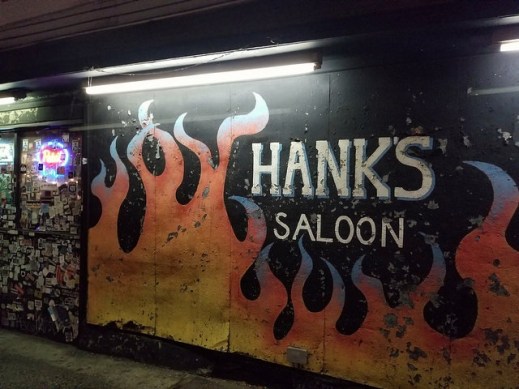
The stars were aligned the right way and we got the band back together. This past Saturday, the 2008 version of my band Blackout Shoppers played five songs at Hank’s Saloon. It was somewhat of a miracle that we managed to play a halfway-decent half set, given that we hadn’t played together in years and didn’t have time to rehearse.
It was good to be among friends again playing music. And it was fitting that we held this fleeting reunion at Hank’s Saloon.
Hank’s Saloon is a quintessential New York institution and it’s a miracle that it’s still standing. That being said, it will be closing down sometime after September, the latest music venue to close up shop.
Hank’s is both a dive bar, a music venue for every type of music imaginable, and a holdover from a past New York era that has managed to live on while its surrounding succumbed to the Brooklyn real estate juggernaut.
Characterized by the flames painted on the outside as well as the band stickers that some reckon are holding the building together, Hank’s is a small place with a concrete floor and a stage that is barely a foot off the ground. Tucked into the back, playing the Hank’s stage is a bit like playing in a cement box. It is hard to see the stage from most of the bar, and the sound can be wonky unless you are close to the stage, but some of the best shows I’ve ever seen or played have been at Hank’s. It is home to many genres of music and like any perfect dive bar, just about anyone can feel at home there.
Hank’s has an interesting history as well. Before it was Hank’s, it was called The Doray Tavern and was frequented by Mohawk Indian ironworkers who were regulars there up until the 1990s.
But late last year the inevitable news came out: Hank’s will be closing after this September. It stands to reason: in today’s Brooklyn anything remotely soulful or authentic is strangled to death by the high cost of doing business. Someone can make more money putting up an absurdly expensive apartment building there, so why don’t they? Good music, which is priceless, can’t often pay the rent.
There was a time not long ago when I would have railed to the uncaring sky about the injustice of it all. I would have felt rage instead of pity towards the naïve hipsters spending their parents’ money on overpriced apartments in the slums their grandparents worked hard to avoid. Instead I am grateful for the good times I have had at Hank’s and other places. I am thankful I was able to play at Hank’s one last time, to enjoy the music and the moment and take a lot of photos.
Hank’s can go out proudly, having outlived most of its competitors in a part of the city that is gentrifying at a dizzying pace. It has a special place in the hearts of New York music fans.
Hopeful lessons from the colder north
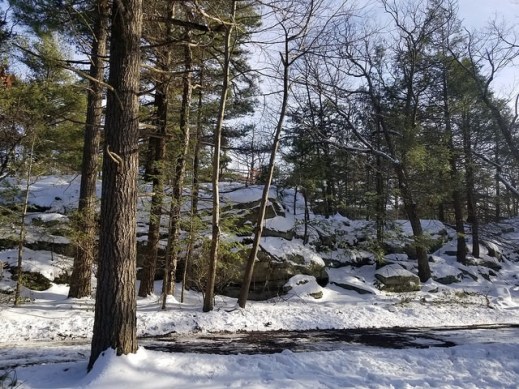
President’s Day weekend has developed into a great family tradition of going to Mohonk Mountain House in New Paltz, New York, which is about an hour and a half drive north of New York City. People who live north of Albany may not consider that upstate but city dwellers have the right to call it “upstate” if it’s one inch north of the Five Boroughs.
Hiking and enjoying the outdoors should be done in all seasons. While it may be tempting to be house-bound during the colder months, too much time in doors will lead to a stifling madness and rotting sloth.
Among the activities there are guided hikes around the large Mohonk Preserve that surround the sprawling yet still rustic resort. Mohonk is surrounded by beautiful wooded mountains. My Father-in-Law and I went on a hike designed to track white-tailed deer. I thought maybe I could pick up some hunting tips that would serve me well later in the year.
We did see some deer tracks and learned a good bit about the eating habits and other behaviors of delicious deer, but there was a lot more to see. Our group’s guide, who is the official naturalist of Mohonk, gave us a lot more information that was useful and some that caught me by surprise. The one piece of information that struck me as particularly hopeful was this one:
When Mohonk was founded in 1869, the founders could look for miles in each direction and not see any trees. Almost all of the surrounding countryside had been clear cut. In the early 1900s, Daniel Smiley, from the family that founded Mohonk, noted the sighting of a porcupine on the surrounding woods, meaning that after 50 years of recovering, the forest was now healthy enough to support porcupines living there.
To see the surrounding countryside now one would think that it has been left in pristine condition since European settlers first came to these shores. But not so. The demands of a growing country took its toll on the natural beauty that we take for granted today, and the beauty of upstate New York is the result of a concerted effort of many years ago.
People fought to rebuild and restore these woods, many of them did so knowing that they would not live long enough to see the full benefits of their work. Today in New York State Adirondack Park is the largest publicly protected area in the contiguous United States, larger than Yellowstone, The Grand Canyon, and the Everglades combined.
It is a sign that with effort and time, we can recover and rebuild. That with enough planning and care, even a ravaged and abused land will recover if allowed. The Earth may be very troubled, but the Earth is also very resilient.
At a time when the country and world around us appears in total conflagration with unending violence and dysfunction, evidence of our ability to renew and improve our surroundings may appear to be in short supply. But the verdant areas not far outside our teeming metropolis is a point of evidence that people living in divisive times can still unite and do great things that will pay off for future generations.
The essential conundrum of Times Square

News came out this past week that the company I work for will be moving all of its New York offices to Times Square, where we already have a flashy facility. It will be a big to-do with renovation and creating an office of the future and I’m sure the office will live up to the hype and it will be great for the company.
There’s everything to love about it but it means having to work in Times Square, which is both a blessing and a curse.
Times Square has undergone a complete 180-degree transformation over the last two decades. In the mid-1990s, it was still famous for its crime and pornography. I remember walking through as a kid and marveling at the graphic photos advertising the pornographic films, the barely-censored photos of naked women you tried to look at while pretending to ignore.
Times Square today is a tourist mecca that glows with the false light of a thousand larger-than-life screens and signs. It is a backdrop to television shows, a center showpiece of a city that crawled its way out of the financial and social gutter to become a well-regarded metropolis of the future. It’s found a way to personify the state of the five boroughs within its blocks. When New York was in a state of decay, Times Square reflected that. Now that economic interests have invested for the future here, Times Square reflects that also. Whether you love it or hate it, it is our city’s barometer.
Like much of the conversation today surrounding questions of the changing character of New York City, the gritty past tends to get sugar-coated. While I prefer watching pornography to shopping for Disney trinkets, the Times Square of today is no doubt better for New York City and a proud measure of our progress over crime. (Keep in mind that the tremendous makeover never completely washes out the criminal element or the sub-strata of sleaze or grit. There are still plenty of con artists, prostitutes and drug dealers making money in the Times Square area.)
Times Square’s success as an attraction for visitors makes it less appealing for local residents. Slow-moving foot traffic is maddening for someone trying to get to work. Long lines of people at overpriced tourist traps do not make for suitable lunch spots. Friends who have worked in Times Square report that some of the potential upsides, such as going to the office to watch the ball drop on New Year’s Eve, are foiled by strict rules, often dictated by security concerns.
But as with the rest of life, working in Times Square will be an opportunity to adapt and overcome. I’ll find the good lunch spots to go to and I’ll figure out how to move in and out without being caught up in mobs of plodding tourists. Being a New Yorker means being able to find the right path through adversity and make inconvenience into something triumphant.
The midtown canyons of concrete and glass will be calling for me within a year’s time. It will be another chance to embrace the chaos of living in New York, and make a new path to life in the city.
Super Bowl Hype Has Run Aground

I had every intention of watching the Super Bowl this past Sunday but life got in the way.
Being a New York Jets fan, I have no real reason to watch the N.F.L., but believe it is a major current event that bears witnessing to be properly informed, not that one needs much of an excuse to sit and eat and watch TV. Also, in keeping with a tradition I had with my mother (RIP), my brother and I have decided to make a bet on the Super Bowl every year. My brother is a die-hard Patriots fan, so the bet was easy to make. I bet on the Philadelphia Eagles to win; the loser buys the other lunch.
As a New Yorker, I should despise both teams. The Patriots are cheating panty waists. They even cheated against my Jets, which is like cheating against people from the Special Olympics. Nonetheless, like the arrogant Dallas Cowboys of decades past, they have become the dominating franchise with numerous Super Bowl victories. The Philadelphia Eagles have been the hated rivals of New York football fans for decades. There’s something about Philadelphia fans absolute violent savagery and dedication that is endearing. They went into the game as underdogs.
Until I went to college, I could not see the use or interest in football. It is a slow game with rules that are not easy to comprehend (wait, they have to kick it again already, what happened?). Sports in general failed to arouse my interest as a kid. Why invest so much into a game when you could be out shooting bad guys or doing karate on people. I prowled around with toy guns, back when you were allowed to have realistic-looking toy guns, and pretended to hunt Russians or terrorists. I would rather practice being a bounty hunter or future warlord than try to remember a bunch of rules that made no sense. Sports seemed a poor substitute for real adventure in the world.
In college, sports made more sense. The athletes represented our school in the most primal, tribal way, and supporting the team was something that could bring even the most politically fractured college campus together.
So this Sunday came and I figured I would turn on the Super Bowl and it would be in the background while I had a regular Sunday with the family. The game was supposed to start at 6:30 p.m. Eastern time, and we knew that Pink was going to be singing the national anthem.
At the appointed time, we told our children that “Pirate Pink” would be singing on television soon. Our children know the singer as “Pirate Pink” from her appearance as a pirate on “Sponge Bob Square Pants.” But something went wrong. We turned in to the Super Bowl when it was supposed to start and they were actually starting to play football? What happened to the 45 minutes of bullshit before the actual game? The coin toss, the national anthem, the endless displays of hype and patriotism? We only have one TV in our home and I was banking on Pink’s appearance to make the transition from “Doc McStuffins” to football; no easy task.
As the actual Super Bowl got under way, my older children began to cry over missing “Pirate Pink” sing on television. I was the worst Dad ever. I made my chicken dip and enjoyed dinner with the family while watching “The Simpsons,” which is the only TV show we allow to run during meal times regularly.
I was glad to miss the game because I tend to jinx many teams that I watch on television. When the New York Yankees were in the World Series against the Atlanta Braves in 1996, I watched the first two games and the Yankees were crushed. I quit watching entirely and the Yankees won the next four games and reclaimed the crown as world champions once again.
Since then my not watching sports has helped my preferred teams. This year was a year I missed more Georgia Bulldogs games on TV than in recent memory, and they had their best year since 1980, making it all the way to the national championship game. Go Dawgs!
It was social media that informed me that my not-watching mojo had helped the Eagles win their first Super Bowl.
Congratulations Philadelphia. Please don’t burn your city to the ground.
 Matthew Sheahan
Recent Comments