
Latest subway brouhaha misses the point
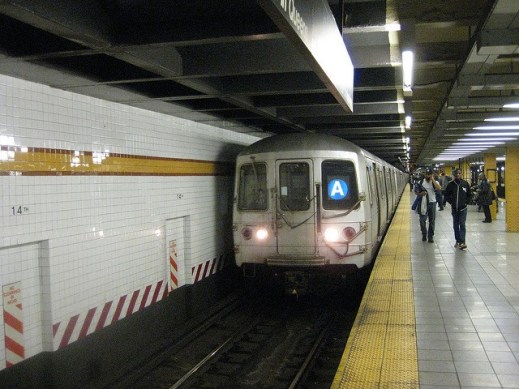
Citizens voiced criticism of the police when a woman selling churros was handcuffed by NYPD officers at the Broadway Junction station in Brooklyn.
The police said the vendor had been issued several citations and had refused officers’ orders to move. Also, the vendor was not officially arrested, but briefly handcuffed and issued a citation. Whichever way you cut it, “the optics” as we say in the public relations world, were bad.
In the scale of subway scofflaws and annoyances, the Spanish-speaking women selling churros don’t register at all. The churro ladies usually stay out of the way of foot traffic and sell delicious homemade treats at a good price. They don’t loudly beg for money from strangers or drag their carts through crowded subway cars at rush hour.
Why aren’t the police clearing out the homeless who can render entire subway cars unusable? Why aren’t we seeing more photos of the brain-addled aggressive panhandlers being put in handcuffs, or the people bringing bicycles or in some cases, motorcycles onto the subways being given the heave-ho by New York’s finest?
I get why the MTA wants to crack down on subway fare beaters, but they are avoiding the bigger, harder issues that makes a bigger difference in the deteriorating level of subway service that arouses the ire of straphangers.
Subway riders are furious because the subways are terrible. There are frequent delays and overcrowding on the subways, trains and buses that never show up, and service that is sub-par even when going according to plan. Almost all of the lines have outdated signaling systems that frequently stall trains and the MTA is decades behind replacing them. People have missed job interviews, meetings with loved ones, and even their own college graduations because the MTA’s inexcusable performances.
The transit system has singled out the people who jump the turnstiles and don’t pay their fare as a major issue to be addressed. Indeed the agency reported that these freeloaders could cost the system more than $300 million this year. Its approach to fixing this problem has been typically ham-handed. It spent money on signs and stickers telling people not to use the exit-only emergency exits to leave the subway, as it enables people to run in through the open door to avoid paying. Such a campaign could only be designed by people who don’t actually ride the subway. The subways need more exit-only gates. Taking up turnstile space to leave only stalls people who are rushing to get on a train. People who leave by the exit only gates and the emergency exits while people are trying to get in are doing the right thing. All these stupid stickers and signs do is flush money down the toilet that could be used for upgrading the system.
While fare beaters certainly do account for a major shortfall in the MTA’s budget, but it is small potatoes compared to the larger underfunding issues that require a political solution. It will be a hard-fought battle between the city and state governments, and will take years to make right. It will include unpopular tax increases.
No doubt there should be cost cutting. Why does track construction cost many times more in New York than anywhere else? Why are there thousands of no-show jobs on the books every time we want to build some new track in New York? Solving these issues of construction corruption and graft will go a long way to improving our transit situation, but it still can’t entirely address the funding gap.
This central funding question is the one the MTA needs to tackle first. Without adequate funding from New York State, all the other ideas are impotent half-measures that will drive more outrage than revenue.
Early voting comes to New York City

The old adage of “vote early and often” is at least half true now in New York City, as the city has instituted early voting this year. This past Saturday the 26th was the start of an early voting period leading up to the Tuesday, Nov. 5 election day.
The last few election cycles have shown us that no corner of the country is immune from serious voting issues. The mid-term election of 2018 was the first time I saw this voting chaos first-hand in the five boroughs. I voted early in the morning, when there are usually fewer people around and voting should be smoother, and there were already difficulties handling the moderate numbers at the polling station. That only got worse as the day wore on, and reports of long line and other logistical issues were crossing the wires by midday.
The mess of the 2018 election caused a series of reforms in New York City around voting, one of them being instituting early voting.
Early voting has been a solution adopted by other states. It encourages participation as many people who work (just about every single voter) often find it hard to take time off during a busy workday to vote, and this has become increasingly difficult as larger turnouts have overloaded polling places across the country. It’s an idea that is long overdue in being implemented, and many states began making this change in the wake of the 2000 presidential election difficulties. Early voting is friendlier to working families and make it more difficult for voter suppression tactics to rule the day. It also helps reduce some of the voting chaos by alleviating some of the crowding of Election Day.
It is wise to start early voting this year. Whatever goes wrong can be corrected in time for next year, an election year that promises a very large turnout. This is not a big election year in New York – there are no Congressional seats up for a vote, a special election for one City Council seat, and only one city-wide election for public office (for Public Advocate), as well as a smattering of ballot initiatives that rarely generate significant turnout or excitement.
So far there have been two major kinks in the city’s early voting: 1. In many cases the early voting place is not in the same place as the regular polling stations, and this has not been widely explained. 2. Some early voting locations that are located in schools gave those schools very short notice that their gyms or cafeterias were going to be off limits for a few days.
Another shortcoming of the early voting so far is the notices sent to voters. Usually the city sends a document that includes a detachable card that has all the relevant voter information on it: where to vote, what district you are in etc. The card sent before early voting has none of this, but does have a scan-able bar code on one side.
In a democracy, voting is a serious obligation for people who wish to remain free. The ballot box is our first defense against tyranny, our first step in making change, and the ultimate check and balance for people in power to be held accountable. By giving us more time to do it, this important duty is easier to execute. Whatever the faults of the city’s first attempt, it is a noble attempt and deserves our support.
Vote early.
A journey through the MTA’s lost and found
Earlier this summer, I arrived home late on a Friday night—late these days meaning after 8 p.m.—and was taking things out of my pockets after a long day. When I reached into my right front picket, I came to the realization that I did not have my wallet. My stomach tied in knots and I cried out in frustrated desperation. I knew it had been in my pocket; there would be no deus ex machina miracle of finding it in my bag or in another pair of shorts.
I knew that it most likely fell out of my pocket on my commute home. I had just gotten off the express bus—this bus was still on the road and someone could radio the driver! I immediately picked up my smart phone and dialed 311 for citywide information. The 311 operator would be able to connect me to the right person. The 311 operator transferred me to 511, which is the information number for the Metropolitan Transportation Authority (MTA).
After a few more transfers, I spoke with someone I was told could help me. I gave them all the information I had. I was on a QM20 bus and was picked up from 6th Avenue and 42nd Street in Manhattan at approximately 8:40 p.m. and was dropped off at Union Street and 26th Avenue in Flushing, Queens at approximately 9:30 p.m. This driver was probably still on their route and with the information I had given them someone should be able to get in touch with the driver ASAP!
But no such luck. The person on the other end of the line said they could not do anything unless I had the bus number. Without the bus number, they could not contact the driver. Seems a bit ridiculous. If this had been a more serious situation and people’s lives depended on finding the bus, there would have been a catastrophe.
I was asked to call back the next day after the bus had gone back to the depot and the driver may have turned in the wallet. It was a small wallet, one that held only cards. I was not out any cash, unless someone was going to town with my debit card.
I started to call credit card companies and my bank to have holds put on cards.
The next day I called the depot. Nothing.
I called back the next day, and called back later in the day again. Nothing still.
I went through with canceling and replacing my credit cards and ATM card and replacing my driver’s license.
By Monday, there was no funny business on my cards and new ones were on the way. I printed out a temporary driver’s license and ordered a new card wallet that came with a money clip. My card wallet needed replacing anyway, and this was a chance to pare down the stuff I carried with me everywhere.
A few weeks later, the same day my new driver’s license arrived in the mail, a notice from the MTA Lost & Found arrived in the mail.
“An article which contains your name and/or contact information was found and turned in to the MTA NYC Transit Lost Property Unit,” the notice began. It instructed me to report to the unit’s office at the 34th Street subway station at 8th Avenue in Manhattan. If I did not claim my property by Nov. 3, “it will be deemed to have been abandoned and you will have forfeited your right to claim it.”
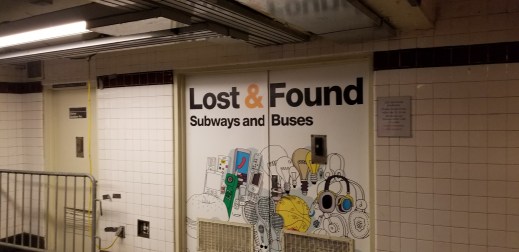
The next day I brought that notice and my newly replaced driver’s license to a hidden-in-plan-sight pocket of the 34th Street subway station in Manhattan. It took some searching and asking to find the lost and found office, which is beneath the tracks of the A, C, E subway lines and without any signs leading you there except in the immediate vicinity. It’s within the subway system, so if you arrive by some other means or exit the subway before you find it, you’ll have to spend another subway fare to reach it or get a helpful MTA worker to let you in.
A small sign points the way to a set of double doors painted in celebration of the many objects found in our transit system. The office is open odd hours—and completely closed weekends and holidays, a travesty in a system that runs 24 hours—but luckily is open until 6:30 p.m. Wednesday and Thursdays.
Inside is a small room with a very low ceiling. I’m five feet eleven inches with my shoes on, and if I had extended my arm fully above my head I would have punched a hole in the drop-down ceiling. There is a metal bench to sit on, a small counter to stand and fill out paperwork on, two old-looking computer terminals, and a thick window above a pass-through door through which one may conduct business with the MTA workers on duty.
I arrived as a worker emerged from another set of doors to hand someone some paperwork, and she took my notice and ID and disappeared in to the bowels of the lost and found. The woman who was there spoke to someone at the window and was told to check back about her property later. She left and another woman arrived to ask if a book she lost on the subway was found. She was told no and to check back later; she left. Another man arrived and looked through his paperwork to check on a claim, and while he was speaking with someone another woman arrived to check on some property she had reported missing.
A worker arrived at the thick window with my wallet. It was a different worker than I had given my notice to; it was a rotating staff of workers answering questions and handling forms. He told me to sign my name on another form and write my address the same way it appeared on the notice in the mail. He opened the door to the silver box under the window and placed a clip board inside, and when he closed his door I opened mine and filled out the form.
A minute later, the same exchange reunited me with my wallet. It looked a little worse for wear, but nothing was missing. Everything was there: my license, my ATM card, my MTA MetroCard, even the coupon for a t-shirt at the zoo. I excitedly took an inventory of my wallet while my fellow transit visitors looked on amazed.
“You give me hope,” said the young woman sitting on the bench, hoping her property would be returned.
I thanked the worker and wished the other people in the office good luck, and went back out into the bustling station. For me, lost and found had worked out well.
Thank you to the Good Samaritan on the bus who turned in my wallet, and the series of honest MTA workers that made it possible for me to get my property back. For me the stars aligned this time.
The proud refuge of Doc Holliday’s

A few weeks ago, my band was fortunate enough to be asked to play music in Tompkins Square Park. The four of us arrived punctually (an impressive feat for an old-school punk rock band like ours).
The sun was blazing but standing in the shade brought sound respite. Having consumed copious caffeinated beverages in transit, I headed for where I knew the public restrooms were located.
The men’s room was locked. A nearby restroom was marked for use only by children. It was also locked. Park workers admonished men looking to use the boys’ restroom, and referred people to the closed men’s room even after being told it was locked. A Parks Department employee told me to use bathrooms at a nearby Starbucks or 7 Eleven, and acted as if she were doing me a favor.
Nearby on Ave. A and 9th Street, there was not a Starbucks or 7 Eleven in sight. Doc Holliday’s was open though.
Even though I long ago left the drinking life, I had the good fortune to drink at many of New York’s most excellent bars before I did. Doc Holiday’s is one of the East Village’s surviving dive bars that did not sell out or lose its character, and has stayed the same quality dive bar that it was meant to be.
As the name implies, Doc Holliday’s could be called a country bar. While by that measure it could easily be lumped in with other “country” bars such as the now-defunct Hogs & Heifers, it’s a bit more subdued and nowhere near the same kind of tourist mecca. It may be a far cry from where David Allen Coe would drink (if anyone knows where David Allen Coe goes to drink when he’s in New York, please tell me), but it’s the closest thing to a country dive bar surviving in the city today.
When a cheesy movie came out about rival bar Coyote Ugly in 2000, Doc Holliday’s celebrated the fact that its name was not associated with such a flop. They had several drink specials and posted scathing movie reviews of Coyote Ugly on the walls of the bar.
For a while when I worked in SoHo, I would bring coworkers to Doc Holliday’s for beer—after the after-work beers we had at work, of course, and it never disappointed me then. I would be one of the last of my party to depart, stepping strongly buzzed into the bright twilight of a New York Friday night, ready to conquer the world some more.
About 10 years later, when I decided to leave the bogus “secret restaurant” located in Crif Dogs rather than take off my hat, I went to Doc Holliday’s where friends were waiting. Three boroughs and many, many drinks later, I made it through that night with few memories but few regrets.
But now I was returning to Doc Holliday’s as someone gone from the drinking life nearly a decade, a frustrated park goer unable to find a decent bathroom. Would I be welcome back to this hallowed place where I had spent so much quality time in the past?
The bartender was chatting with three people at the bar and the place was otherwise empty. There was no crowd to blend into if I pretended to be a customer. She looked to me, expecting me to order a drink. I decided to come clean and admit I was there just to go to the bathroom. I explained my situation to the bartender. Could I use their bathroom?
The bartender told me yes and thanked me for asking. I walked back to where the bathrooms were to find that Doc’s had done some remodeling and the restrooms were not in a state of filthy disrepair. By dive bar standards the new men’s room was pretty luxurious. I left a five-dollar bill on the bar in my way out and got a friendly smile.
I returned throughout the day and was warmly greeted. It was good to be welcome and enjoy the dive bar scene again. Even removed from the drinking life, our bars are cultural markers that can offer a guide to the state of society. Doc Holliday’s confirms there are some pockets of righteous goodness left in our city.
Punk rock in Tompkins Square Park

This coming weekend two free punk rock shows will be held in Tompkins Square Park in New York City’s East Village.
The shows commemorate the Tompkins Square Park riot of 1988, when police clashed with squatters, homeless and others that had been camping out in the park. Accounts of that night very but few dispute it involved widespread police brutality. Police lined up on the street for an extended period of time before moving into the park, and they were subject to sustained abuse by activists that did not want them there and saw them as agents of a landlord-controlled city that (to this day) lets property go abandoned rather than occupied while working people struggle to pay rent.
The riots were one of the first instances of widely-publicized videos of reported police misconduct thanks to the efforts of East Village video archivist and neighborhood stalwart Clayton Patterson. His videos showed police covering their badge numbers and chasing down protesters and beating them without arresting them. “Little brother is watching big brother,” he told Oprah Winfrey.
The 30-plus years have done a lot to change the East Village. Tompkins Square Park is no longer a homeless encampment or open-air drug market; it is now a safe place you can bring children. The abandoned buildings and art spaces that were abundant in the late 1980s have been replaced by high-end restaurants and expensive homes. The story is the same throughout the city.
It would be useless to pretend the East Village is the same, but it would be a disservice not to commemorate a scene that produced great art. Even if the crucible that created an esteemed body of art is long gone, the art does not get thrown away. I’m happy that feudal Italian city states no longer wage war on the Italian peninsula, but the art that survives from this period is among the finest in the civilized world.
The scene may be over, but the art endures. So let it be with punk rock. Though please don’t think that punk rock is over or that new generations don’t have the same legitimacy as the old-timers that were there when New York was a shithole. There are excellent bands playing in the city today, comprised of young people who were not born yet in 1988, and they are as punk rock as anyone else.
And the East Village is still a home for punk rock. The Bowery Electric, located a short distance away from where CBGB once stood on the Bowery, still hosts great punk rock shows. Niagara, which his located where punk rock club A7 once stood, has started booking hardcore punk concerts there regularly again.
And free punk rock still reigns in the park. Full disclosure: my band Blackout Shoppers is scheduled to play the free punk rock show in Tompkins Square Park this Sunday, Aug. 4, with The Voluptuous Horror of Karen Black, Hammerbrain, Porno Dracula (one of the greatest band names ever, but please don’t Google them at work), Jennifer Blowdryer Soul Band, Ruckus Interruptus, and Young Headlight. Saturday the 3rd hosts the first of the two-part series with Disassociate, the Nihilistics, Rapid Deployment Force and more.
Blackout Shoppers have been rehearsing and sounding good, even judging by my overly critical, curmudgeonly ears. We don’t play as often as we used to and it’s a blast when we can get together and play a show. It was touching when people came out to see us last year when we bid farewell to Philthy Phill of World War IX. We don’t want to wear out our welcome, but we are playing more shows this year than we’ve played more recently and it feels good to be out there being loud.
See you in the park this weekend.
Blackouts in a changed New York
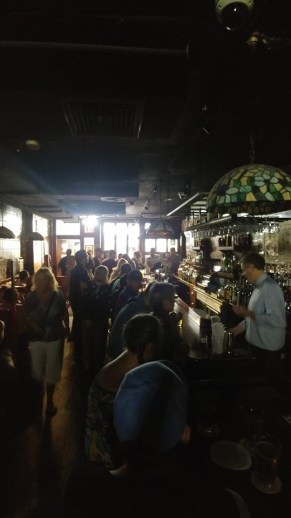
This past Saturday I noticed a friend posting on social media from the dark interior of one of Hell’s Kitchen’s finer dive bars, Rudy’s.
“Uh-oh. Power’s out. Better drink all the beer before it gets warm.” That was the caption accompanying a photo of business as usual on a busy Saturday night at Rudy’s. There was never a lot of interior light there to begin with, so one had to take her word for it that there was a blackout.
A little while later, a message from work indicating a “Code Red” situation—the company’s building in Times Square was without power and this was a problem. I scrambled to join the emergency communications line, only to be told there were enough people working on this already, I could drop.
News reported that the West Side of Manhattan and a significant portion of midtown were dark. This was a major event though it was small potatoes compared to previous New York City blackouts. It was short-lived as well. By 10 p.m. power had been restored to much of the affected areas, and my employers’ building in midtown had power again but was still waiting for electricians to arrive to make sure everything was up and running.
The cause was not immediately known and Con Edison does not have a great track record of accountability when these things do happen. Several years ago, a significant portion of Astoria, Queens was out of power for an extended period of time. Sadly, an outage in Manhattan generates greater news coverage and more intense scrutiny.
New York City suffered a blackout exactly 42 years ago to the day of the one this past Saturday. On July 13, 1977 a blackout hit New York City and was the scene of widespread looting and arson.
Seventeen years ago this August marks the anniversary of the 2003 blackout that darkened a significant swath of the Northeastern United States. I was downtown getting ready for a late night of editing at work and wound up taking a 12-mile walk home over almost the entire length of Manhattan. Although incidents of looting were underreported, they were indeed rare and the peaceful evening rush hour and dark night was a testament to the transformation that had happened in the years since 1977.
Even after walking 12 miles to get home in crumbling shoes that blistered my feet, I walked around my neighborhood of Inwood in Manhattan, amazed at the peacefulness of the city at such a time. People played dominoes in the moonlight near the Dyckman Farmhouse, and the sound of steel drums and street parties filtered up from blocks away.
Power outages serve as a barometer of where New York resides along the lawlessness spectrum. Are we close to widespread chaos or will the line hold during a night in the total dark? The Manhattan blackout of July 2019 showed we are holding the line for now.
It was a relief to find that New York has not regressed to the point of making our blackouts more of the 1977 variety. But that question will always linger in the back of New Yorkers’ minds, and maybe we should get to a point that it shouldn’t be there at all. How much has to be done to create that city, that country, that world, and will we ever get there? And what is being done to make sure that we don’t lose power during critical summer months?
A relieved city needs those answers.
Taxi scams are born anew
Technology continues to advance and change our world, human nature does not change. Technological advancement does not mean moral advancement. While we can summon a wealth of information in less than a second, the human race isn’t applying this knowledge in a way that makes our world any more just and fair.
And so it is with our taxi cabs. While technology enables us to hail cabs, it has not improved the ethical standards of drivers or riders. I have seen this illustrated across our city in several ways, but most vividly this past week.
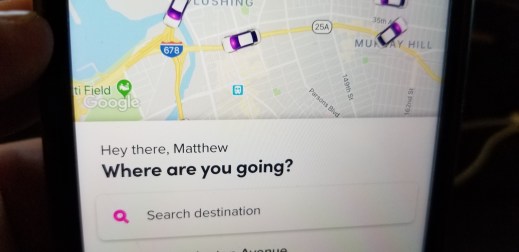
It was after 6 p.m. and since I was out of work late I wanted to waste no time in getting home. I was in downtown Manhattan and the traffic looked painfully slow. I positioned myself near a street corner so a car could make a quick exit off of a bumper-to-bumper Broadway. I requested a ride from Lyft.
I got a call from the first Lyft driver.
“Hi this is your driver from Lyft, can I confirm where you are?”
“Yes. I am at Broadway and Worth Street. I’m a bit before Worth Street so you can make a left and get out of this terrible traffic.”
“And can I confirm where you are going?”
“Flushing, Queens,” I said truthfully.
A few seconds after our call ended. I saw that the driver had canceled my ride and the mobile app was searching for a new driver for me.
I also realized how I had made a terrible mistake. One of the features that is supposed to make ride hailing services better than hailing cabs on the street is that the application does not tell the driver where you are going until they confirm on their device that you are in their vehicle. This stops them from cherry picking rides the way yellow cab drivers do, asking passengers where they are going before they get in the cab, so they can avoid taking fares to destinations they don’t like.
Ride hailing drivers subvert this system in two ways: they will pull over and confirm on their device that you are in the cab when you are not, and then canceling the ride before you get to them. And, like they did with me, they call you and ask where you are going and then cancel the ride if they don’t like what you tell them.
The second Lyft driver called a few minutes later, doing the same thing. I didn’t tell them, but it didn’t help anyway.
“Can you confirm where you are going?”
“I’m on Broadway and Worth. I’ll see you soon. Are you nearby?”
“Yes. I am at Broadway and White Street. I will be there soon. … Can you confirm where you are going?”
“That’s a great question. I’ll confirm when I see you. And I’ll see you soon,” I said with the friendliest confidence I could muster.
My phone soon indicated that this driver had canceled as well, and now I had to start the request for a driver all over again. And guess what? The price for a ride was now about $20 more than when I was first looking for a ride. This made me livid but I was too tired to get worked up about it, and besides, I would have been mistaken for a crazy person, shouting at my smartphone in the middle of Broadway as downtown traffic slowly crawled by.
The third driver arrived and completed the trip. With all the shady driver shenanigans, I probably saved no time in getting home and would have been better off taking a subway or express bus.
A friend who is a yellow cab driver broke down the one issue he may have with taking fares to the outer boroughs: if it’s towards the end of his shift, he faces late fees if he brings his cab back to the garage late. That’s the only time he picks and chooses his fares, and he recommends reporting those drivers that won’t take customers where they want to go. My friend is exceptionally good at what he does, and even lets passengers know when they can get somewhere faster using public transit. I had one Lyft driver tell me that in Maryland recently, and I much appreciated it.
In a few short years, the drivers at ride-share services like Uber and Lyft have perfected many of the repugnant practices that sent riders away from yellow cabs to begin with. Ride-hailing service drivers are known to cancel rides in time to take advantage of surge pricing times. No-show cab drivers can still saddle would-be riders with $5 cancelation charges which are difficult (though not impossible) to fight through the companies’ Web sites. And yellow cab drivers are left in the lurch, many of them deeply in debt with loans for medallions that they may never be able to pay back, a situation regulators ignored.
At the same time, ride sharing services are in greater demand, since our public transit system is so rotten to the core the subways lines can be delayed even by an overflowing toilet.
As with yellow cabs, remain vigilant when you are taking one of the raid hailing services. What looks like a minor inconvenience could be another scam.
Congestion pricing will not fix our subways

New York is a city of many firsts. It was the first capital city of the United States; it had the first hot dog, first American public brewery, ATM, mobile phone call, and children’s museum.
It also promises to be the first American city to institute congestion pricing on cars driving into its busiest areas. Although these fees are not expected to take effect until 2021, it could cost motorists up to $10 to drive into Manhattan below 60th Street according to a plan expected to be passed April 1 as part of the New York State budget.
It could mean as much as $14 for a car and more than $20 for a truck going into Manhattan. That’s likely going to be on top of heavy tolls already paid to take the bridges and tunnels needed to get into Manhattan in the first place. Cities such as London and Stockholm have instituted congestion pricing and it’s considered a success there, but those cities have more viable public transportation.
New York City has one of the most comprehensive public transit systems in the country, and that’s more of a statement on how sorry the U.S.’s transit system is than a compliment to New York.
The politicians that are advocating for congestion pricing are doing so because they don’t want to do the hard work it would take to fully fund the M.T.A. It means possibly raising taxes and definitely raising fares. It means significantly reforming construction policies to reduce exorbitant costs. Governor Andrew Cuomo and Mayor Bill de Blasio, who despise one another, agree 100% that this is a good idea, which is as good a reason as any to oppose it.
People are turning more to cars because public transit is so unreliable and unpleasant. I once worked with a man who had health issues and had to go to the Bronx every other day from work in order to have kidney dialysis done. He took a cab there because he couldn’t be late and his health issues meant he couldn’t be wedged into a subway car with a few hundred of his closes friends. He was able to get some of his cab fare subsidized, but that’s money that could have been spent elsewhere if we had a reliable transit system, and it’s on the backs of people like my former coworker that this new tax is going to be balanced.
I would rather not spend about three times the regular fare to get to work, but I know I need to be on time to work and not on the cattle car that passes for the 7 train these days, so I splurge for an express bus. It’s still a lot less than a cab but more expensive than a regular subway or bus fare.
Congestion pricing is going to cost the people who can afford it the least: cab drivers or people who have their spouses or friends drive them to work or who are carpooling like good citizens. There will be a significant portion of people who will avoid paying it using the same schemes that work with the now toll-booth-free tolls and red light cameras.
We will fight this out in the press and in the courts until congestion pricing becomes the law of the land or not. But all that will be time wasted building the political capital, civic will, and thoughtful plans needed to truly fix our transit system.
The mystery commuter on the QM20 bus

For about a year and a half, I have commuted to and from my job in Manhattan using an express bus, a more expensive but comfortable coach bus run by the Metropolitan Transit Authority.
Most of the bus drivers who drive these buses hustle to get us through traffic and make good time getting into Manhattan from the Eastern reaches of Queens. A meek or extremely defensive driver is going to fail at driving and express bus, and fail hard.
And that’s been happening recently in the early morning on the QM20 line. One driver I have not seen but only heard about, an older gentlemen, is a slow-paced driver that is content to hang in the slow lane of early rush-hour traffic while his passengers fret about reaching work on time. I have spoken with people who have stopped riding the 6:45 bus because they cannot get to work on time if they ride it. In fact, the 7 a.m. bus routinely reaches Manhattan sooner.
Because the driver of the 6:45 a.m. bus is such a pathetic slowpoke, passengers that used to take that bus now flood to the 6:30 bus. There are now at least three times as many passengers waiting at the bus stop for the bus I take, which means the other stops are all more crowded as well. I used to be able to find a seat all to myself with regularity, now it’s nearly impossible.
Yet still people insist on putting their bags on seats, even knowing that they’ll have to move them at some point. It’s a gamble on their part, they’ll possibly get the seats to themselves if enough passengers decide not to ask them to move. I usually make it a point to make these rude people move their bags, though if they are an exceedingly large person then I will often pass them by because I’m a large person also and then we’re both crammed into our seats seething and miserable. There is one rude fat bastard on my bus line who does this without fail and sits in corpulent luxury every day.
Sometimes I’ll choose people who are polite and thin because I’ll have more room. There’s a man who uses his time on the bus to sketch drawings and I feel camaraderie sitting next to someone interested in the arts, even if I never talk to him.
This past Monday however, there was a mystery man and I felt I had to sit next to him. By mystery man I mean someone who had a black wool hat pulled down all the way over his face. This was not a ski mask (aka balaclava), but just a hat that normally sits on top of the head and over the ears. He had it pulled down all the way over his face, so that his head was just one monolithic orb of woolen darkness.
I was appreciative of the aesthetic and felt a kinship to it. I often wear a ski mask when I perform in bands, and have enough ski masks at home to clothe a paramilitary battalion for a decade. So I sat next to this man. He was a bit spread out but I managed to get comfortable enough and read the news on my work phone. I didn’t want to see the man’s face, wanting his mystery to be kept for all eternity or at least until the weather was warmer and one would have to be psychotic to wear a winter cap. But no, soon after we rolled into Manhattan the man woke up and pulled up his hat revealing the countenance of a middle-aged commuter.
I don’t know where the man departed the bus. I got off at my usual stop at Herald’s Square and made my way downtown, hoping to engage with more of life’s mysteries as the day wore on.
Amazon on the East River

The skyline of Long Island City is a glowering army of glass and steel. As the 7 train crawls its way into the Queensboro Plaza station, commuters see buildings under various stages of construction. Many of these are high-priced residential towers boasting views of the Manhattan skyline and closeness to one of the subway lines that run though that part of the city.
The housing boom has moved high tech professionals to Long Island City – it’s a short commute to Manhattan and is still plenty cosmopolitan and relatively young and new. A largely industrial area until things began changing two decades ago, there is still a lot of charm that sanctifies Long Island City with the Whitmanesque aesthetic lacking in Manhattan and much of the more popular areas of Brooklyn.
So it was with a twinge of disappointment that New Yorkers learned that Long Island City was going to be home to one half of Amazon’s “HQ2,” or second headquarters. The city government bent over backwards to bring Amazon to our teeming shores and actual New Yorkers are right to be pissed off.
Full disclosure: I am an Amazon Prime member and I have several books available for purchase on Amazon. The Seattle-based retailer is the goliath it is because it championed online commerce before anyone could make money from it, and they made online shopping easy. I know I can go to Amazon and knock out a good portion of my Christmas shopping in a matter of minutes. So while I may heap some well-deserved hate on the company for its tactics and practices, I can’t deny the company has earned its dominant place among online retailers.
But Amazon engaged in a very slick and underhanded game. Putting out the notice that it was looking to build a large second headquarters in an American city, municipalities fell all over themselves to woo the company. Cities and states handed over reams of data they hadn’t provided to any other corporate caller on infrastructure, industry, demographics and economic forecasts. Amazon has yet another leg up on any and all remaining competitors. More than that, Amazon fielded offers of tax breaks and other lucrative pledges that would embarrass Tammany Hall. And in the end, none of these overtures may have made a difference. The factors that attracted Amazon were there long before the overtures of tax breaks.
Long Island City in Queens, New York and Crystal City, Virginia were the big “winners.” What exactly did they win? In New York’s case its nearly $2 billion in lost tax revenues thanks to guarantees made to the company, in addition for helping to build a helipad.
New Yorkers didn’t exactly break out the champagne to learn Amazon was coming to Queens. 50,000 well-paid tech workers means that already high rents and real estate prices will go up even farther. It means our already overloaded and dysfunctional subways and commuter railroads will be getting that much more crowded. It means more crowded classrooms in public schools, a bigger scramble for resources, and an infusion of shallow West Coast tech culture in our beloved Gotham. The specter of the big tax giveaway had people agreeing that this era of corporate toadying on the part of our political leaders had reached its nadir, especially in a city and state run by Democrats. Even the conservative National Review, no bastion of corporate-bashing Commies, agreed with Democratic Socialist Alexandria Ocasio-Cortez that Amazon’s corporate welfare is wrong.
New York City doesn’t need to play this game. The city makes itself attractive by investing in its infrastructure and working to keep the standards of living high. That means we lock up criminals, keep homeless people off the streets and subways, and make sure those subways are no longer dysfunctional. That’s a lot we have on our plate, and we can’t afford to give away billions in tax breaks.
Let Amazon build its “HQ2” somewhere else if they don’t like paying their taxes. But don’t blame Amazon; New York and Virginia offered them sweet deals and it took them. Amazon didn’t make anyone beg them to come to their city. Our political leaders did that to us, figuring the win of wooing Amazon’s office was worth whatever Faustian bargain they had to make to get it done.
It wasn’t Jeff Bezos who sold New Yorkers down the East River. It was Bill de Blasio and Andrew Cuomo.
Punk rock’s champion leaves NYC
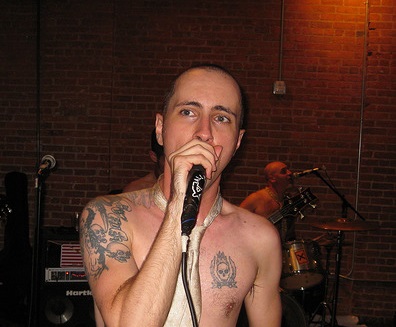
I knew it was a possibility; he had told me about the idea. But when I got word from Philthy Phill that he was leaving town I was still shocked.
Phill Lentz, better known to the New York punk rock world as Philthy Phill, is the singer for World War IX. He’s much more than that though. Over the 13 years he’s been in New York he’s excelled at stand-up comedy, writing, podcasting, concert organizing, and being a creative jack-of-all-trades that would be the envy of most Big Apple newcomers. He’s conquered New York City without losing the Midwestern disarming charm and good humor that drew some of this town’s finest musicians, artists, and comedians into his orbit.
I first got to know Phill when he was the lead singer in a band called Sexual Suicide. His singing style captured the necessary aggression of the genre while also displaying a keen sense of humor; a you-are-being-subjected-to-our-noise-but-we’re-in-on-this-together vibe. Bands with no sense of humor are miserable to watch. If you had any doubts about Phill’s take on things, the highlight of any Sexual Suicide show was when Phill would put on a Spider Man mask and sing a song about performing cunnilingus on Mary Jane Watson.
He came to New York City from the suburbs North of Chicago in 2003, following a girlfriend who had moved here. Three years later they broke up and he considered moving out of town at that point but decided to stay and drown his sorrows in punk rock.
Phill not only sings but also plays guitar and drums. Over the years he has served as the drummer for Joey Steel and the Attitude Adjusters, the Misanthropes, and toured Canada and Europe with the Scream’n Rebel Angels. I was fortunate to play with him in New Damage.
Phill wrote a book, a long-form short story, written from the point of view of a down-on-his-luck New Yorker who made a living as a Spider Man character for kid’s parties. It was a great read because it celebrated, among other things, the joy of the creative act. Read Self Poor Trait if you are down and feel jaded as a creative person, you won’t be sorry.
To top that all off, Phill worked the stand-up comedy circuit and played some of the top clubs like Caroline’s. And he co-founded the Dispatches from the Underground podcast.
Earlier on in my time in New York, I discovered the comics of Justin Melkmann through the New York Waste. I was so impressed that someone was doing a comic strip about the life of GG Allin, that I made it a point to go see the artist’s band, which was subtly advertised in each strip with a discreetly inked URL. Catching my first World War IX show at CB’s Lounge and meeting Justin was a turning point in my punk rock life. Blackout Shoppers have played numerous shows with World War IX and there’s nothing we like better.
A few years after I got to play my first show with World War IX, they were looking for a singer, and I and I’m sure a whole bunch of others called and told them to get Philthy Phill.
Having Philthy Phill join World War IX was like Beethoven coming back from the dead to conduct the London Philharmonic – it’s the supreme punk rock combination that had to happen. And it did.
World War IX entered a new period of productivity and creativity and produced some of my favorite songs over the past several years. I had the honor of playing a villain in a few of their videos, including the video for my favorite World War IX song, Cutlass Supreme. Phill’s acting chops earned him roles in other punk rock videos as well.
“Without a doubt, I will miss my World War IX and the friends I made playing with that band,” Phill told me. “We’ve toured many times, put out an envious number of high-quality music videos and some outstanding music to boot. Anyone who has partied with us at a show can tell how well we all get along because it comes across in what we did. Unrelated fun fact: everyone in the band has wanted to fight me at some point.”
Phill also met his wife among the punk rock fans that came to his shows. He and Erin married in 2012 and last year they had twin boys. While they excelled at making a family of their own, they have no other family in the area, at all. That, coupled with the high cost of living and the need for more space, was the deciding factor in making the move to Indianapolis.
Sometimes, the people who best embody the humor, creativity, and egalitarian grit of New York City find it is best to leave New York City.
There’s also a trap that New Yorkers fall in to easily, thinking that the world revolves around what happens in the five boroughs and believing that residing in the New York City area counts as an artistic achievement in and of itself. While surviving in New York is an accomplishment, we’d be kidding ourselves to think that any work of art is somehow automatically superior if it originates from an NYC zip code.
This Saturday, Philthy Phill will sing with World War IX for one last time at Otto’s Shrunken Head. My band, Blackout Shoppers, will be joining them, along with Controlled Substance. It will be a packed house and there will be lots of music, loudness and alcohol.
Phill hasn’t stopped being creative, and he’s already working on his next project, which he’s keeping under wraps for now.
While people will forever come from all over the world to pursue their creative dreams in New York City, the point is to keep being creative and live a good life while doing so. Great art, music, and literature can be found wherever there are people great enough to do great work, wherever the creative spirit ignites a spark that leads to more ideas, wherever there are people like Philthy Phill.
30 years after the Tompkins Square Park Riots
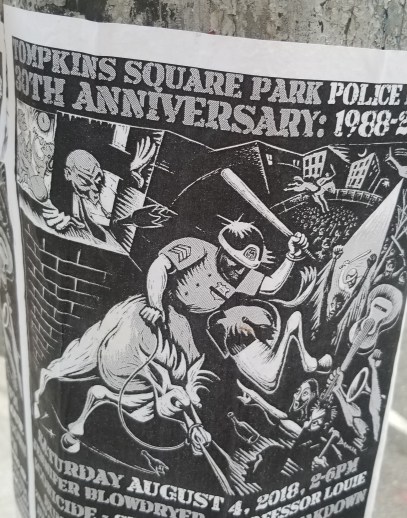
This weekend the East Village commemorated the three decade anniversary of the Tompkins Square Park Riots with two days of concerts and speeches in the once-notorious East Village park.
Protests over a 1 a.m. curfew of the park and eviction of homeless encampments there ended with multiple clashes with police and multiple instances of police brutality. It was among the first widely documented instances of police brutality caught on video and broadcast on the news. Angry protesters shouted dire warnings about gentrification, yelled “Die Yuppie Scum,” and vandalized a new apartment building. Police chased people down and clubbed them with night sticks. It was a low point in New York’s history but things would soon change.
I was an angry suburban punk rock high school kid in the late 1980s and I made it a point to go to New York and walk to Tompkins Square Park after the riot. While I made it there, I did not stay very long. The park was still a homeless encampment and drug-invested village of skels and squatters, even with the 1 a.m. curfew. I would walk along 8th Street and St. Mark’s after visiting a great record store called It’s Only Rock & Roll that did not survive to the late 1990s.
This year’s commemorative concerts included a reunion of Team Spider, a group I have long admired and followed that embody the best of the East Village punk rock ethos. For about a decade they had an elderly songwriter ZAK, join them for most of their performances. ZAK passed away in 2006. So I made it an imperative to get to the park to see Team Spider.
The fact that I felt safe enough to drive to the East Village in a minivan with my wife and three small children is testament to the radical changes that have affected the East Village in the interceding 30 years. Amazingly, I found a parking spot right alongside Avenue B. I parked right across the street from St. Brigid’s Church. The church has a storied history, including being used as a center for activists during the 1988 park protests. There is personal history there too. I was arrested for taping a flyer to a light post right on the corner outside the church in 2005.
We walked into the park between bands, and someone was on stage making a long-winded political speech. They had been there during the riots in 1988 and now the spirit of resistance was needed even more because Trump is a racist and in league with the Nazis and no borders and die yuppie scum and …I tuned out most of the rambling speech and instead said hello to friends that I saw there. Some of my friends that I know through music have not yet met my children, so it was good to introduce some of my punk rock family to may actual nuclear family.
Team Spider took the stage and rocked. Their brand of ska-infused, politically conscious punk rock is as relevant today as it was when they were performing regularly, and they even updated some of the lyrics to mention Donald Trump instead of George W. Bush. The concert was well attended – Choking Victim closed out the show after Team Spider – and evidence that the spirit of political protest has not been cleansed from our city streets entirely.
But by any measure of anti-gentrification politics, the yuppies have won in the East Village. There are only a few squatters left among the increasingly expensive real estate that have driven out much of the radical politics that fueled the protests. The 1 a.m. curfew on the park is still in effect and there’s a Starbucks where there was once a pizza place not long ago.
After we listed to Team Spider play, we brought our girls to a playground. I took a small detour to meet with old friends at the show, but soon it was time to go for ice cream. I am happy to report that Ray’s Candy Store is still on Avenue A and I and the family got to eat ice cream cones served by Ray himself. We found a bench in the park that was away from some of the homeless congregations that still take up a lot of space there and quickly ate the ice cream, though the summer heat made us all a mess. Soon it was time for home.
New York City has changed dramatically in the last three decades, and it wouldn’t be New York if it was any other way. We won’t always have the same punk rock bands to listen to in the decades ahead, but New York City will always be home to what is interesting.
The crucible of summer in New York
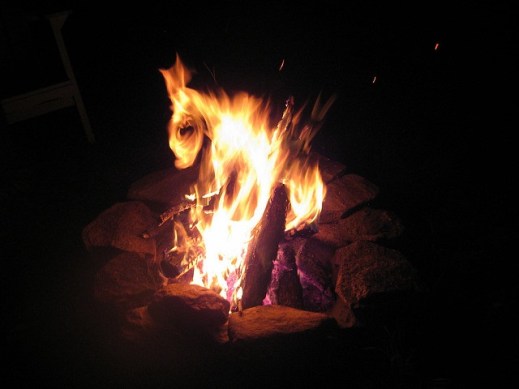
If hell exists, it borrows heavily from New York City in the summertime. The unescapable humid heat that is magnified on the sidewalks and amplified in the subways, the crowded aggravation of our crumbling infrastructure, and the general unrest that foments rage where there might normally be annoyance or resignation, are the central ingredients of our sulphuric summer stew.
New York goes into its Independence Day holiday in the midst of one of its heat waves. The general state of the country only adds to the humid misery, with half the country protesting and demonizing the other half at light-speed intervals, new Internet outrages generated almost by the hour. It’s a dizzying spiral downward in civil discourse that fuels a blanket disgust made more maddening by temperatures that bake an already exhausted brain.
This work week is interrupted by our Independence Day holiday on July 4. Imagine putting up with all the outrages of national politics today but without air conditioning and in wool clothes, and you’ll see why the colonies revolted. In New York City today, our country’s divided politics are writ large across the city. People who once enjoyed vibrant conversation on the state of affairs skip such conversations; it doesn’t pay to engage in civil discourse, even on a personal level.
This week we will get through our work week, hoping it will be easier with so many people using the holiday for vacation. The trains will be a little less crowded, the traffic a little lighter and the sidewalks will be blazing hot but not quite as mobbed. Tourists will walk downtown past where George Washington was inaugurated (New York City was America’s first capital).
Sometimes, even though I appreciate air conditioning, I have a moment when I leave a heavily air conditioned building and feel a sense of relief and satisfaction at feeling the blanket of humid heat cover me when I step outside. It is good to feel the real world on your skin, to embrace reality no matter how unpleasant, because that’s what we are destined to do.
That is part of our story. New York gives its residents all four seasons at full blast. You will be hot, you will be cold, you will feel the full force of nature’s fury and blessings, sometimes within the same month. On the first day of Spring, New York City had a snowstorm. I would have gladly endured many more if it meant we would be spared the stifling heat of the summer months, but I knew better than to think we’d have such a lucky trade.
The crucible of summer in New York makes for stronger New Yorkers and spurs our innovation, our creativity, and our own more quiet revolution. Some of us will “embrace the suck” as the military puts it, and barrel through the overheated times with a gimlet eye towards the future.
Our destiny means we move through this overheated season with a desire to embrace the heat, to dive into the fevered truth that others work hard to avoid or shout down. The hot weather will pass, and we cannot huddle in the air conditioning forever. We have nothing to do but have pride in ourselves as New Yorkers and live summer to the fullest.
Brown Bin Follies, and Why Composting is Not Just for Hippies Anymore
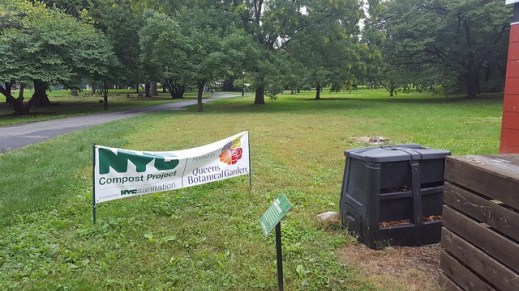
One of the odors that comprises the urban bouquet is that of garbage. The smell can be ubiquitous and is unmistakable, and the air of the hot summer months amplifies the oppressive stench when it sits uncollected for too long.
New York City has had recycling laws on the books for some time now, and while the success of the city’s recycling program is mixed—plenty of trash goes in recycling still, and the most ardent recyclers are homeless people who collect aluminum cans for the deposit money—recycling has wound its way into the everyday bustle of city life. It’s accepted as part of our routine.
The new frontier in responsible trash processing today is in composting: separating out the organic matter that can be used to create rich soil and put back into agricultural use. To this end the New York Department of Sanitation began a program that collects food scraps and yard waste to both promote composing and to help cut down on rats and roaches. The more edible food that’s in the garbage, the more vermin there will be to feast upon it.
But recently the Department of Sanitation halted the expansion of the program, saying it would focus on increasing adoption in those areas that were already in the program before expanding it. I can see why they did this. One could easily confuse these smaller brown bins for medical waste receptacles or for regular small garbage cans. No doubt people are adding their own manner of organic matter to these bins and probably making a mess of it.
Whatever the merits of the city’s program, you don’t need the Department of Sanitation to begin composting on your own. You can do it yourself and there are several organizations that will help you do it.
Among the enthusiastic composters in the city is my wife, who grew up in Eastern Queens and her family had a house with a yard when she was a youngster, and her family had a composting pile in their garden. She is one of the leaders of our local community supported agriculture program, Flushing C.S.A., and brings compost to a drop-off location at Queens Botanical Garden.
I was very skeptical of my wife’s plan to keep rotting food in our kitchen on purpose, but the composing has worked out so far and is easier to do than you might think. You can buy an inexpensive (about $20) countertop composting bin with charcoal filters to contain the odors. And the odor doesn’t get that bad, it actually smells like someone is trying to make pruno in your kitchen for a few seconds after you open and close the bin.
We have healthy jalapeno plants growing on our windowsill in containers filled with compost we got back from Queens Botanical Garden. Our basil plans, which make half our kitchen smell like a fancy Italian restaurant, are also growing in soil that is partly compost.
Why is this kind of thing important? Because we are running out of places to dump our garbage, with China recently refusing to handle more trash and recycling from other parts of the world. New York City ships much of its garbage out of state, but that is getting more expensive and it’s only a matter of time until that becomes unfeasible.
This kind of thing is smart to do. It’s for survival and the fittest people that are going to survive are the ones who can do more with less and organize to consume resources in a reasonable and sustainable way.
It would be easy to brush off composting as tree-hugging hippie nonsense, but it is not. Hippies are slackers who only want the trappings of conservation so they can feel good about themselves. Real conservationists and survivors are willing to do the hard work and build real systems to have the confidence in their future.
So embrace the rot and death of life to cut down on the rats and roaches and add more nutritious soil to our land. It is the smart thing to do.
 Matthew Sheahan
Recent Comments