
The never ending “Tetris” of city life

This past weekend my wife and I went to an obnoxious Scandinavian furniture store and purchased some sensible furniture we will need for our recently expanded brood. The heavy boxes of yet-to-be-assembled furniture is still sitting in the back of our van, not because we lack for strength or willpower to haul them up to our apartment, but because we have yet to make the necessary logistical calculations and plans needed to move furniture in a New York City apartment.
Perhaps I should call Mike Moosehead, a bandmate and New York City hardcore punk musical Renaissance man among whose many talents includes the ability to “Tetris” large amounts of musical equipment into seemingly impossible spaces. He can figure out how to fit an entire backline of drum kit parts, amplifiers and instruments into the back of a taxi cab and narrow storage areas.
In New York City, space is such a premium that every move has to be calculated and every inch must be justified. Few can afford spacious living. And even in Northern Queens where we live, where things are not as crowded as other parts of the city (grocery stores in our neighborhood have parking lots – a rare luxury if you are accustomed to Manhattan life), space is still a precious commodity.
In the furniture store we found dressers and book cases that would have been much better without the very common decorative overhangs and trimmings. We had to go to the store with very exact measurements of our daughters’ bedroom and then sit down and do a lot of math after collecting all the dimensions of the furniture we were considering buying. No doubt every homeowner has to do that, but New York City living means getting right down to the half inch.
At the office where I work, there was a pay parking lot next to our building when I first started working there two years ago. It is now a construction site for a hotel that is being built. Even in this age of Airbnb, hotels are being built in spaces that would normally seem too small. Every square foot of this city can be made into a money-making venture. If you aren’t getting the maximum use of your space, you are losing money somehow.
At home, we have a nice two-bedroom apartment that was spacious when it was only two of us. But we began creating new human beings and now our apartment shelters five. Three of those are under three but they grow fast and our space is already crowded. It is going to be a months-long effort to make our space more comfortable to live in, and we have to plan everything out meticulously.
All things considered, we are lucky to have the problems we have. There are plenty of people who are living in more crowded conditions and we have a stable living situation in a safe neighborhood and a roof over our heads. But the maddening “Tetris” of city life continues unabated and won’t slow down.
RAMONES and the quest for Queens’ artistic respect

The Queens Museum is a site of pilgrimage for punk rock fans from all over the area thanks to its Ramones exhibit, which is open until July 31.
I made it there not long ago one weekend after seeing friends posting photos of their visits there over social media for the last several months. It is a fine exhibit, one long overdue in the borough that gave the pioneering punk rock band to the world. I made a point to wear my Norman Bates & The Showerheads t-shirt when I visited, because one great Queens punk band deserves another.
The exhibit is colorful and brief. It’s only two modest-sized rooms and a screening room. I went there with my family, which means that a good deal of our time was spent stopping our two and half year old twin girls from banging Tommy Ramone’s snare drum. We didn’t have time to really take all of it in, maybe we should have gotten a sitter.
But as rushed as our walk through the exhibit was, it was important to be there. Queens is often overlooked in the pantheon of New York City artistic greatness. But Queens has given the world not only the Ramones but Johnny Thunders, Run-DMC, Simon & Garfunkel and more. Queens doesn’t get the respect it deserves – all the outer boroughs carry with it that basic desire to poke their finger in the eye of the city being defined as Manhattan.
One thing that the contemporary adoration of the Ramones tends to obscure is that they were grossly underappreciated when they were a functioning group, at least here in the U.S. I remember going to see them in 1989 in Connecticut and they were playing at Toad’s Place in New Haven, an admirable music club but a small venue (it was a 21+ show and I had no fake I.D.). When I finally saw them in late 1995, they were playing a larger venue, but as part of a shitty alternative radio show, headlining but sharing the bill with the unworthy likes of Better than Ezra and Silverchair (the oft-hated Silverchair were actually very good to be honest).
Queens is fully embracing its Ramones fame. Murals of the Ramones now grace Forest Hills. There are plans to rename the intersection next to Forest Hills High School Ramones Way.
The Ramones who moved to the East Village in the 1970s could not afford to live there today. While the Joey Ramone Place street sign is the most stolen in the city, the area looks nothing like it did when the Ramones first played CBGB in 1974. The refrain is a familiar one: New York is no longer affordable to the artists who made New York’s art scene famous. The artists I know don’t talk about New York, they speak of Philadelphia, Buffalo, or Berlin. New York’s East Village is a victim of its own success in a lot of ways. I’m not ready to give up on New York just yet, but it’s easy for me to say that from Flushing.
To be a punk rock fan in New York City means to constantly wrestle with nostalgia. There is a rich history to celebrate, but nostalgia can be a trap as much as a motivator.
New York continues to produce great punk bands. You may have to travel farther away from Manhattan and the trendy parts of Brooklyn to see them, but great local bands, the Ramones of tomorrow, are playing somewhere in Queens today.
Battle of the Queens Night Markets
Not too long ago, Friday nights were when I wanted to rage in abominable weekend warrior style and get home in the early hours of dawn after partying harder than Robert Downey Jr. with a 40-pound crack rock. Not so anymore. I’ve become mellowed with age and exhausted by child wrangling and by Friday evening I want nothing more than to sit at home and try to catch up on sleep.
So this past Friday I was reluctant to leave home with our brood to attend Flushing Night Out that was held on the campus of Flushing High School, not far from where we live. I did not want to deal with a large crowd and trying to supervise two active toddlers amid a mob of festivalgoers. But my wife insisted we go support this thing.
The five of us plus my mother-in-law took a bus less than a mile to the corner of Northern Boulevard and Union Street.
Flushing High School is the oldest high school in the city and unlike most city high schools, it sits on a large piece of land that has a nice lawn. That’s where the Flushing Night Out was held.
The event was well attended but not horribly crowded, a welcome relief. It was an overwhelmingly Asian crowd, which was no surprise since it was Flushing, and it was largely Flushing High School students and people active in community events. The mobs of ill-mannered drunks, arrogant thugs, and hipster abominations I feared never materialized, and while the DJ music that was there was aimed at a younger audience and therefore pretty shitty, it wasn’t hard to get away from it. Things sounded much better once the live music started.
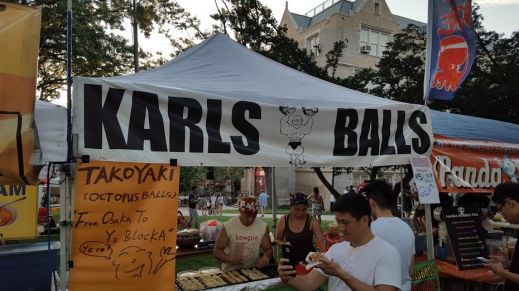
The food offerings were impressive and things are usually $5 or less. I had some excellent classic mac and cheese as well as fried mac and cheese from House of Mac, ate a tasty scallion pancake from Seoul Pancake, a seafood and pasta mix that had an Asian name I can’t remember from Teinei Ya and an amazing banana-flavored homemade pastry from Jai NYC Eats. The food booth that caught my attention the easiest was Karl’s Balls. Karl’s balls are delicious octopus balls. Meticulously tended to by the chef, the balls lived up to the hype. I can’t wait to have Karl’s Balls in my mouth again.
There was a $1 dollar All You Can Craft table that allowed us to keep our small children occupied and allowed them to leave with some hand-made jewelry. They also enjoyed painting their own and their grandmother’s arms with paint. Helpful volunteers were incredibly good-natured and patient with rambunctious toddlers who wielded paint brushes like machetes. Not far away, a vendor used a real machete to slice coconuts for special drinks.
There were also a lot of different vendors selling various inexpensive crafts. There was some seating available and space for people to bring picnic blankets. It was an all-around pleasant evening.
Flushing Night Out will be held several more Fridays this summer: July 29, August 12 and August 26. They run from 6 p.m. to 11 p.m. It is a good way to experience Flushing and family friendly too. It’s organized by the Greater Flushing Chamber of Commerce.
There is also a Queens International Night Market that is held in Flushing Meadows-Corona Park, on Saturdays. Our family tried to go there once but we drove and there was no parking available. My wife got out and walked through and found that the lines were incredibly long because there were not enough vendors. However, it has improved and my mother-in-law attended a more recent night market there and reported that there were many more vendors and that the crowd situation has improved.
The Brooklyn Night Bazaar was very popular and featured a lot of food vendors, beer, and music. It closed though it appears to be on its way back as its web site says it will be revived this September. Queens doesn’t need to duplicate Brooklyn to prove its worth, but these night markets can be a lot of fun if done right, and the Queens night markets are proving to be successful.
Queens has the most to offer of any borough in the city as far as food and different crafts. If something exists in the world, you can bet someone in Queens can cook it, get it for you, or show you how to make it. Night markets like Flushing Night Out are a good way to discover new foods, restaurants, or other fun things that may already be close by.
Looking like a homeless person while going to buy bagels
Doing my part to help the cause and help bring about the rise of the Nietzschean Übermensch, I am happy to report that my wife and I recently celebrated the birth of our third child, a healthy baby girl.
While my wife is still recovering and helping care for our newborn at the hospital and our older girls are spending time with helpful grandparents, I am home alone to try to ready our apartment. I came home after spending a few days at the hospital and managed to get a good night’s sleep for the first time in several days.
Hungry for something to eat before starting down my long to-do list, I put on whatever clothes were convenient and at hand and headed out to buy a bagel.
I wear a camouflage baseball cap for practical purposes, one being that horrible sweat stains that would turn a solid-colored hat into some kind of grotesque greasy tie-dye won’t show up on a hat that is already a patchwork of colors. My Georgia Bulldogs hunting camouflage hat makes me look like a backwoods redneck compared to most of New York City, and I’m OK with that. I actually do go hunting and watch college football if that makes a difference.
I was also wearing olive drab cargo shorts. Cargo shorts are considered unfashionable, but I like having pockets to put things in. I put functionality over fashion every time. I’d rather look like a slob and not lose my cell phone or wallet. I also had on an olive drab t-shirt that depicts an American flag constructed from grenades and rifles. It was a gift from my brother, a former Marine.
It might also be worth noting that I’m wearing a plastic hospital bracelet that allows me to visit my wife and newborn in the hospital, and that because we had to be at the hospital very early in the morning and I stayed there through the first night and into the second, that I had not shaved or showered for three days.
Not until I started down the stairs of my building did I realized that I looked like a homeless person and probably smelled like one too. That it reached 85 degrees by 9 a.m. didn’t help my case either. I felt the rays of the sun baking my greasy skin like a fine glaze being put on a pastry.
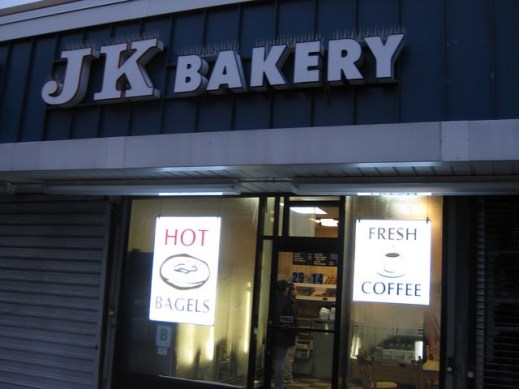
I felt like a load of hot garbage and hoped that the good people at JK Bakery wouldn’t recoil in horror or ask me to leave their store. I go there often enough that they hopefully recognize me and realize that maybe I’ve had a rough couple of days. It’s one of my favorite stores in the neighborhood and one of the best bagel shops in New York – I’ll put it up against any other bagel store – they make the bagels there and it’s a no-nonsense place.
JK Bakery did not disappoint. Despite my looking like an escaped mental patient, they served me promptly and I was soon enjoying a delicious bagel. I bought a few extra to bring my wife.
One of the things I like best about New York is that even though it’s a place of high fashion, it’s also a place where people make it a point of pride not to give a rat’s ass what anyone thinks of them or their clothes. And it remains a place where tired fathers can occasionally enjoy a delicious bagel in peace.
Exploring the Abandoned Rockaway Line
Because New York City is constantly being remade and revised, pieces of the city’s past can often linger around and become subsumed into the present, sometimes barely noticeable. These totems of city history are treasures often right in front of our faces.
Such is the case with the abandoned track of the Long Island Railroad’s Rockaway Line, which has been a tempting forbidden zone to Queens residents since the early 1960s when this part of the LIRR stopped operating.
Years ago, when I lived on 101st Avenue only a few blocks from the abandoned Ozone Park station, I would walk by the abandoned tracks, which are elevated for much of its stretch through Queens. The city rents out the space beneath the tracks to some businesses along the way. And one auto parts business near Rockaway Boulevard and Liberty Avenue welded a large spider sculpture together from used auto parts and suspended this from one of the trestles over the track. It has since fallen down. While I was living in Ozone Park, a motorcycle club rented out one of these spaces beneath the tracks, and would have parties in their clubhouse there.
The success of the High Line in Manhattan has encouraged communities in Queens to push to make a three and a half mile stretch of this abandoned LIRR line into a similar park. The QueensWay is a plan to turn the abandoned line into a “family-friendly linear park and cultural greenway.” Others would like to revive the tracks so they can be used for public transportation again. This plan would meet a lot of resistance from people who now live near the existing track, and face an uphill battle for funding. The prospect of a 20-minute commute to midtown is enticing and New York’s transportation system is in such a shambles that any stretch of track should be welcomed with open arms. Maybe some long-term compromise can be reached, whereas much of the railroad is revived and used for transportation again but some segments are made into a park.
But I have long wanted to walk along some of this abandoned track and this weekend I got my wish in Forest Park. Not far from Woodhaven Boulevard, there is a paved road that looks like a regular street but is closed off to regular traffic. This road traverses an overpass that runs over a segment of abandoned track. With a two-year-old girl in a carrying pack on my back, I walked down a steep drainage gutter that runs along the overpass.
There were some N.Y.U. students there filming what they described as an experimental film, and they looked more nervous about filming on off-limits abandoned property without a permit than about the critical success of their film. They had camera equipment and enough food and beverages there to be a proper film crew. I discreetly made my way around them and started walking on some of the abandoned track.
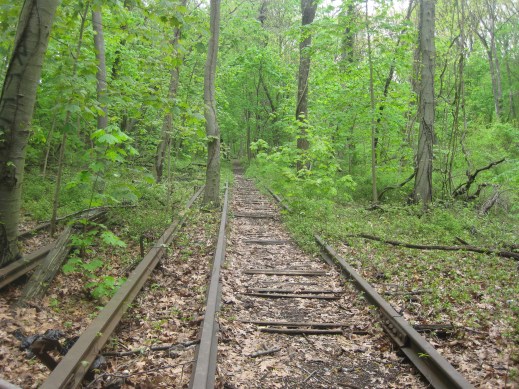
The tracks are overgrown and the rails are rusted. Trees both grow out of and in some cases lay across the tracks. There is a lot of graffiti on the concrete surrounding the tracks and even some on the trees. Rusted wire towers stood sentry along the line; some of them have topped over. The lush greenery is also dotted with signs of the tracks being a party place. There are empty beer cans, and sadly, traces of a poorly-tended campfire.
A second overpass is more remote to pedestrians and has more elaborate graffiti. A collection of discarded spray paint can tops sit together among the leaves and other detritus.
It feels like stepping into part of history, even poorly preserved history from 50 years ago feels significant. It is a feeling of pleasant quiet and secret entre among the bustle and grind of our five boroughs.
Someday the Rockaway Line will be busy again, either with park-goers, tourists, or even trains. Take some time to explore it before this piece of overgrown history goes away.
Road tripping through Kerouac’s Queens
Taking a road trip sometimes happens on a whim on a random weekend day, not because I’m suddenly inspired with the desire to know the American road, but because our toddlers have fallen asleep in their car seats and the wife and I want them to nap for a while. So began our latest sojourn on the great American road, which kept us mostly around our borough of Queens, but that’s OK because as you might have surmised, Queens is secretly New York City’s greatest borough.
We left the Queens Botanical Garden in our neighborhood of Flushing and our twin girls were asleep before we reached the nearby highway. We headed to the Rockaways because it was the anniversary of the Easter Uprising in Ireland and the Rockaways have been a home to hardscrabble Irish for a long time, including one Queens native who wound up fighting in the Easter Uprising of 1916.
Our navigation system took us into Nassau County and we passed by Valley Stream State Park before getting off of the highway and driving through the villages of East Rockaway, Malvern, and Lawrence.
We didn’t end up in the Irish part of the Rockaways, and the housing projects that tower over the bungalow houses are not filled with Irish immigrants. We decided to start our journey home going through Broad Channel and my old neighborhood of Ozone Park.
We took Cross Bay Veterans Memorial Bridge and cruised over Jamaica Bay. On one side of the bridge the skyline of Manhattan was prominent through the haze of sun and clouds. On our right and north was JFK Airport. Broad Channel is a small community that sits on the waterfront of Jamaica Bay. It’s a rare example of small town life within the five boroughs of New York City.
Cross Bay Boulevard brought us farther north, past the Jamaica Wildlife Refuge on both sides of the road and into Howard Beach and Ozone Park.
When I first came back to New York City, I worked at JFK Airport and lived in Ozone Park. I was very happy to learn that Jack Kerouac lived in Ozone Park for 12 years. He’s celebrated a lot in Massachusetts where he is originally from and buried, and in Manhattan where he would give readings and where he wrote On the Road. But Kerouac wrote his first novel, The Town and the City, while living in Ozone Park.
There is a historic marker outside the house where Kerouac once lived. When I lived nearby, it was good to go to Glen Patrick’s Pub and gulp down drinks, hoping some literary magic might have survived and would rub off on me. That kind of sentimentality is crap, really, but it was good at the time to know that the inheritors of America’s great literary traditions came from working-class enclaves like Ozone Park and Howard Beach.
It was good to see reinforced the knowledge that real literary grit and work takes place not in the posh hipster enclaves and trendy bars or bookstores of Manhattan or (nowadays) Brooklyn. Kerouac didn’t haul his typewriter to a coffee shop so people could gawk at him write. He got his writing done in a cramped apartment a few feet away from Cross Bay Boulevard.
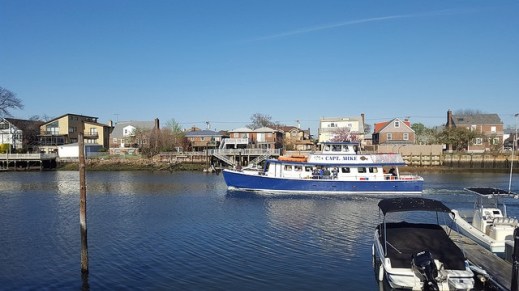
We took our girls into the Cross Bay Diner and had a late lunch while watching boats and seagulls come by on Hewett Creek. Fishing boats, a police boat, and even a large fishing boat called The Capt. Mike, came by and served as a great distraction for the kids.
Howard Beach and Ozone Park have changed quite a bit since Kerouac lived there, and they’ve changed a lot since I moved away in the summer of 2001, but their working-class character survive and they remain great neighborhoods to live in. They will continue to inspire and bring more great artists to the world.
Monorail!
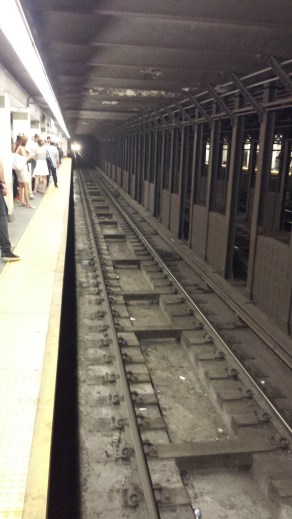
New York Mayor Bill de Blasio announced his idea to put in a light rail that would connect Brooklyn and Queens. With the exception of Red Hook and Sunset Park, his light rail system would not be bringing public transit to places that need it but rather add additional tourist glut and uber-gentrifying cachet to areas already overpriced and tourist heavy.
The idea sounds great at first. The public transit system in New York is abysmal and the outer borough are woefully underserved. To get from Southern Brooklyn to Northern Queens would require a lengthy detour through Manhattan or an epic journey of Byzantine bus transfers that would see you grow old or give up on life before you were halfway there.
The proposed rail runs only along the East River waterfront of Brooklyn and Queens. Some of these areas, such as Astoria, Queens and Williamsburg, Brooklyn, are already served by rail system and there are not too many people commuting between Sunset Park and Astoria.
With our subway dollar stretched thin and the MTA constantly cutting service while increasing fares, de Blasio says he’ll rake in the $2.5 billion he needs to build this light rail system from the increase in property tax that will result from the light rail being built. So he’ll wring money out of rich people who will somehow welcome this sorry trolley outside their homes and this will help the working class people of Red Hook and Sunset Park commute to Astoria where there are no good jobs waiting for them.
Whatever de Blasio’s motives or likelihood of the light rail system coming into being, the issue highlights two central problems of New York City transit: Our transit system is very Manhattan-centric to its own detriment and New York City does not have enough control over its own transit system.
The Metropolitan Transit Authority, though it generally serves New York City, is controlled by New York State. Whatever we need to do here in the five boroughs has to pass through several gatekeepers in Albany. The bureaucracy is twice-removed from the systems it operates, and it shows in every step of the system’s operation. The New York City transit system is among the most extensive in the country and it runs 24 hours, but that’s more of a remark about how sad the state of public transit is in the U.S.A. rather than a statement about how good New York City’s transportation is.
Every weekday morning I give myself an hour and a half to travel 11 miles, and I’m sometimes late. My first day back at work this year after the holidays, it took me more than two hours to get to work, even after I left the subway in disgust in Jackson Heights and took a cab the rest of the way to work.
New York City is comprised of 304.6 square miles and Manhattan comprises only about 33 of them. I have nothing against Manhattan and it makes sense for it to have a large transit infrastructure to deal with commuters going to work every week, but this leaves the most of the city underserved. Even many parts of Manhattan are not well served by the subway system – the Second Avenue subway has been a running joke for decades. They expanded the terrible 7 line so that people can go to the Javitz Center with greater ease – well not with greater ease since it involves having to take the 7 train. That the 7 train is an overcrowded clusterfuck in every way imaginable doesn’t seem to be on anyone’s radar to fix.
This latest proposal from the mayor looks like it will go the way of so many well-intentioned and poorly planned transit fixes. When it gets built, if it gets built at all, it will be way over budget and of limited usefulness.
I wish I could be more hopeful, but the line as planned will not go into any of the parts of the outer boroughs that are not served by a rail system, so the people still not served by our subways will still be out in the cold, waiting for the bus.
Chasing down the last vestiges of punk rock youth

The other night I left home to walk to the Parkside Pub in Whitestone, Queens to see an excellent hardcore punk rock show. I love punk rock music and this show was so close it took only a few minutes to walk there. I have loved punk rock for a long time and knew some of the bands that were playing from playing with my own band, Blackout Shoppers (currently on hiatus).
It was late and I didn’t have a lot of time to spend there, but as I set out I noticed an envelope that needed mailing, so I figured I could drop it in a mailbox on my way to the show.
Publisher’s Clearinghouse is a shitty lottery that only requires you mail back a form. Of course my chances of winning are next to zero, but instead of spending two bucks on Powerball I spend only the price of a stamp. That’s a very low-cost form of gambling, though it does come with the added humiliation of having your name on a Publisher’s Clearinghouse envelope.
I didn’t run across a mailbox until I got the block that the Parkside Pub was on. How can I show up at a hardcore punk rock show with a Publisher’s Clearinghouse envelope? Would that make me a horrible old poser? I had no choice. Those Publisher’s Clearinghouse millions are destined to me mine. If I win enough money, I’ll spend part of my fortune on starting a new non-profit arts venue in New York City that will feature punk shows. As I neared the show, I hoped no one would see me drop the sweepstakes envelope into the mailbox. No one did, or at least had the kindness not to call me out on it.
It was glad to see the show was packed. There were people there old and young and the bands were excellent. It was great to see friends from many different bands there. Some of them are my age or even older and many of them also have kids.
Being a parent with serious bills to pay and a job that requires long hours means I don’t get to very many concerts anymore. So any time I can steal away for a few hours and subject myself to the full blasting fury of as much aggressive music I can take.
The show at the Parkside did not disappoint. The bands were excellent. And even if they hadn’t been, it was worthwhile to see people you haven’t seen in a while. There are a lot of people that I know and love to see but only see them in the context of going to shows.
There are people like my friend Pete, who I ran into at the show. I have known Pete for years but don’t know his full name and couldn’t tell you what he does for a living. I’ve seen him at numerous shows for my band and others. I’ve spent hours talking to him at bars and on sidewalks outside of music clubs. I know he lives in Douglaston, Queens and used to have a girlfriend named Nicole and he loves punk and metal music, and that’s all I need to know. We love the music and the scene around it and so it doesn’t matter what we may or may not have in common.
Because while the band one plays in may not last, the friendships and the love of music will endure. People have been writing punk rock’s obituary since the 1970s. It’s still here. And as long as I can stand on my feet, I’ll make it to shows from time to time. No regrets. See you there.
New York City Never Quits
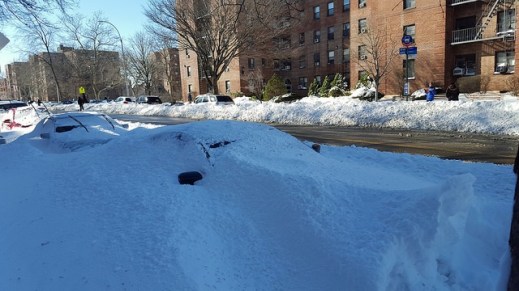
New York City is the city that never sleeps and never shuts down. It take events of epic proportions to knock us off of our game, and even then nothing is ever completely deserted. This is, after all, where the world takes its pulse and sets the pace for Western Civilization, and we take that task seriously.
New York is digging itself out from a winter storm that hit us on Jan. 23. It was as if we got all our winter weather in the span of about 24 hours. When winter started this past December, we had spring-like weather. Seventy degrees on Christmas? That’s bullshit. Old Man Winter got his revenge in a big way and buried much of the East Coast in a blanket of snow. For New York City, it was the second-largest snowstorm on record in the city’s history with more than two feet of snowfall recorded in Central Park.
Preparations started in earnest with people watching the weather reports and making jokes about stocking up on bread and milk as they made sure to stock up on bread and milk. Anyone who had plans for the weekend canceled them if they could, but it was heartening to see from social media that some things didn’t stop.
It was also heartening to see worthy displays of “New York Values” in dealing with the severe weather. The term “New York Values” has recently become an issue the 2016 presidential campaign, with Texas Senator Ted Cruz using the phrase as a smear against Donald Trump. I’m as cynical and jaded as any other long-time New York resident, but there was enough cooperation and good will on display during the storm to shame any friendly Texan. In the parking lot of our apartment building, one of our neighbors helped shovel out part of our truck. We returned the favor by helping shovel out the car parked on the other side of us, with a shovel lent to us by another neighbor.
My social media feed was littered with stories of neighbors helping neighbors with shovel and snow blower alike. A photo of a team of good Samaritans pushing a stranded ambulance out of a snowbank in Manhattan was enough to warm the heart even as your fingers and toes became numb.
City living makes people into blazing assholes, but it also makes people into cooperative souls out of point-blank necessity. When you are surrounded my millions of people, living life isn’t possible without some measure of cooperation. It may take a while to understand the ebb and flow of city life and plug yourself into it in a way that both preserves your sanity and allows you the boldness and hustle to get things done. New York rewards a certain level of aggression, but even the strongest of the strong cannot get by without a certain degree of give and take, there’s just too massive a crush of humanity to fight everyone to the death over every trivial slight.
Now as we look to get our work week underway, we all expect some of this city camaraderie to sublime like idle snow as we navigate an already overtaxed and incompetently run transit system in an attempt to get to work on time. Wish us luck.
Outer borough arts explosion

I recently went to a friend’s art opening at Q.E.D., a small art space in Astoria. Going to a friend’s art opening made me feel like I entered a proper adult sphere of being a creative person. Luckily Q.E.D. is as unpretentious as an art space can get without being a punk rock venue or a squat of some kind.
My artist friend, Michael Harper, is a former drummer for my band Blackout Shoppers and has played with Furious George and other punk groups. He is a far cry from the obnoxious snob you would expect to find having their work displayed on the walls of an art space in New York City.
But that is one of the good things that is happening in the city right now. While the high price of real estate had driven many good art and music venues out of Manhattan and the established art world is horrendously pretentious and completely out of touch with aesthetics and real value, the outer boroughs have responded by adapting and setting up their own respective art, literature and music scenes. Astoria’s Q.E.D. has comedy shows, open mic for poetry, music and storytelling. It hosts performances as well as classes—it is even hosting a Burns Night lecture—all days of the week.
More and more space like this are starting to open up in all of the outer boroughs. The kind of art spaces that used to proliferate our central borough can no longer generate the money they need to stay afloat. There are a few notable exceptions, such as the Lower East Side’s ABC No Rio, that have been around for a long time and manage to stay afloat with government grants, smart fundraising and a thrifty, DIY spirit. But these venues are very rare now. Those kinds of places are now in the other four boroughs.
One caveat to this is that Brooklyn has become so popular and overpriced that it is an outer borough in geography only – it long ago took on the same level of pretension and established demand that has long plagued Manhattan. This wasn’t always the case, of course. Before Williamsburg was the shit show of hipsterdom it is notorious for being today, it was a bad neighborhood where artists and writers fled to after being priced out of Manhattan. Parts of Brooklyn remain a haven for artists today, though time is running out for them even in the farthest reaches of the borough.
And New York’s outer boroughs have always been epicenters for the arts. Jack Kerouac wrote his first novel in Ozone Park, Queens. Louis Armstrong lived in Corona. Stanley Kubrick and Ace Frehley are from The Bronx. Matthew Brady, The Wu-Tang Clan and Blackie Lawless of W.A.S.P. hail from Staten Island. New York both attracts millions of creative people and produces great creativity among its natives that there is no neighborhood in the city that has not seen a glimmer of artistic greatness in some decade.
We can do nothing to roll back the clock and stop development and real estate price inflation, but like the good people of Astoria and elsewhere, a great art space is wherever you can make one. The outer boroughs are carving out space for the future of the arts in New York City.
The Queens ethnic supermarket shuffle

When a local supermarket closes down, people scatter like ants seeking safety. Our area of Queens is seeing two stores close down over the next few weeks. It will be interesting to see where shoppers will go before these stores are reopened.
The scene in the Waldbaum’s on 20th Avenue in College Point, Queens was a sad one. More than half the shelves were empty. Where abundant displays of vegetables once stood were now vacant. Everything was on sale. Products in the aisles were consolidated onto a few shelves. As I was checking out, a woman asked if she could have my shopping basket when I was done; she couldn’t find another one anywhere.
Local supermarkets throughout Queens are being sold or closed after the A&P, which owned several supermarket chains, declared bankruptcy earlier this year. The local ones near where I live are supposed to be reopening. The Waldbaum’s will reportedly reopen as a Shoprite later this year. The Pathmark near our home is supposed to reopen as a Stop & Shop. Both are closing down in the meantime leaving people wondering where they are going to shop.
Food shopping, like much else in New York City, is a generally ethnically segregated affair. There was a Key Food in the shopping center right behind our home. It closed and is now Good Fortune, a grocery store that mainly caters to Chinese shoppers. All the announcements on the PA are in Chinese and many of the people who work there speak no English. Some of our neighbors refuse to go but it’s not a bad store. If you’re looking for fresh fish they have a lot of it, and they even kept a real deli, but if it’s too early in the day and the deli person isn’t there, none of the multitude of Chinese workers will help you other than to tell you in the best broken English they can that you are shit out of luck.
One thing I noticed when I first visited Good Fortune is that there is no cash register #4. The cash registers skip from register #3 to register #5. The Chinese believe that #4 is bad luck. The word for the number four is similar to the word for death in Chinese, so Chinese will go through great lengths not to have the number four in their addresses or phone numbers. Similarly in western cultures there is often no 13th floor of an office building because of bad luck associated with that number.
A few blocks down the street is the H-Mart, a Korean grocery store. It’s smaller and does not have a wide selection, though on Fridays you can go through there and practically eat an entire lunch’s worth of food in the form of free samples. This supermarket also has odd sections of electronics and other things you don’t normally find in a grocery store; maybe that’s a Korean thing. Their selection of non-Asian foods is pretty dismal and we rarely go there. A few years ago supermarket union workers protested outside of this store asking people to boycott it because it had no black or white employees. I haven’t seen these protesters in a while. I don’t normally go to this store but I’ve never seen a black or white employee there to this day.
So some people are not going to shop at the Asian supermarkets and they’ll soon get the chance to shop at their old stores, renovated and under new management. Some have taken to shopping at some of the smaller stores in Whitestone and some will shop at the nearby Target.
New York’s ethnic cauldron will continue to boil and churn. Luckily I don’t mind shopping among the Chinese and will stay well fed.
The mad carnival that is the New York City Marathon
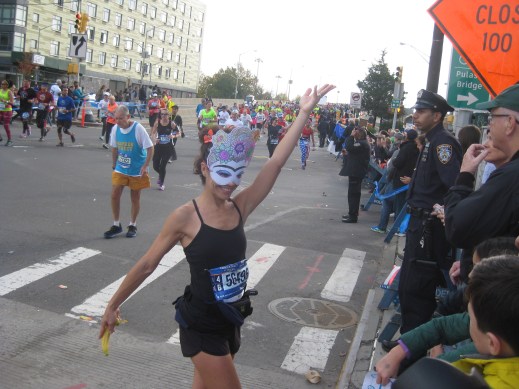
My wife’s cousin Erin ran the New York City Marathon and several of us planned to go meet her along the route. Erin had arranged things so that friends and family would meet her at several points along the 26.2 mile run. We were scheduled to meet her about halfway through the run in Long Island City, Queens.
Taking two toddlers onto the 7 train is one of the most torturous mass transit experiences you can have. We gave them munchkins from Dunkin’ Donuts and that sated their hunger but made them thirsty. We had no water for them, only giant coffee drinks that they couldn’t have. They cried and tried to wrestle free. Where on the 7 train they intended to go we had no idea, but they cried and screamed to be free of us.
Time slows down when you are the couple who brought crying children on the subway, but we eventually reached the Vernon-Jackson stop on the 7 train in Long Island City. Not wanting to take a double stroller onto subway, we brought backpack baby holders to carry them around in, but we had to hustle off the train to have space on the platform to wrestle the girls into those. We emerged from the subway stop into the cool November air. The weather was perfect for the race, and the marathon was close by and well under way.
The New York City Marathon is a somewhat of a crazy carnival. People show up with funny signs and runners often jog by in odd costumes. People show up to push their own causes: people handed out pamphlets for Bernard Sanders and solicited donations; the Jewish group Chabad had a space set up with a PA and hospitality to cheer on the runners.
There were a plethora of inspirational signs: ‘You CAN even!’ and ‘Run like the METS Depend on it’ were two of the more clever ones on display in Long Island City. A few held up signs that read, ‘Welcome to Queens!’ A few groups had enlarged photos of their friends and loved ones in the marathon. A couple near where we were standing had two large neon-colored Ls, their daughter’s initials. She gave them big hugs and was moved by their presence.
The runners reflect the city’s diverse patchwork of oddities as well. There were lots of runners dressed in the spirit of Halloween. I saw one competitor wearing a sheep suit and many more dressed superheroes such as Superman or Iron Man.
The runners are also an inspiration and represent all that is good about New York. They showcase the perseverance of the human spirit. There were runners that looked like they had to be in their 60s or 70s, including one elderly runner hobbling along with forearm crutches. One marathon runner was blind and was being helped along by some guides.
Lots of runners had their names on their jerseys and it was easy to root for them by name. More still had ear buds in their ears and were listening to music and so shouting encouragement to them was in vain. I decided I would shout, “Vive La France!” at French runners. They seemed to appreciate my support.
After tracking her via smart phones, our family group saw my wife’s cousin Erin as she approached us. She was in great spirits and chatted with us for a bit while waiting for her running partner. She munched in a snack, gave us hugs, and was off again. She finished the race in good time.
Here’s to all the marathon runners and everyone hitting the pavement and chasing your dreams.
The Great Brick Oven Pizza Scam

Walking towards Brooklyn Bridge Park this past weekend on a family outing, we came across the sight that represented everything not to like about Brooklyn. I even took a photo of it because it summed up so much of what is wrong with our city and world.
There was a long line in front of a brick oven pizza restaurant. People crowded into a dense rope line like cattle to the slaughter to pay handsomely for the honor, while a little ways up the street they could have gotten more food for less and eaten with real Brooklynites at the Park Plaza Restaurant. And worse than that, they were waiting to pay for brick oven pizza.
Brick oven pizza is a big scam. It should shame New Yorkers that some of our most heralded pizza restaurants are overpriced tourists traps offering crappy food. Somehow the powers that be have convinced millions of people that there is something authentic about eating poorly-made and overpriced pizza.
Take a good honest look at a brick oven pizza if you are ever roped into going to one of these insufferable establishments. You’ll notice that not only is the pizza weak and thin and the cheese coverage extremely spotty, but there will usually be bubbled and burned parts of the crust. You could take off some of these burnt pieces and use them to make a charcoal sketching if you wanted. Everyone pretends that this is good pizza, and brick oven pizza restaurants somehow get away with this even though there are hundreds of good pizza places that can make a delicious and authentic New York pizza.
If visitors to New York were willing to just travel a little farther away from the well-tread tourist areas, this con game could be put to an end faster. Sadly many New Yorkers themselves have fallen into this trap and gush on about some of these places.
Some of the celebrated brick oven pizza places boast that they offer a clam pizza, which really means they are failures in both pizza and seafood. There are too many good restaurants to get pizza and clams, don’t spend your money on the brick oven hype.
The brick oven pizza deception plays into the innate human trait to romanticize the past. While craft and tradition are certainly worth celebrating when they result in something positive, making sub-par pizza just because it’s old fashioned is stupid. Yes, they had brick oven pizza in the 1800s in New York. Do you know what else they had? Cholera and Yellow Fever. We shouldn’t be eating brick oven pizza any more than we should be commuting to work on horseback or leeching our children when they get colds. Let’s embrace those technologies that have improved our lives, including ovens that can cook pizza evenly.
Many people from outside the city are not aware that pizza making has a long history in New York and they wrongly believe that they must choose between the artisanal and brick oven swindlers and the legion of national chains that are sadly permeating New York neighborhoods. This is a false choice. The five boroughs and many surrounding areas are full of small, independent pizza parlors that can make you a delicious pizza.
Brick oven is a “brand” now. Just like you can charge extra money by calling something “artisanal” or “natural.” I have no doubt that bad pizza makers are baking their abominable pizzas in regular ovens and then just charging extra for it. They’re laughing at their self-satisfied marks who think they are somehow more “authentic” New Yorkers for being dumb enough to get taken by this racket.
It took years for this sham to get its hooks in the public and it may take longer to get people to open their eyes to the fact that they are paying more for less pizza.
So please, say no to the brick oven pizza hustle. There are still many independent pizza parlors that make real New York pizza.
Children of the Corn Maze

Every year in the underrated borough of Queens, New York, the Queens County Farm Museum holds the annual County Fair. It’s pretty small as far as county fairs go, especially when you consider that Queens is one of the most populated municipalities in the country and is undisputedly the most ethnically diverse place on Earth. But it has all the features of a good country fair: there is overpriced junk food, agricultural exhibits, arts and crafts, and even hay rides.
There is also a corn maze. Adults can pay nine dollars apiece for the honor of finding their way through the corn maze and feel like completely lost fools for an hour or so. Every year the maze is in a different design with an image that carries a theme throughout the whole ‘The Amazing Maize Maze’ experience. This year the corn was planted in a design of a jokey on horseback to celebrate American Pharaoh winning horse racing’s Triple Crown just outside of Queens at the Belmont Stakes.
I went through the corn maze with my wife a few years ago before we had children. I didn’t enjoy it very much. My wife wanted to get our toddler daughters out of the apartment and give them something interesting to do. A corn maze is an old American tradition and one you wouldn’t think you’d find in New York City. But the Queens County Farm Museum is a verdant oasis in the middle of our sprawling metropolis, and it seems wrong not to take full advantage of all it offers.
We got to the fair and made our way through the petting zoo and to the corn maze. I paid our admission and asked if we would be allowed to take the stroller with us. The people working the maze said that while we could bring the stroller with us, the corn maze could be narrow and muddy in places and we were better off without it. Our girls have been fully mobile for months now, so a brisk walk through the corn would do them some good. It would serve to tire them out and get them ready for their post-lunch nap.
We were issued a flag on a tall piece of narrow PVC pipe and a paper map that we would fill out as we found clues and mailboxes with map pieces throughout the maze. We started our walk, holding our daughters’ hands and relishing the lovely afternoon among the corn stalks.
I quickly remembered why I didn’t like the corn maze several years ago. It embodies two things that I like the least: being hot and sweaty and getting lost. It was an unseasonably warm day and the corn provides no shade. The sun was at its highest and no one had a choice but to get lost. Our daughters tired out first and my wife and I had to carry them everywhere. The girls cried whenever we tried to put them down, which we needed to do frequently to gather clues and map pieces.
We kept at it though, not wanting to bail out before we found our way out of this confounded crypt of corn. We kept running into many of the same people who were trying to make their escape as well. Every few minutes another group would find their exit and a happy-sounding employee would announce it over a public address system that was otherwise belching warmed-over pop tunes. “OK, we have another victor, what is your name??!”
Workers oversee the maze from a raised platform and a separate tower. In at least one spot within the maze, a length of irrigation tubing serves as a communication conduit and a monitor in a tower will provide a clue once you give him or her the password.
“I need a Triple Crown,” I gave the password to a young man at the other end of the tubing.
His answer was a cryptic clue-laden sentence along the lines of, “Sectors five and six are the hardest ones you seek, mount the horse to get a peek.”
“You want us to start doing heroin,” I mentioned. I actually took it to mean that we should head for the part of the maze depicted as the horse or jockey, but he offered no advice on how to get to that location. Other maze workers who roam around within the giant puzzle offered more tangible clues and to the staff’s credit, the corn maze is run very well. Just be sure to bring lots of extra water and if you have children under three bring something to carry them in.
After much walking around and getting lost over and over again, we eventually found our way to the exit. We emerged as victors, thirsty and miserable and vowing to do it differently next time.
It took us 56 minutes to get through the corn maze and we got out too late to catch the Great Cordone’s 12:30 show, which had people spilling out of the show tent.
We made our way through the fair and over to where most of the food was. My wife celebrated our surviving the corn maze by ordering some roasted sweet corn. The girls couldn’t have been happier.
 Matthew Sheahan
Recent Comments