
Making a dent in the world of media “interns” and “entry level” jobs

Recent rules issued by the U. S. Department of Labor have mandated overtime pay for employees who work more than 40 hours a week if they earn $47,476 per year or less. That adds a lot of people to overtime and will put a much-deserved dent into the business models of innumerable shady corporations. It’s one of those rule adjustments that outgoing administrations do: it’s something Obama wants credit for but wasn’t willing to spend any political capital on.
The New York Times pointed out that this plan threatens to disrupt the “Prada Economy,” referring to the novel and film “The Devil Wears Prada,” a fictionalized account of working for Vogue editor Anna Wintour. That many publications or institutions of measurable influence are horrible places to work is no surprise at this point. I know people with Masters degrees who are brilliant at what they do yet live in poverty because access to paying work in their field is through unpaid or nearly-unpaid work.
A friend I worked with years ago once had a job interview with the prestigious Paris Review. George Plimpton asked her at once point, “How important is it to you to get paid?” She was newly arrived to New York City and getting paid was very important with any job she took and she told Plimpton that. She did not get the job.
When I was trying to get a writing job I managed to get an interview with a trade publication (Chemical Week – it is still around) and after a few rounds of interviews and a writing test they wanted me to come in and work for a while. “Don’t do it unless you can stay at least four hours,” the editor told me. I came in and worked a full day, writing some stories, re-writing news briefs and the like. I never heard back from them. A year or two later I discovered that they had published some of my work and never paid me for it. When I contacted the editor all he did was send me a photo copy of the pages of the magazine in which my work appeared. As rotten as that is, it’s kids’ stuff. I know freelancers who struggle to get paid by name-brand companies and mainstream publications.
There are instances where low-paid or even unpaid internships are acceptable and permissible. When I was in college and able to live with parents, I had an internship on a gubernatorial campaign. I worked some incredibly long hours driving our candidate around the state of Georgia in the summer heat for a month, at one point not sleeping for more than two or three hours. It was an incredibly fun time and I was paid only $100 per week. But that was when I could afford to do that and it was only a temporary assignment. Colleges and parents can often subsidize interns. Once people graduate college, they usually have to start paying the rent and start trying to pay down their student loans.
Using an internship as an unpaid apprenticeship for large, for-profit institutions is unacceptable. You shouldn’t’ have to be a sucker to pursue your dreams. And in the end it’s the publications that suffer. If the only people able to work in the arts or media are wealthy scions or sociopaths who still live in their parents’ basement past the age of 30, then you’re not going to get the best minds of your generation.
I wouldn’t be surprised to find that a lot of companies give raises to overworked employees to $47,477 per year just to skirt these rules. But maybe that may be a kind of back-handed victory in and of itself if enough people get raises. They’ll still be overworked and underpaid, but underpaid by a little less. In these times, we’ll take what we can get.
Half-assed soccer hooligans unite! Why New Yorkers should support NYCFC

It’s an encouraging sign for soccer in America that we are starting to have riots outside of games. This past weekend supporters of NYCFC and the Red Bulls clashed outside Yankee Stadium before a game. It was incredibly tame stuff by soccer hooligan standards; we are still behind Europe in both soccer skills and organized gang violence among soccer supporters. But it’s a start.
I have not been to a professional soccer game in my life and I could not name a single player on NYCFC. But I believe that you have to take sides and stick with your team loyalty. There is no room in this world for weakness and indecision. I chose to support NYCFC as my local soccer team and here’s why.
Reasons New Yorkers should support NYCFC as your New York soccer team:
NYCFC plays in New York City. NYCFC plays at Yankee Stadium in The Bronx. Their rival “New York” teams the Red Bulls play at MetLife Stadium in New Jersey and the Cosmos play outside the city also at James M. Shuart Stadium on the Hofstra University campus in Uniondale, Long Island.
NYCFC is not named after a shitty energy drink or failed team of the past. I’ll admit NYCFC is not a very original name for a soccer team. It simply stands for New York City Football Club. But the Red Bulls are named for a shitty energy drink after initially being called the MetroStars. And while the Cosmos at least have some history in New York prior to their revival in 2010, it is as a failed attempt in the 1970s and 1980s to get Americans interested in soccer.
Getting on the ground floor of fandom. New York City FC started just last year. It’s early enough in this team’s history to get in on the ground floor and be able to tell your grandchildren you were there from the beginning.
Better aesthetics. A team should have a logo and colors you are proud to wear, especially if the team doesn’t do so well. NYCFC has a better color scheme and logo than its rivals. That their team is named for an energy drink makes Red Bulls fans pathetic enough. The New York Cosmos are trying to relive the 1970s, which is good in some respects maybe but not when it comes to sports jerseys and logos. The Cosmos designs should have gone the way of the line green leisure suit.
They can only get better. NYCFC lost to the Red Bulls 7-0, which is a humiliating defeat in a traditionally low-scoring game such as soccer. So the team can only get better. And for Yankee fans, we finally get to experience what it’s like to have the camaraderie of the underdog. I no longer have to think about the Jets to experience that. NYCFC has yet to experience any glory days. Our best days, and even our mediocre days, are still ahead of us.
So I urge my fellow New Yorkers to support NYCFC. It is at its beginning and will eventually achieve greatness.
Popping Up Near You
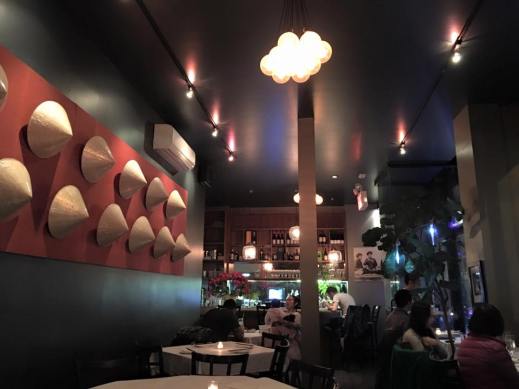
This past week I managed to catch up with a friend of mine, who is a former coworker and neighbor. In true New York City fashion, we lived in buildings next door to each other and worked in the same office for nearly a year before we realized we were neighbors.
We met in Hell’s Kitchen at a pop-up restaurant. It was a pop-up called Pop Up Ramen that was being hosted by BQ Ramen in a restaurant called Co Ba 53 on 53rd Street near 9th Ave. The BQ of BQ Ramen in this context means homemade, authentic Japanese food—I had no idea and assumed it was some kind of fusion place that mixed barbecue with Ramen noodles. I was completely prepared to see a pig roasting on a spit. There was no Southern style barbecue there but I was not disappointed. The food was great.
It was my first pop-up restaurant experience, at least that I’m aware of. I may not notice these things. At first glance the pop-up trend could be viewed as a silly fad and you most often hear about it in the context of very trendy things that life on hype and excel and taking money quickly from ignorant hipsters and tourists. But pop-ups can serve a real purpose.
My friend knows the husband and wife team who were running this specific pop-up and theirs is a great New York story. They each arrived in New York from Japan during the city’s crime-ridden years of the yearly 1990s with little money and almost no proficiency in English and they each became successful in their respective fields.
This pop-up is a way for them to generate interest in their business. To open a restaurant in New York is extremely expensive and risky. The costs of renting or buying real estate on top of investing in equipment and staff means hundreds of thousands of dollars in potential debt, and the restaurant business is extremely competitive. Other kinds of stores face similar odds and large costs. A temporary restaurant or store can prove a business model to potential investors while establishing a customer base. Pop-ups themselves are a good way to let good ideas thrive and bad ideas fail before anyone has lost too much money on it.
The dinner at Pop-Up Ramen was outstanding and it was delicious food with conversation that veered from city living to religion and politics and back again to city life. I regret I couldn’t stay longer but I had a long journey home. If there is another Pop-Up Ramen or BQ Ramen restaurant established I will be sure to go there.
Hell’s Kitchen is a vibrant place and while it has a great nightlife and restaurant scene, it’s avoided the kinds of obnoxious crowds that now over populate the city’s more trendy neighborhoods of Williamsburg and the Lower East Side. It was a weeknight and the spring air brought people outside and the neighborhood has still kept some of the grit that made it interesting even though it’s suffered some of the same gentrification and commodification that’s affected the entire city.
I made my way through the Hell’s Kitchen night with a promise to return.
Exploring the Abandoned Rockaway Line
Because New York City is constantly being remade and revised, pieces of the city’s past can often linger around and become subsumed into the present, sometimes barely noticeable. These totems of city history are treasures often right in front of our faces.
Such is the case with the abandoned track of the Long Island Railroad’s Rockaway Line, which has been a tempting forbidden zone to Queens residents since the early 1960s when this part of the LIRR stopped operating.
Years ago, when I lived on 101st Avenue only a few blocks from the abandoned Ozone Park station, I would walk by the abandoned tracks, which are elevated for much of its stretch through Queens. The city rents out the space beneath the tracks to some businesses along the way. And one auto parts business near Rockaway Boulevard and Liberty Avenue welded a large spider sculpture together from used auto parts and suspended this from one of the trestles over the track. It has since fallen down. While I was living in Ozone Park, a motorcycle club rented out one of these spaces beneath the tracks, and would have parties in their clubhouse there.
The success of the High Line in Manhattan has encouraged communities in Queens to push to make a three and a half mile stretch of this abandoned LIRR line into a similar park. The QueensWay is a plan to turn the abandoned line into a “family-friendly linear park and cultural greenway.” Others would like to revive the tracks so they can be used for public transportation again. This plan would meet a lot of resistance from people who now live near the existing track, and face an uphill battle for funding. The prospect of a 20-minute commute to midtown is enticing and New York’s transportation system is in such a shambles that any stretch of track should be welcomed with open arms. Maybe some long-term compromise can be reached, whereas much of the railroad is revived and used for transportation again but some segments are made into a park.
But I have long wanted to walk along some of this abandoned track and this weekend I got my wish in Forest Park. Not far from Woodhaven Boulevard, there is a paved road that looks like a regular street but is closed off to regular traffic. This road traverses an overpass that runs over a segment of abandoned track. With a two-year-old girl in a carrying pack on my back, I walked down a steep drainage gutter that runs along the overpass.
There were some N.Y.U. students there filming what they described as an experimental film, and they looked more nervous about filming on off-limits abandoned property without a permit than about the critical success of their film. They had camera equipment and enough food and beverages there to be a proper film crew. I discreetly made my way around them and started walking on some of the abandoned track.
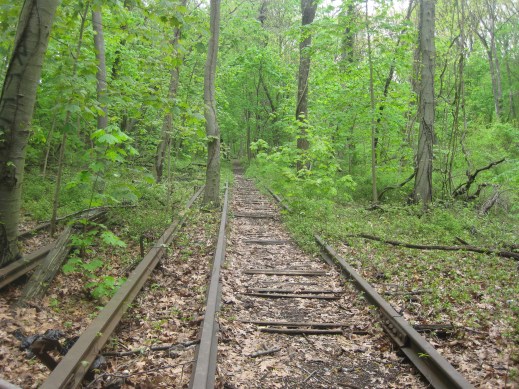
The tracks are overgrown and the rails are rusted. Trees both grow out of and in some cases lay across the tracks. There is a lot of graffiti on the concrete surrounding the tracks and even some on the trees. Rusted wire towers stood sentry along the line; some of them have topped over. The lush greenery is also dotted with signs of the tracks being a party place. There are empty beer cans, and sadly, traces of a poorly-tended campfire.
A second overpass is more remote to pedestrians and has more elaborate graffiti. A collection of discarded spray paint can tops sit together among the leaves and other detritus.
It feels like stepping into part of history, even poorly preserved history from 50 years ago feels significant. It is a feeling of pleasant quiet and secret entre among the bustle and grind of our five boroughs.
Someday the Rockaway Line will be busy again, either with park-goers, tourists, or even trains. Take some time to explore it before this piece of overgrown history goes away.
Judge the livability of your city using the White Castle Index

At a proud moment last year, I won the Literary Open Mic competition hosted by my comrade-in-arts and Renaissance man Filthy Phill Lentz at The Cobra Club. I decided to celebrate my victory with a late-night snack before heading home. I drove to where my navigation system indicated was the nearest White Castle, only to find a construction site in its place.
It is at least the second White Castle to be purged from the popular and overrated borough of Brooklyn. The much-valued Castle in Williamsburg on the corner of Metropolitan Avenue and Humboldt Street was closed nearly two years ago to make way for more overpriced apartments.
Before I got married, I made sure my bachelor party ended with a visit to White Castle to cap off an evening of Yankees baseball, strippers and punk rock. When my band plays shows near a White Castle we are sure to stop by for some sliders on the way home.
I wouldn’t advocate eating junk food regularly, and I limit my White Castle visits to special occasions and balance with attempts at a healthy diet and regular exercise. But after a night of victorious effort, whether that be in producing great art, achieving a career or personal victory, or otherwise exerting yourself above and beyond the call, it is suitable to indulge with some excellent excess, and you should be able to safely do that in multiple locations around any major American city.
New York City has fallen behind in its White Castle Index, meaning that low-cost good food at all hours is increasingly unavailable. Williamsburg was once a haven for artists; it’s now home to the $150 doughnut. Williamsburg managed to strike it rich and still slide into the sewer.
I prefer White Castle, and I’d be happy to expound on its excellence both culturally and calorically, but there are other options that are similarly convenient and meaningful. Regionally there are many differences and the White Castle chain does not ready many parts of the U.S. But every region should have its own version of White Castle. Waffle House often fits the bill in many parts of the country. It is open 24 hours a day and has plentiful offerings of quickly made indulgent food at a relatively low cost (it might be useful to call this the Waffle House Index in the Southern U.S. I don’t know any Waffle House restaurants north of Pennsylvania). And diners are a great American institution that are being priced out of existence as well.
Everyone should be able to have an all-night restaurant that they can go to relax among their own kind (leaving it up to each person who counts as “their own kind.”)
If the all-night party isn’t available at an affordable cost, then something is wrong, and we are getting to the point in New York City where only the extravagantly wealthy can afford to live life to the fullest. That leads to a decline in the character and long-term viability of the city. Without strong, vibrant, working and middle classes, the cultural and physical rot of its society becomes evident very quickly.
The world’s best artists do not emerge from the pampered class that looks down their noses at the common people. The arbiters of taste and culture should not be people who’ve never waited tables, washed dishes, or dug a ditch. With fewer and fewer working Americans able to find a rewarding life in our urban centers, cities will cease to be engines of creativity and genius.
As goes the working class, so goes our city. Luckily, there are still numerous White Castles to be found in the outer boroughs. I’ll see you at one.
Road tripping through Kerouac’s Queens
Taking a road trip sometimes happens on a whim on a random weekend day, not because I’m suddenly inspired with the desire to know the American road, but because our toddlers have fallen asleep in their car seats and the wife and I want them to nap for a while. So began our latest sojourn on the great American road, which kept us mostly around our borough of Queens, but that’s OK because as you might have surmised, Queens is secretly New York City’s greatest borough.
We left the Queens Botanical Garden in our neighborhood of Flushing and our twin girls were asleep before we reached the nearby highway. We headed to the Rockaways because it was the anniversary of the Easter Uprising in Ireland and the Rockaways have been a home to hardscrabble Irish for a long time, including one Queens native who wound up fighting in the Easter Uprising of 1916.
Our navigation system took us into Nassau County and we passed by Valley Stream State Park before getting off of the highway and driving through the villages of East Rockaway, Malvern, and Lawrence.
We didn’t end up in the Irish part of the Rockaways, and the housing projects that tower over the bungalow houses are not filled with Irish immigrants. We decided to start our journey home going through Broad Channel and my old neighborhood of Ozone Park.
We took Cross Bay Veterans Memorial Bridge and cruised over Jamaica Bay. On one side of the bridge the skyline of Manhattan was prominent through the haze of sun and clouds. On our right and north was JFK Airport. Broad Channel is a small community that sits on the waterfront of Jamaica Bay. It’s a rare example of small town life within the five boroughs of New York City.
Cross Bay Boulevard brought us farther north, past the Jamaica Wildlife Refuge on both sides of the road and into Howard Beach and Ozone Park.
When I first came back to New York City, I worked at JFK Airport and lived in Ozone Park. I was very happy to learn that Jack Kerouac lived in Ozone Park for 12 years. He’s celebrated a lot in Massachusetts where he is originally from and buried, and in Manhattan where he would give readings and where he wrote On the Road. But Kerouac wrote his first novel, The Town and the City, while living in Ozone Park.
There is a historic marker outside the house where Kerouac once lived. When I lived nearby, it was good to go to Glen Patrick’s Pub and gulp down drinks, hoping some literary magic might have survived and would rub off on me. That kind of sentimentality is crap, really, but it was good at the time to know that the inheritors of America’s great literary traditions came from working-class enclaves like Ozone Park and Howard Beach.
It was good to see reinforced the knowledge that real literary grit and work takes place not in the posh hipster enclaves and trendy bars or bookstores of Manhattan or (nowadays) Brooklyn. Kerouac didn’t haul his typewriter to a coffee shop so people could gawk at him write. He got his writing done in a cramped apartment a few feet away from Cross Bay Boulevard.
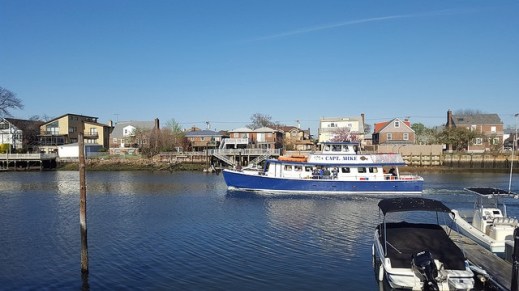
We took our girls into the Cross Bay Diner and had a late lunch while watching boats and seagulls come by on Hewett Creek. Fishing boats, a police boat, and even a large fishing boat called The Capt. Mike, came by and served as a great distraction for the kids.
Howard Beach and Ozone Park have changed quite a bit since Kerouac lived there, and they’ve changed a lot since I moved away in the summer of 2001, but their working-class character survive and they remain great neighborhoods to live in. They will continue to inspire and bring more great artists to the world.
Earth Day is Not Just for Hippies Anymore

April 22 is Earth Day and no doubt many of the Earth Day observances will be obnoxious and useless. People have given environmentalism a bad name. Whether trying to tie helping the environment to New Age mysticism, linking terrorism to climate change, or comparing eating meat to the Holocaust, the mantle of environmentalism and appreciation of the Earth is a damaged one.
Just because hippies are doing it, doesn’t mean it’s necessarily wrong or bad. Hippies were one of the first groups to organize against prohibitions against marijuana and now only the most dyed-in-the-wool authoritarian throwback wants to keep banning the weed. There are some things hippies get right, and appreciating nature is one of them, even if they do it in ham-handed and atrocious ways.
There is no American in history who embodied personal greatness and strength more than Theodore Roosevelt. And Teddy Roosevelt never met a nature preserve he didn’t like. To him, men who sat around inside all day were pussies who deserved to be thinned out of the bloodlines. Enjoying the great outdoors is a necessary part of life Roosevelt would tell you if he were still with us today, and anyone who doesn’t appreciate nature is some kind of effete nincompoop who should have no say in civic affairs. Even after he was president, at a time when most people retire to the quiet life, Roosevelt nearly died on an expedition in South America. You can go to the American Museum of Natural History today and see animals that Roosevelt went and shot so you could enjoy looking at them today.
Theodore Roosevelt would rightfully despise hippies and other layabouts but he would approve of Earth Day.
In order to appreciate the world and the great outdoors, it has to be there and in good working order. If you’ve ever gone to a favorite camping spot and found logging going on nearby, or seen heat-induced drought dry up streams in a favorite deer hunting spot, you will be drawn to the cause of the environment not matter what your politics.
Environmentalism used to be the exclusive province of more left-leaning groups, but now there is much common ground and elements on all ends of the political spectrum have found reason to embrace elements of the environmentalist movement.
And contemporary Earth Day observations will feature a lot of DIY community organizations acting independently and doing things that involve lower-cost, non-government solutions to some of our problems. For example, my wife is one of the founders of our local CSA (Community Supported Agriculture) group, which is a cooperative that allows members to get fresh produce from a local farm. Flushing CSA is taking part in several Earth Day events, and CSA groups are one of a lot of different cooperative organizations out there that are doing very direct and helpful things outside of what is normally thought of as environmental activism.
Earth Day may still be stigmatized as a lot of nonsensical claptrap, but that’s not excuse not to do something that is helpful to the Earth. It’s what Theodore Roosevelt would do.
News Flash: New York’s subways are horrible

Presidential candidate and former Secretary of State, carpetbagger Senator, First Lady Hillary Clinton was recently criticized for needing to swipe her MetroCard five times to access the New York City subway system. She rode the 4 train all of one stop after entering, and technically broke the law by campaigning in the subway.
There are a lot of things to criticize Hillary Clinton for, but the media focused on her needing five swipes to get her MetroCard to work. But the MetroCard incident (if you can even call it that) didn’t expose Secretary Clinton as being out of touch, it demonstrated what any New York City resident will tell you in a heartbeat: New York’s subways are horrible and only getting worse.
I’ve been a regular New York City subway rider for nearly 20 years now, I’m a seasoned professional when it comes to riding the subway, and there are times when I will need five swipes or more to get through the turnstile.
And the MetroCards and the turnstiles are only the tip of the iceberg. The entire subway system is unreliable, poorly run, and in need of massive reform reconstruction.
The same week that Hillary Clinton had her MetroCard wielding skills thrown into doubt, I visited the subway system’s newest station for the first time. The 34th St. – Hudson Yards station opened up last September to much fanfare as being the sleek, modern station of the future that the city had been waiting decades to see. I had to ask someone where it was because signs do not lead pedestrians to the station and it is surrounded by the massive Hudson Yards construction project. But once you find it, and this is old news now, the Hudson Yards station is a leaking boondoggle. When I got the station, all but one of the down escalators were out of service.
In theory the station is supposed to be ready in a few years to welcome thousands of people who work there and see off thousands of residents who will live there during the workdays. It can barely handle the small amount of traffic it gets now. In fact it proved to be a disaster even before it opened.
And the 7 train is the most overloaded train line in the system (though there are several other leading candidates for this honor, the L train being one of them). Even if the Hudson Yards station is the dream station it was meant to be by the time the construction on Hudson Yards is completed, there are no plans to double the tracks or the capacity of the trains, so the transit authority thinks that a few extra thousand users a day can be absorbed by the 7 line with no problem. That idea is absurd.
And as bad as the 7 line service is, there are actually train lines with less reliable service. Almost every workday, as I’m on my way to work. Emails from workers in the small office I work in arrive on my phone. Just about every day at least one or two people are emailing that subway or commuter train lines are messed up and they may be late for work. My first day back in the office this year after the holidays, it took me two and a half hours to travel 13 miles, and that was after I gave up and got out of the subway at Jackson Heights and took a cab the rest of the way to work.
Here is what New York City’s subway system desperately needs:
Infrastructure overhaul: New York’s subways are running on an antiquated switching system that in some places is more than 100 years old. There’s no excuse for that in a city as modern as New York.
More trains: No one should wait more than fifteen minutes for a train or bus anywhere in the system anytime. Am I unrealistic? No. It’s a matter of public safety at night as much as it is a matter of decent public transit.
Faster trains: The trains were made to run slower after an accident in the 1990s. Let’s reverse that and let the trains go at the speeds they are able to move. The way to avoid accidents is to avoid accidents, not degrade the service to mitigate risk.
More passenger capacity: The Long Island Rail Road has some trains that are doubled decker and can handle more passengers. There’s no reason we can’t have that for the city. The same applies to busses. If the tourist busses can be double decker, there’s no reason that some of our transit system busses can do that as well.
New York City is the greatest city in the world. It deserves to have a transit system that reflects that. We are far from that today.
New York is full of adult children

One day I was on my way through a part of the Lower East Side that used to be tragic because it was filled with open-air heroin markets and abandoned buildings that were once beautiful. Now the tragedy came from the pendulum swinging too far in the other direction. I was walking by the playground of a public school and it was filled with grown adults playing kickball.
People are free to do whatever they want to with their time, but it’s hard not to be embarrassed for people who are full-grown adults doing things designed for children.
Adult kickball is the least of it. Washington Square Park recently hosted an adult pillow fight. Grown people will now pay money for summer camp for themselves. Biological adults have even held big-wheel races for themselves. There is now a Night at the Museum sleepover at the American Museum of Natural History for adults instead of just children.
If it were only stunted teenagers or adults who were developmentally disabled who were participating in these kinds of events, I’d understand. But people who are involved in these childish games are often educated adults with good jobs, who are old enough to be mature. Adults will spend thousands of dollars to dress like elves or witches or Star Wars characters and not just on Halloween.
There’s something deeply wrong with wanting to revert back to childhood. Even if you had a happy childhood, why live it again? The things we did as children were fun, but they were always a substitute for the adult things we wanted to do more at the time. At least I did. I thought kickball sucked when I was a kid; I wanted to read books and shoot real guns instead. Why should we want to go back to a time when all of our decisions were made for us and we had only limited access to the real adult world? If grade school was the best time of your life, you have failed miserably somewhere along the line. No one should peak at 10 or 12.
The adult privileges we have come at the price of the responsibilities we inherit. Older generations partied hard when they were in their 20s and 30s, but they were working jobs to support families. There’s nothing wrong with being a late bloomer in life. I didn’t get married until I was 40 and became a father at 41, but I retired from the big wheel racing circuit before the second grade.
Our educated adults should feel free to party, but not at the expense of their dignity. There’s a danger to clinging to the past and wanting to act like a child; it stunts your development as an adult.
It’s sad to see people bragging about doing things as an adult that they should have mastered decades ago. There’s even a cute term for it: “adulting.” People who use ‘adult’ as a verb deserve to fall into the same vat of acid as people who use ‘summer’ as a verb.
I understand wanting to keep the party going and avoid responsibility, but if you have a clear mind and the courage to face reality, you won’t feel good about yourself if you avoid life. Accepting major adult responsibilities can be a daunting undertaking, but you will feel better about yourself knowing you didn’t run from the challenges of life.
Political enemies make the best friends

There is a popular meme being widely shared on social media. It depicts several of current crop of presidential candidates and says, “If you are voting for any of these candidates, please unfriend me now …. Just kidding. I’m not twelve.”
It’s a funny meme and one people ought to take to heart. I learned long ago that political views and personalities are not one and the same. Just because someone agrees with you on political philosophy and public policy doesn’t mean they are agreeable people are even good people. You will find that you will completely loathe some of your own allies more than your sworn enemies. A person’s personality is not dictated by their politics.
Some of my most productive and pleasant conversations have been with people on the extremes, the outside of what is considered proper or viable political discourse. These people could speak honestly with me because they had nothing to lose. They didn’t have to put on airs to convince themselves or the world around them who they were. Their outlier status bestowed on them an easy confidence that meant they didn’t have to prove who they were or make a dramatic demonstration to establish their identity at every turn.
I have friends who span the political spectrum from far left to far right. Some of my friends would be horrified that I’m friends with communists, cops, Black Lives Matter protesters, white nationalists, transgender activists, Republicans, Democrats, Green Party activists, Libertarians, and more. I’m friends with active duty military members as well as pacifists, anti-war demonstrators as well as veterans (and some of the most fervent anti-war people I know are veterans).
I didn’t set out to cultivate friendships from every political persuasion, it just happened that way. I’ve met lots of interesting people from all walks of life. I value the friendships I’ve made along the way even though I will always disagree with many of my friends on the important issues of the day. I wouldn’t have it any other way.
I don’t want to live in a world where everyone agrees with me. That would be a strange place and no fun at all. Life is better when your ideas are challenged and you are exposed to ideas on all sides. Many of the opinion writers I read are people I rarely agree with but their arguments are so well written I can’t resist. Also, how will you learn to defend your ideas unless they are challenged by worthy adversaries?
Also, human beings are complex, many-sided beings. The person who may be very conservative on one issue may be very liberal on another. No one worth knowing is a completely blank slate of ideological talking points. No one with a sound intellect can be pigeon-holed into a stereotypical ideological bracket on every matter.
There’s nothing wrong with despising someone’s ideas or speaking your mind when it’s appropriate. But trying to pick and choose your friends by an ideological litmus test will lead you to quickly paint yourself into a corner.
Top five people it’s OK to punch in New York City
There’s been a lot of discussion in the news of recent political violence in this country. Scuffles have broken out at political rallies between protesters and supporters of rival candidates. Protests have gotten ugly. The overwhelming majority of Americans deplore violence of all kinds.
We’ll have no shortage of political ugliness in New York. Some of it has already gotten under way in earnest. But our Gotham is full of human abominations that people of all political affiliations can agree ought to be subjected to swift and brutal physical punishment on sight. Here is a catalog of the top five worthy subjects:
People who stand on the left side of the escalator. Sometimes people don’t realize that they have committed this infraction and there are people who come to New York from parts of the world where escalators are rare (watching Haitians attempt to board an escalator at JFK airport was an eye-opening experience), and they are usually sensible enough to move aside when you say “excuse me.” But some people think that an escalator is an amusement park ride, and they ought to have some common sense and manners beaten into them frequently and without mercy.
People who read their smartphone, kindle or book while walking. You can see these zombies a mile away and each one of them thinks they are the rare exception that can pull it off and not be that plodding imbecile impeding the progress of our precious Gotham. They are wrong. Trample them underfoot. They are not fit to live here.
People who use public transit seats for their luggage. Unless your purse or backpack paid $2.75 to ride this crowded bus or subway, let it sit on the floor or on your lap, or else you will find a host of volunteers willing to cram it up your ass.
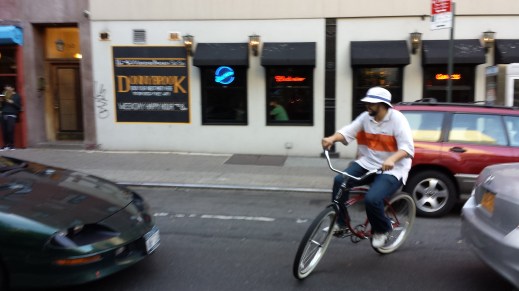
Cyclists who ride on sidewalks, run red lights and ride on the wrong side the road. It is never these rancid, entitled brats who are dragged to their deserved deaths by garbage trucks or city buses, but it should be. If I’d go to jail for doing it with a car, don’t you dare try it with a bicycle. What’s most galling is when they yell at pedestrians to get out of their way as they are preparing to run a red light.
People who listen to music or watch videos in public spaces without earphones. Some people are not content speaking on their cell phones in theaters, they want to bring the theater experience with them and everyone within earshot. Simply inform these people that their earphones must be broken since you can hear their sports event/Chinese soap opera/rap mix tape, etc. If they don’t get to the hint, see to it that their devices and jaw is broken as well.
Can we all get along? Yes, we can all agree that some people need to learn some manners. New Yorkers can unite around these common enemies.
Getting our Irish up ahead of St. Patrick’s Day

St. Patrick’s Day is the time of year when everyone wants to be Irish for a few hours and their definition of being Irish is being an obnoxious drunk. There are actually a lot of nice things about being Irish and Ireland has given us a lot of great things besides a love of the drink.
Among the many positive contributions the Irish have made to the world is music, and around St. Patrick’s Day every year a litany of Irish groups come through the Big Apple to quench our thirst for authentic Irish art.
The Chieftains have been popularizing traditional Irish music since the 1960s and with some luck of the Irish and the busy schedule of generous in-laws, my wife and I scored tickets to see them at Town Hall in midtown Manhattan.
Most of the crowd at the show were well-dressed middle aged people like me or older. I thought I might be overdressed but I wasn’t, which confirms yet again I’ve reached middle age where I can blend in with a crowd that used to look old to me.
But sitting behind us was a loud, possibly drunk, but definitely rude women who acted as if she were in her living room, talking loudly and even shouting ahead to a woman seated in the row ahead of us. After sitting through several songs listening to this absurdly inane and incredibly impolite chatter, my wife asked her to keep her voice down.
The woman took great offense and spent the rest of the show muttering under her breath about how she planned to confront my wife. ‘Go ahead lady,’ I thought to myself. ‘It’s your funeral.’
The Chieftains put on an outstanding performance. They’ve had many celebrated collaborators in the past and had an impressive cast of guest musicians and dancers joining them throughout the evening. A good time was had by all.
Once the show was over and the lights went up, the woman told my wife that she had no right to ask her to be quiet, that the show was for everyone to enjoy and some such malarkey. My wife told her in no uncertain terms that she was wrong and needed to learn some manners. The woman, embarrassed to be called out for such puerile behavior, wouldn’t let go. But my wife can dish out whatever you send her way. The woman’s friends were horrified and did not want to see their friend get thrashed by a visibly pregnant woman.
One of her friends motioned to me and implored me to get my wife out of the building. I told her it was her friend that needed the help, not my wife. The rude woman’s friends eventually corralled her and we all went our separate ways.
No punches were thrown, no chairs hurled through the air. I’m glad for that, though I think it would have been great to watch my pregnant wife knock out this nasty shrew of a woman. I’d take a video of it and then yell, “WORLDSTAR!!” and post it to WorldStarHipHop web site, a popular place to post videos of altercations.
In the end we walked out into the sweet Spring New York night and walked to Times Square, where my wife once reminded me that sometimes you have to enjoy being a tourist in your own city.
We will survive the stupidity of this St. Patrick’s Day as we have survived all others, with pride in our Irish culture intact and our tempers only a little bit the worse for wear.
My cool Vermin Supreme story

As our American political discourse slides further into the gutter with every new televised debate, it may be worthwhile noting that there are some who saw the satire in our politics decades ahead of time. One such person is Vermin Supreme.
Vermin Supreme, you may know, is a perennial presidential candidate who wears a boot on his head and promises everyone a pony. He’s attempted to turn religious conservative candidates gay by pouring glitter on them and promise to fully fund time travel research.
It was 1992 and as the Democratic primary continued to go on then-Governor Bill Clinton’s only real competition after the early primaries was former California Governor Jerry Brown. Brown was the Bernie Sanders of his day, a more liberal alternative to the establishment favorite who captured the enthusiasm of the younger, more activist wing of the Democratic Party. He swore off corporate donations and set limits on what individuals could donate through a 1-800 number (this was in the days before widespread Internet.)
At any rate, that spring before the New York and Connecticut primaries, Jerry Brown had a rally at the University of Connecticut. This was during my freshman year there. I was a columnist for UConn’s Daily Campus and since I showed up there with a notebook, the campaign staff waved me ahead to the press section where I sat among more serious and established members of the media.
Brown’s rally was at the large theater on campus. The event was well attended and the crowd was enthusiastic. When it was over, I hung out with the rest of the media contingent, most of whom were bored by the whole thing (“Once you’ve seen the candidate’s speech you’ve seen them all,” I overheard one say.) Jerry Brown answered some questions before being whisked over to do a live interview with the local news.
As I watched Brown do the TV interview in the auditorium that was now mostly empty, I noticed a strange figure head down a side aisle unnoticed. He was dressed in a coat made of fur pelts and he had a large boot on his head. He continued walking down the aisle until I lost sight of him. As Gov. Brown wrapped up his interview and hurry away to his next campaign event, I heard a voice amplified by a speaker or bullhorn call out to him.
“JERRY! WHAT ARE YOU GOING TO DO ABOUT THE WEATHER?!? WHAT ARE YOU GOING TO DO ABOUT THE WEATHER, JERRY?!?”
Brown looked over in the direction the voice was coming from but didn’t break stride as he exited the building with a gaggle of campaign staff.
As I stood there I spotted this same strange figure coming back up the aisle. He and I made eye contact and he stopped to address me.
“Another candidate avoiding a question about the weather,” he said, shaking his head. He moved on and I had had the strangest political campaign experience ever.
Years later I saw Vermin Supreme on television and was glad that he hadn’t lost the boot on his head and that he was still engaging in the kind of absurd spectacle that has sadly seemed downright dignified compared with some of our discourse today.
I hope Sid Yiddish seriously considers him for his running mate.
Stuck in Place in New York

New York City right now is a city where people are often stuck in place. Not because they lack ambition or a work ethic, but because the juggernaut of high real estate prices is making life difficult.
I work in an office where most of the people who work there that live within the five boroughs have a commute that is at least an hour on a good day. My commute to work is an hour and fifteen minutes under the best of circumstances and can be significantly longer when things are at their worst. We would all love to live closer to our office, which is in the Flatiron district, but none of us can afford to live nearby.
Even the New York Times, whose primary audience is the more affluent New Yorkers among us, ran a story about retirees who would like to return to the city but can’t because real estate prices are becoming so outrageous.
When I first moved back to New York and was looking for an apartment in early 1998 one of the places I looked for a studio was Wavecrest Gardens in Far Rockaway. They had beautiful studio apartments with ocean views for about $500 per month. There were some drawbacks that kept me away (it would have been a long commute to work and a coworker who moved there said he saw people smoking crack in the stairwells), but the apartments were beautiful and affordable. If prices had simply kept up with inflation, a $500 per month apartment in 1998 would cost roughly $740 today. A studio at Wavecrest Gardens now lists for roughly $1,000 per month today. So rents have moved up at more than double the rate of inflation over the past sixteen years. And for areas that are more fashionable, the increase has gotten even steeper. Parts of Astoria and Williamsburg list small studio for upwards of $2,800 per month, and probably more in some places.
I consider myself very fortunate. I have a steady job with a good salary and my family is healthy and does not want for food, clothing, or shelter. But if we were to try to move to a larger apartment to house our growing brood we would have to take on considerable debt to remain in the same neighborhood, and would not find a place much larger than what we have now for what we could afford.
I have many friends who are bright, hard-working people trying to raise families in safe neighborhoods with good schools. They are not looking for handouts or set-asides. They can’t afford to stay where they are and can’t afford anything else in the area. Some friends and family have fled to New Jersey, some are considering leaving the Northeast entirely, heading to wherever they can make a sound living and provide for their kids.
New York is a place famous for attracting creative people, but creative people need affordable places to live and New York is starting to lose is creative critical mass. Artists and writers don’t need to have the same geographic presence they once did. In the digital age it doesn’t matter if you’re creating your work in New York or Detroit or Tuscaloosa. Most of the Western world downloads its content from the Internet, and traveling to a geographic center to get your work recognized is not as necessary as it used to be.
New Yorkers don’t mind paying a premium to live in the center of Western civilization. And New York is not an anti-capitalist place. It’s the most capitalist place on Earth in many ways. New York is a very tough place to get ahead but at the same time is famous for providing more opportunities than anywhere else in whatever your field of choice. If we want to continue to be that way, then something’s got to be done about the cost of housing. You have to get people to live here and stay a while before they can accomplish things.
If it doesn’t make sense to stay in New York, the middle and working classes will be gone and what will be left wont’ be pleasant for anyone.
 Matthew Sheahan
Recent Comments