
Illegal fireworks are as New York as bagels
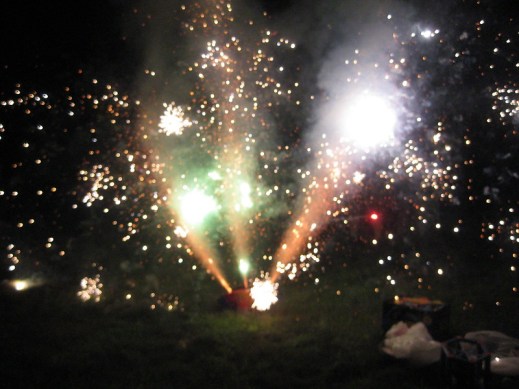
Years ago, when I lived in Inwood, I walked to the public pier at Dyckman Street on the Hudson River to see fireworks on the Fourth of July. The sightings were disappointing. Through clouds in the distance I could see the faint glow of a few shows over New Jersey and could see none of the official Macy’s fireworks happening farther downtown.
I returned to my apartment disappointed but was soon treated to shows of illegal fireworks that more than compensated. The barrage of ordnance that filled the northern Manhattan sky was a welcome sight that took me back to my childhood in Yonkers. I would emerge from our apartment in Yonkers on July 5th to a scene that resembled a war zone. The curbs and corners were filled with the spent paper from reams of firecrackers, and one time I saw a metal garbage can that had been exploded and overturned, looking like a giant metallic banana peel.
When I first returned to the city to live as an adult, I lived in Ozone Park, once the home to professional-grade illegal fireworks shows and street festivals paid for by the Gambino Crime Family boss John Gotti. Gotti had been in prison several years at that point, and the authorities worked hard to prevent the return of a large-scale illegal fireworks display. Police were all over 101st Ave. and the surrounding streets, but it made little difference. Managing to get on the roof of my building, I could see the official fireworks far away in Manhattan, but the cat-and-mouse game of cops and illicit fireworks was more entertaining.
Illegal fireworks have been a New York City staple for decades. When I was in fifth grade in the New York suburbs, I went to a neighbor’s yard where a friend’s father let me light sparklers off some candles set on the ground. I felt like the greatest outlaw on Earth. Kids waved around sparklers while adults set off bottle rockets and M-80s. When we heard police sirens in the distance, adults blew the candles out and we ran to the backyard until the danger had passed.
More recently, we have enjoyed the sights of fireworks over Whitestone and College Point. Early morning jogs through Flushing Memorial Field has found launch sites of the previous evenings fireworks displays, the tubes still smelling of gunpowder in the cool dawn, like a mortar position of a recently passed battle.
The allure of illicit explosives dates to the birth of the American nation. The first battles of the American Revolution were fought over the British Army’s attempt to seize illegal weapons.
New York, which was under the yoke of British rule for the bulk of the Revolution, was no less fervent in its commitment to the cause. One of the bloodiest battles of the war was fought in Brooklyn; the Battle of Long Island almost ended the Revolution—Washington barely escaped to regroup. The first woman known to take up arms for the United States did so in Manhattan at the Battle of Fort Washington; Americans lost that battle too and Fort Tryon park still bears the name of the British governor of New York at the time.
Our founding fathers would have been hanged as traitors to the crown had we not won. No matter our heritage, Americans are proudly descended from outlaws and outcasts. People setting off fireworks today are not would-be revolutionaries, but they are tapping into the same antiauthoritarian sentiment that is alive in spades in America today.
The city has seen an increase in setting off illegal fireworks. We hear them in every neighborhood and in some cases too late (true fireworks enthusiasts know to stop between 11 p.m. and 12 a.m., July Fourth excepted). There is a need now for people to celebrate and sending exploding stars into the night sky is best done while remaining safely distant from fellow citizens. Many bars and restaurants remain closed, large parts of the city are effectively locked down by massive protests. Fireworks are a needed respite, a needed release of our energies to celebrate something, whether that be the birth pangs of a better America or a fiery exegesis of an abiding patriotism.
Illegal fireworks are a proud New York tradition, a proud American tradition. Let it never die.
What is still beautiful about us…
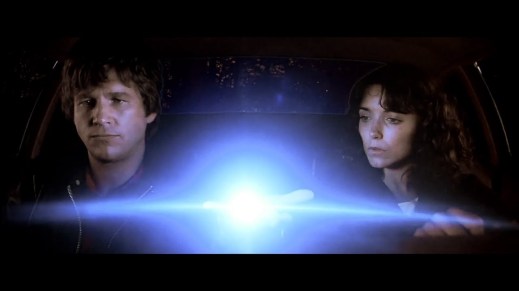
In John Carpenter’s 1984 film “Starman,” Jeff Bridges stars as an alien who is stranded on Earth, and goes on the run from U.S. government agents with the widow of a deceased housepainter, whose body he has cloned as a disguise. They have misadventures while eluding the authorities and the widow (Karen Allen) falls in love with this alien in the body of her dead husband.
In retrospect the plot summary makes this sound like a ludicrous B-film, but it works. One scene and one line from the film has stuck with me since I watched it in a movie theater as a 12-year-old.
The couple are finally cornered in a restaurant by the authorities and the federal agent who has been leading the hunt for them comes to confront them. He asks the alien about his journey and learns he is here to study Earthlings.
“You are a strange species, not like any other, and you would be surprised how many there are, intelligent but savage,” the Jeff Bridges/alien tells his pursuer. “Shall I tell you what I find beautiful about you?”
The federal agent nods yes.
“You are at your very best when things are worst.”
That line has been etched in my mind for more than three decades now, and it’s a fitting mantra for the times we are in.
“You are at your very best when things are worst.”
It can be hard to imagine things getting worse. We are still in the midst of a global pandemic that has hit the U.S. harder than any other country, followed by widespread civil unrest over the death of George Floyd in Minneapolis police custody, poisonous politics in an election year and unemployment levels not seen since the Great Depression.
These are times that try our patience and our resolve. It is easy to want to withdraw and bunker down, to tune out the outside world and lapse into a fatalistic nihilism, a hopeless sloth of withdrawal.
The pandemic reminded us that contact with others is an essential part of life. Human contact is something we took for granted, or even came to resent in New York City, where everything is too crowded and the inconsideration of others is amplified by proximity.
But the need to interact with others is more important now than ever, and despite the myriad conflagrations boiling over in our society, we can still find common ground with decent people of differing ideas.
Human life is inherently tribal, and America has forged tribes along lines of culture and character in ways other societies cannot fathom. These cultures appear to be irreconcilable, but basic human decency and goodness can transcend even our deepest chasms. The past few weeks have shown the extent of our divisions but also the depth of our decency and resolve.
“You are at your very best when things are worst.”
It is time to be the best person you can be and play some part in making our world a better one. You may be at odds with your friends and family, you may be subjected to hatefulness from smaller minds, but the things most worth doing are often most difficult. Keep going.
We can look back at this time and be proud we were at our very best.
Meeting New York’s First Guardian Angel

Traveling to Washington, D.C. for work means taking the Amtrak Accela train from Penn Station. Penn Station was once a gleaming monument to New York’s greatness, but decades ago it was leveled, reduced to a subterranean maze of misery by the powers of commerce without conscience and New York’s Philistine tradition of tearing down some of its most beautiful historical landmarks in the name of progress.
Getting ready for the three-hour train ride to Washington meant stopping by one of the independent delis that still survive there amid the chain concessions. As I approached I saw a man in a red Guardian Angels jacket and red beret, and thought it was probably Curtis Sliwa. It was.
Curtis Sliwa was a night manager at a McDonald’s on Fordham Road in the Bronx when he decided to do something about New York’s Crime problem. He founded the Guardian Angels, an unarmed, unformed crime fighting group that started patrolling New York’s dangerous subways and streets. He didn’t ask permission or get political approval for what he was doing, he just did it. This was at a time when landlords were burning down their old buildings because the insurance money was worth more than the property was valued. The 1970s saw crime explode in every borough as a bankrupt New York City appealed to the federal government for help that never came and was forced to lay off police officers.
The Guardian Angels were the vanguard of resistance to the hopelessness that gripped New York. They didn’t have police approval and politicians dubbed them “vigilantes;” they didn’t care. The unarmed volunteers in their trademark red berets were a sign that people still cared about the city and were willing to put their lives on the line to make a difference.
It was not all straight shooting, though. Sliwa admitted that some of the early stories he told about Guardian Angel heroism were fabrications. Still, Sliwa was an anti-crime crusader before it was cool, a strong voice that cut through the blather of polite talk and gave the criminal class the harsh language it deserved. Even as New York started to turn around, Sliwa’s crime-fighting ways led to an attempt to kill him by the Gambino Crime Family.
Sliwa’s career as a broadcaster has almost always paired him with someone left-of-center to discuss and debate the issues of the day. His pairing with Ron Kuby on MSNBC was a highlight of the network’s earlier days before all of cable television spun into hyper-partisan outposts; they later reunited on AM radio.
I said hello and Curtis Sliwa shook my hand and give me his business card, asking me where I was from. I gave him my business card and told him I was from where I worked.
“No, where are you from? Born and raised?”
“I’m from the city originally and grew up mostly in Yonkers.” I didn’t want to give him my last two decades of history being a city resident, as we were waiting in line at the deli. Our wait was shortly over, and he bid me farewell.
The politicians who once spurned the Guardian Angels later embraced them, and they now operate in more than 130 cities in 13 countries. And Sliwa remains an outspoken personality in New York politics. He’s even vowed to run for New York City mayor next year.
Similar to Ed Koch, Curtis Sliwa is a personification of New York City and will always remain one of the defining personalities of our chaotic metropolis. My encounter with a legit New York City celebrity was brief, but it brightened my day.
NYC’s transit mess to spread above ground

The lives of New York City residents are filled with transit fatigue and the endless negotiation of a failing subway system. Our city subways are in such a sorry state that real lives get interrupted and sidetracked. People miss their college graduations, arrive late for job interviews, or don’t get to say a final good-bye to loved ones.
With the resignation of MTA chief Andy Byford in a dispute with Governor Andrew Cuomo, there is a sense that the situation will get much worse before it gets better.
Queens is poorly served by the New York City subway system and does not have the more comprehensive service that you find in Manhattan, Brooklyn and the Bronx. The subways are so Manhattan-centric that Queens lacks a basic north-south subway route. If you want to get from Ozone Park to the Queens Center Mall it can take you as little as 25 minutes by bus. It would require at least three different subways to get there and it’s only four and a half miles.
Where I live is more than a mile to the nearest subway, which would add 25 minutes to my commute were it not for buses. More recently I’ve learned to take the express bus, which is more expensive but is much better—more comfortable seats and direct service to midtown Manhattan.
The express buses are not a panacea though. Just this past week, as I stood directly next to a bus stop sign on 6th Ave. and 42nd Street, a QM20 bus drove right by as if I wasn’t there, even though I was trying to wave down the driver. So even the express bus system, which is the best experience the MTA has to offer, is still rife with problems.
But not content to serve up sub-par subway service on a good day, the MTA has proposed a plan to slash bus service throughout New York City’s largest borough, Queens. Neighborhood after neighborhood in the borough are organizing to try to stop service cuts that will do things such as: consolidate bus stops, denying service to some areas of the city already lacking for subway access; and stop service earlier in the evening, leaving people stranded in Manhattan if they go to a play or concert.
We need more bus service in the city, not less. Especially at a time when the subways are running so poorly.
Here is a goal for any and all mass transit systems. No one should ever have to wait more than 15 minutes for any bus or train at any time of day or night at any bus stop or train station.
Is that not realistic? Under our current system, yes, that’s a pipe dream, but why should we expect anything less than the best in our city. This is New York. Were it not for our transit system, we would not have experienced the tremendous growth over the last century.
Mass transit will pay for itself in a stronger economy and more productive workforce. Think about all the things you don’t do or places you don’t visit because the travel would be too difficult. Seriously, things only a few miles away are considered out of reach right now because our transit system is so underperforming and unreliable. I know I avoid going to cultural events because getting there and back in a reasonable amount of time is not possible under our current system.
A reliable transit system will have people going more places and doing more things, spending money that keeps our economy going.
Take the MTA out of the hands of political appointees and officeholders who have the power to raid its coffers. Our taxes should support an independent entity governed by a board of directors selected from a population of accomplished people who are transit users.
New York City transit is still way too far away from where it needs to be. There’s no quick fix. Creating a fully functioning transit system is going to take years of political struggle. Let’s start now.
A grateful New York City bids farewell to Two Toms
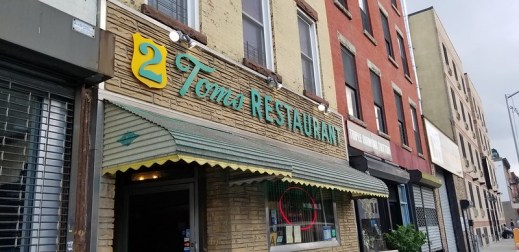
Two Toms Restaurant in the Gowanus section of Brooklyn announced in October that after more than 70 years in business, it is going to close its doors at the end of this year.
Founded in 1948, Two Toms is an institution unlike any other restaurant that is open to the public. It’s a modest and understated very simple dining room in a relatively narrow space, with a street-facing entrance in the front and a kitchen in the back. The food is outstanding and often served family style in large groups, at least that is their specialty. I’ve seen regular tables order off a menu there. But every time I’ve been there it’s been a large meal with several courses.
An Italian restaurant with great pasta and shrimp parmesan among other dishes, it’s most famous for its pork chops, that are enormously thick and juicy and will count as one of the most memorable meals you ever have. I rarely take photos of food, but I had to stop and take a photo of my meal while I was working on one of the pork chops there last year.
I became aware of Two Toms after meeting a group of friends for dinner there several years ago. The restaurant then was known mostly to locals and has a distinct following among law enforcement. My friend Poppy knew of Two Toms from his time working in Brooklyn with the NYPD and it became a regular spot for people we worked with at JFK Airport to hold meet up.
The several courses are conducive to long dinner conversations, the perfect setting for families and old friends. Its unassuming décor adds to its appeal. You are at home there. You can help yourself to beer or soda or bottled water from the refrigerator that is there in the dining room. You knew there was going to be another amazing course coming soon. You didn’t have to worry. Everyone was going to have a good time, and no one was leaving hungry.
When Two Toms owner announced in October that the restaurant would be shutting its doors at the end of the year, its many fans were in shock and jumped into action. Loyal customers flooded the restaurant with so many reservations they began opening extra days and even still they were quickly booked through the end of the year.
My group of friends that took to meeting at Two Toms worked to get a gathering together, but by the time I called to make a reservation, all bookings were gone. I asked the woman I spoke with on the phone to please let me know if any openings at any time for any number of people would be available—if the usual group couldn’t make it at least a few of us would be able to give a final farewell to the place. Social media is alight with tributes pouring in, and legions of New Yorkers who managed to get a reservation are paying their respects.
Two Toms achieved a devoted following because it does what it does best simply and without pretention. It doesn’t boast a celebrity chef or change its menu to some trendy fusion to match the hip flavor of the month. It also refuses rest on its laurels and scream to the world about how long it has been around either. It has stayed true to its roots and has never let up.
New Yorkers will continue to search for the kind of honest authenticity embodied by Two Toms and we owe the legendary eatery a debt of gratitude.
Thank you, Two Toms!
Early voting comes to New York City

The old adage of “vote early and often” is at least half true now in New York City, as the city has instituted early voting this year. This past Saturday the 26th was the start of an early voting period leading up to the Tuesday, Nov. 5 election day.
The last few election cycles have shown us that no corner of the country is immune from serious voting issues. The mid-term election of 2018 was the first time I saw this voting chaos first-hand in the five boroughs. I voted early in the morning, when there are usually fewer people around and voting should be smoother, and there were already difficulties handling the moderate numbers at the polling station. That only got worse as the day wore on, and reports of long line and other logistical issues were crossing the wires by midday.
The mess of the 2018 election caused a series of reforms in New York City around voting, one of them being instituting early voting.
Early voting has been a solution adopted by other states. It encourages participation as many people who work (just about every single voter) often find it hard to take time off during a busy workday to vote, and this has become increasingly difficult as larger turnouts have overloaded polling places across the country. It’s an idea that is long overdue in being implemented, and many states began making this change in the wake of the 2000 presidential election difficulties. Early voting is friendlier to working families and make it more difficult for voter suppression tactics to rule the day. It also helps reduce some of the voting chaos by alleviating some of the crowding of Election Day.
It is wise to start early voting this year. Whatever goes wrong can be corrected in time for next year, an election year that promises a very large turnout. This is not a big election year in New York – there are no Congressional seats up for a vote, a special election for one City Council seat, and only one city-wide election for public office (for Public Advocate), as well as a smattering of ballot initiatives that rarely generate significant turnout or excitement.
So far there have been two major kinks in the city’s early voting: 1. In many cases the early voting place is not in the same place as the regular polling stations, and this has not been widely explained. 2. Some early voting locations that are located in schools gave those schools very short notice that their gyms or cafeterias were going to be off limits for a few days.
Another shortcoming of the early voting so far is the notices sent to voters. Usually the city sends a document that includes a detachable card that has all the relevant voter information on it: where to vote, what district you are in etc. The card sent before early voting has none of this, but does have a scan-able bar code on one side.
In a democracy, voting is a serious obligation for people who wish to remain free. The ballot box is our first defense against tyranny, our first step in making change, and the ultimate check and balance for people in power to be held accountable. By giving us more time to do it, this important duty is easier to execute. Whatever the faults of the city’s first attempt, it is a noble attempt and deserves our support.
Vote early.
Old punks don’t die, they just do more cocaine

Capturing the New York punk scene better than anyone since the death of Lester Bangs is The New York Waste, and picking up the Waste is a must. When I first started reading it almost two decades ago, it introduced me to the best punk rock bands on the scene at the time. It featured cool photos of the Lunachicks and the Toilet Boys and the Bullys, awesome mention of The Spunk Lads and others. Paging a little farther, what did I find but ‘Last in Line for the Gang Bang, a comic biography of G.G. Allin.’
For those unaware, G.G. Allin was a punk rock musician infamous for his violent and obscene performances. He may be better known today as his legend has grown with retellings of his stories and the admiration of musicians who have broken into the mainstream. But in the early 2000s, only a select and disturbed few were allied in their admiration of the late self-described “scumfuck.” (Insider’s note: despite his violent habits, G.G. Allin was a gifted songwriter who left a prolific legacy of excellent punk rock and country music before his untimely end at age 36 in 1993.)
So the fact that someone was producing a comic strip serial biography of G.G. Allin bowled me over. That such an awesome artistic endeavor was underway and had an audience getting it free through the New York Waste made me realize I had found a great home in the punk scene of New York. The Big Apple became a little less lonely knowing that there were other sickos out there.
Discreetly inked into the margins of every comic strip was a web site address for a local punk rock band, World War IX. The band’s guitar player, Justin Melkmann, was the talented cartoonist documenting G.G. Allin’s life.
At the same time, I began looking to start my own punk rock band, and was soon working on original songs with, as the luck of the Internet would have it, Bruce Steinert from the band Buzzkill. We needed a singer.
“I’m friends with a guy who our band would play with back in the day in New Jersey. He used to do things like take bloody meat out of his pants and throw it at the audience,” Bruce mentioned at rehearsal, speaking of the New Jersey band Daisycutter.
“That sounds like our guy,” I said. “Call that guy.”
Soon afterwards, Seth Amphetamines entered the picture and became the singer of what would be Blackout Shoppers. There are not too many people who can command a stage and make the entire venue the center of punk rock chaos in the way that Seth can, and that’s a good thing. It’s an acquired skill to engage with the audience in a mosh pit with great passion without creating lasting hostility or becoming one of the bogus tough-guy copycats that have created so many boring hardcore bands over the last few decades.
Seth is the only singer I’ve seen who has gotten members of the audience angry enough to throw beer cans at him only to have them share beers afterwards. Whatever violence he dishes out is in without hate or malice, and in sincere appreciation of old school hardcore punk.
I went to see World War IX at CB’s basement, which was part of a still-existent CBGBs at the time (where Blackout Shoppers would play its first show in a complete fluke later that year), and introduced myself to Justin. He was glad to meet someone who enjoyed his comic and we vowed to stay in touch.
Not soon afterwards, World War IX and Blackout Shoppers played the first of many shows together. It’s an alliance that has lasted about a decade and a half. We’ve put out a split seven-inch record together. Blackout Shoppers’ guitar player Mike Moosehead now plays in World War IX, and World War IX’s drummer Johnny Special K has filled in on drums for Blackout Shoppers. Blackout Shoppers came back from an official hiatus at a show where World War IX bid farewell to its singer Philthy Phill. It’s an incestuous bouillabaisse that only works in punk rock or among inbred Mormon fanatics, and we love it.
This month, both Justin and Seth turn 50, and the bands are celebrating with a show together at Otto’s Shrunken Head, one of our favorite places to play. It will be an evening filled with alcohol, music and good times. Please join us.
A journey through the MTA’s lost and found
Earlier this summer, I arrived home late on a Friday night—late these days meaning after 8 p.m.—and was taking things out of my pockets after a long day. When I reached into my right front picket, I came to the realization that I did not have my wallet. My stomach tied in knots and I cried out in frustrated desperation. I knew it had been in my pocket; there would be no deus ex machina miracle of finding it in my bag or in another pair of shorts.
I knew that it most likely fell out of my pocket on my commute home. I had just gotten off the express bus—this bus was still on the road and someone could radio the driver! I immediately picked up my smart phone and dialed 311 for citywide information. The 311 operator would be able to connect me to the right person. The 311 operator transferred me to 511, which is the information number for the Metropolitan Transportation Authority (MTA).
After a few more transfers, I spoke with someone I was told could help me. I gave them all the information I had. I was on a QM20 bus and was picked up from 6th Avenue and 42nd Street in Manhattan at approximately 8:40 p.m. and was dropped off at Union Street and 26th Avenue in Flushing, Queens at approximately 9:30 p.m. This driver was probably still on their route and with the information I had given them someone should be able to get in touch with the driver ASAP!
But no such luck. The person on the other end of the line said they could not do anything unless I had the bus number. Without the bus number, they could not contact the driver. Seems a bit ridiculous. If this had been a more serious situation and people’s lives depended on finding the bus, there would have been a catastrophe.
I was asked to call back the next day after the bus had gone back to the depot and the driver may have turned in the wallet. It was a small wallet, one that held only cards. I was not out any cash, unless someone was going to town with my debit card.
I started to call credit card companies and my bank to have holds put on cards.
The next day I called the depot. Nothing.
I called back the next day, and called back later in the day again. Nothing still.
I went through with canceling and replacing my credit cards and ATM card and replacing my driver’s license.
By Monday, there was no funny business on my cards and new ones were on the way. I printed out a temporary driver’s license and ordered a new card wallet that came with a money clip. My card wallet needed replacing anyway, and this was a chance to pare down the stuff I carried with me everywhere.
A few weeks later, the same day my new driver’s license arrived in the mail, a notice from the MTA Lost & Found arrived in the mail.
“An article which contains your name and/or contact information was found and turned in to the MTA NYC Transit Lost Property Unit,” the notice began. It instructed me to report to the unit’s office at the 34th Street subway station at 8th Avenue in Manhattan. If I did not claim my property by Nov. 3, “it will be deemed to have been abandoned and you will have forfeited your right to claim it.”
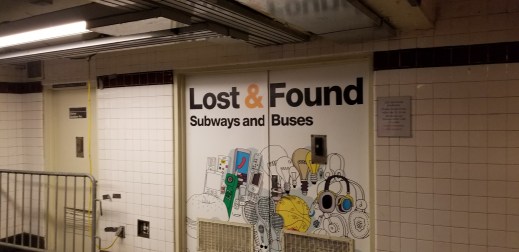
The next day I brought that notice and my newly replaced driver’s license to a hidden-in-plan-sight pocket of the 34th Street subway station in Manhattan. It took some searching and asking to find the lost and found office, which is beneath the tracks of the A, C, E subway lines and without any signs leading you there except in the immediate vicinity. It’s within the subway system, so if you arrive by some other means or exit the subway before you find it, you’ll have to spend another subway fare to reach it or get a helpful MTA worker to let you in.
A small sign points the way to a set of double doors painted in celebration of the many objects found in our transit system. The office is open odd hours—and completely closed weekends and holidays, a travesty in a system that runs 24 hours—but luckily is open until 6:30 p.m. Wednesday and Thursdays.
Inside is a small room with a very low ceiling. I’m five feet eleven inches with my shoes on, and if I had extended my arm fully above my head I would have punched a hole in the drop-down ceiling. There is a metal bench to sit on, a small counter to stand and fill out paperwork on, two old-looking computer terminals, and a thick window above a pass-through door through which one may conduct business with the MTA workers on duty.
I arrived as a worker emerged from another set of doors to hand someone some paperwork, and she took my notice and ID and disappeared in to the bowels of the lost and found. The woman who was there spoke to someone at the window and was told to check back about her property later. She left and another woman arrived to ask if a book she lost on the subway was found. She was told no and to check back later; she left. Another man arrived and looked through his paperwork to check on a claim, and while he was speaking with someone another woman arrived to check on some property she had reported missing.
A worker arrived at the thick window with my wallet. It was a different worker than I had given my notice to; it was a rotating staff of workers answering questions and handling forms. He told me to sign my name on another form and write my address the same way it appeared on the notice in the mail. He opened the door to the silver box under the window and placed a clip board inside, and when he closed his door I opened mine and filled out the form.
A minute later, the same exchange reunited me with my wallet. It looked a little worse for wear, but nothing was missing. Everything was there: my license, my ATM card, my MTA MetroCard, even the coupon for a t-shirt at the zoo. I excitedly took an inventory of my wallet while my fellow transit visitors looked on amazed.
“You give me hope,” said the young woman sitting on the bench, hoping her property would be returned.
I thanked the worker and wished the other people in the office good luck, and went back out into the bustling station. For me, lost and found had worked out well.
Thank you to the Good Samaritan on the bus who turned in my wallet, and the series of honest MTA workers that made it possible for me to get my property back. For me the stars aligned this time.
The proud refuge of Doc Holliday’s

A few weeks ago, my band was fortunate enough to be asked to play music in Tompkins Square Park. The four of us arrived punctually (an impressive feat for an old-school punk rock band like ours).
The sun was blazing but standing in the shade brought sound respite. Having consumed copious caffeinated beverages in transit, I headed for where I knew the public restrooms were located.
The men’s room was locked. A nearby restroom was marked for use only by children. It was also locked. Park workers admonished men looking to use the boys’ restroom, and referred people to the closed men’s room even after being told it was locked. A Parks Department employee told me to use bathrooms at a nearby Starbucks or 7 Eleven, and acted as if she were doing me a favor.
Nearby on Ave. A and 9th Street, there was not a Starbucks or 7 Eleven in sight. Doc Holliday’s was open though.
Even though I long ago left the drinking life, I had the good fortune to drink at many of New York’s most excellent bars before I did. Doc Holiday’s is one of the East Village’s surviving dive bars that did not sell out or lose its character, and has stayed the same quality dive bar that it was meant to be.
As the name implies, Doc Holliday’s could be called a country bar. While by that measure it could easily be lumped in with other “country” bars such as the now-defunct Hogs & Heifers, it’s a bit more subdued and nowhere near the same kind of tourist mecca. It may be a far cry from where David Allen Coe would drink (if anyone knows where David Allen Coe goes to drink when he’s in New York, please tell me), but it’s the closest thing to a country dive bar surviving in the city today.
When a cheesy movie came out about rival bar Coyote Ugly in 2000, Doc Holliday’s celebrated the fact that its name was not associated with such a flop. They had several drink specials and posted scathing movie reviews of Coyote Ugly on the walls of the bar.
For a while when I worked in SoHo, I would bring coworkers to Doc Holliday’s for beer—after the after-work beers we had at work, of course, and it never disappointed me then. I would be one of the last of my party to depart, stepping strongly buzzed into the bright twilight of a New York Friday night, ready to conquer the world some more.
About 10 years later, when I decided to leave the bogus “secret restaurant” located in Crif Dogs rather than take off my hat, I went to Doc Holliday’s where friends were waiting. Three boroughs and many, many drinks later, I made it through that night with few memories but few regrets.
But now I was returning to Doc Holliday’s as someone gone from the drinking life nearly a decade, a frustrated park goer unable to find a decent bathroom. Would I be welcome back to this hallowed place where I had spent so much quality time in the past?
The bartender was chatting with three people at the bar and the place was otherwise empty. There was no crowd to blend into if I pretended to be a customer. She looked to me, expecting me to order a drink. I decided to come clean and admit I was there just to go to the bathroom. I explained my situation to the bartender. Could I use their bathroom?
The bartender told me yes and thanked me for asking. I walked back to where the bathrooms were to find that Doc’s had done some remodeling and the restrooms were not in a state of filthy disrepair. By dive bar standards the new men’s room was pretty luxurious. I left a five-dollar bill on the bar in my way out and got a friendly smile.
I returned throughout the day and was warmly greeted. It was good to be welcome and enjoy the dive bar scene again. Even removed from the drinking life, our bars are cultural markers that can offer a guide to the state of society. Doc Holliday’s confirms there are some pockets of righteous goodness left in our city.
FNO Flushing Fantastic, daytime festival edition
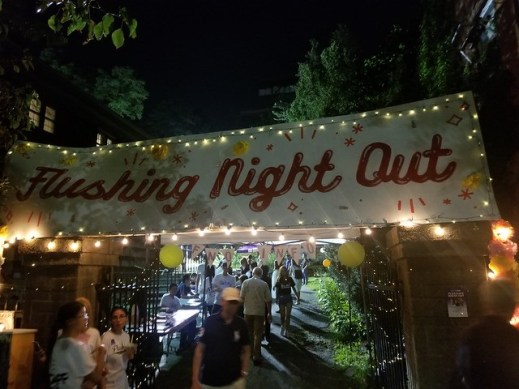
Despite the popularity of some parts of Brooklyn, our collective dialogue around New York City remains excessively Manhattan-centric. New Yorkers will still say “the city” when they mean Manhattan, even though the five borough boundaries of our city have been in place since 1898.
And New York City is so large that telling people what borough you are from will not cut it. No one actually from Manhattan would introduce themselves as being from Manhattan unless they were in a very borough-specific conversation. Each of New York City’s boroughs is a tapestry of neighborhoods, and it is these neighborhoods that are the lifeblood of life in NYC.
Queens is New York City’s largest borough and among its most well-known neighborhoods is Flushing. This weekend, local residents are showing off the neighborhood’s many attractions Saturday at FNO 2019: Flushing Fantastic.
FNO stands for “Flushing Night Out” as past events have been held at night, but this festival is going to run from 12 noon until 6 p.m. and is going to be at historic St. George’s Episcopal Church, right in the center of downtown Main Street a short walk from both the 7 train and the LIRR.
Flushing is known as a destination for Chinese cuisine, and people will come from all over to sample some of the great restaurants, food carts, or food court stalls that make this neighborhood unique. But there is much more than Chinese food, and the Greater Flushing Chamber of Commerce is promoting the neighborhood as an international melting pot, though admittedly one that is heavily Asian. I often point out to people that among the best dining attractions in Flushing are 24-hour Korean restaurants such as Kum Gang San and Noodle Flower, where you can barbecue an awesome assortment of meat right at your table at two o’clock in the morning if you are so inclined.
The Greater Flushing Chamber of Commerce also notes that the event is designed to give a boost to local businesses and entrepreneurs that are competing with large franchises. Downtown Flushing has seen a boom in construction of high-rise condominiums and the rising price of real estate has made life harder for small businesses throughout Queens and five boroughs.
“Flushing, NY is the crossroads of the world — where you can find amazing culture and people from around the globe,” the chamber says in its event notice online. “We want to celebrate the unique food, fashion, and music found here as well as help the small businesses and entrepreneurs who are struggling to make ends meet. Over the past decade, rising rents and major development projects have threatened to displace the small mom-and-pop stores who invested their blood, sweat, and tears into making our neighborhood prosperous.”
Flushing Night Out has been held at various locations, centered on the downtown area. The first one I attended was on the campus of Flushing High School, and it was a memorable event, even for cynics like me that hate crowds.
It was at my first Flushing Night Out that I was introduced to Karl’s Balls, a food stand of traditional Japanese takoyaki balls—those are octopus balls inside a doughy sphere that are cooked on an egg-shell like grill. Go to Karl’s Balls because it’s an ingenious name and you may never stop joking about wanting to put Karl’s Balls in your mouth. But all joking aside, the takoyaki balls are extraordinarily delicious and Karl himself—Karl Palma—is a celebrated chef who has been featured on the Cooking Channel among other accomplishments.
While Karl’s Balls may not be at this FNO event, there is going to be a smorgasbord of amazing food, from Ecuadorian cuisine to Japanese ramen to craft beer and gourmet ice cream. You have no excuse to leave hungry. The organizers require all the vendors there to have items that start at $5 or less.
FNO also features live music, crafts, and other cultural interests. This Saturday will feature Harmonyc Movement, a city-based dance troupe steeped in K-pop and Korean culture.
And at the Flushing Queens Macaroni Kid booth, they will be giving away protein bars for free (full disclosure, my wife Emily Griffin Sheahan runs our local Macaroni Kid web site and will be manning the booth at the event – tell her I sent you!).
The pure Hell of New York Summer

A few years ago a friend who lives in Las Vegas posted a photo of his car’s dash board, which displayed a temperature reading of close to 120 degrees Fahrenheit. “Still nowhere near as bad as New York City subway in the summer,” was his photo caption.
New York City survived its first major heat wave of 2019 this past weekend and survived is as good as it gets.
Public pools were kept open an extra hour, though one pool had to close during the heat wave. Large numbers of homes lost power throughout Brooklyn and Queens during some of the hottest hours of Sunday. In Times Square, where the heat index got as high as 110 degrees, my colleagues from Ask A New Yorker began frying an egg on the sidewalk.
To endure a New York City summer is to taste the atmosphere of Hades if Hades had fewer redeeming qualities. It was Sunday and the heat was high early. I couldn’t avoid doing the grocery shopping and I’d be subjected to consistent air conditioning, at least while I was indoors.
At the local supermarket, I got to the crowded parking lot and found a space on the perimeter. The blacktop of the lot was a welcoming carpet of black lava. I saw containers of recycled glass sitting by the can and bottle redemption machines. Four large tubs were filled with the smashed remains of recycled bottles. The image summarized the weekend’s heat wave. There in all the gleaming punishment its jagged shards could dish out, penned in for all to see, the shards seemed to taunt us. This is my time, the broken glass could boast to passers-by. I was born of a blast furnace and your city’s asphalt is a cool breeze in the mountains to be. How fragile you must be…
I stopped to take a photo of the glass. It was so simple yet so brutal.
“What’s wrong with my glass?” a man asked me. I turned to see a man in a blue jumpsuit with ear protection headphones on. He was collecting the recycled glass and thought maybe I was taking a photo to establish some kind of complaint. I explained it was unusual to see all the glass out of the machines like that and made for a neat photo. This was true. I decided that a parking lot in 100-degree weather was not the place to have a discussion about the murderous indifference of nature and human kind’s being at the mercy of the Earth despite our collective ability to damage it, especially as this gentleman was spending his day working in the hot sun collecting the industrial chum of the recycling machines.
The supermarket requires shoppers use a quarter to unlock a shopping cart from another. It also employs a locking system that stops someone from wheeling a shopping cart off its premises. Because I parked on the edge of the parking lot, my shopping cart locked up once I got it to my van. I loaded my groceries but now the wheels on the cart couldn’t move.
I was enraged and determined that I would get this quarter back if it was the last thing I ever did. I dragged the shopping cart across the parking lot to one of the docking stations where you can return cars without walking all the way back to the store. All the carts at the station had been self-locked and I would not be able to get my quarter back there. I dragged the cart all the way back to the store where an army of locked carts stood silently as I strained and cursed my way to redemption.
I managed to lock my shopping cart to another and retrieve my quarter from its infernal lock. I celebrated this victory by taking a photo of the quarter held aloft before the shopping cart in victory.
If I had looked closer at the photo before driving home I would have noticed my glasses inside a case on the seat. I have not yet found these glasses. Heat wave: 1, Matthew Sheahan: 0.
Blackouts in a changed New York
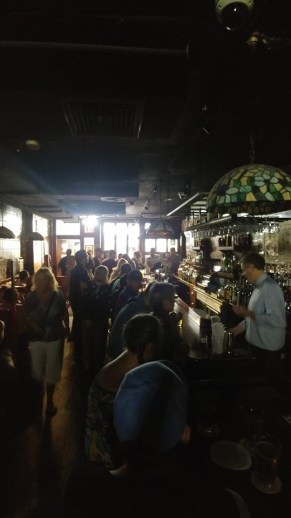
This past Saturday I noticed a friend posting on social media from the dark interior of one of Hell’s Kitchen’s finer dive bars, Rudy’s.
“Uh-oh. Power’s out. Better drink all the beer before it gets warm.” That was the caption accompanying a photo of business as usual on a busy Saturday night at Rudy’s. There was never a lot of interior light there to begin with, so one had to take her word for it that there was a blackout.
A little while later, a message from work indicating a “Code Red” situation—the company’s building in Times Square was without power and this was a problem. I scrambled to join the emergency communications line, only to be told there were enough people working on this already, I could drop.
News reported that the West Side of Manhattan and a significant portion of midtown were dark. This was a major event though it was small potatoes compared to previous New York City blackouts. It was short-lived as well. By 10 p.m. power had been restored to much of the affected areas, and my employers’ building in midtown had power again but was still waiting for electricians to arrive to make sure everything was up and running.
The cause was not immediately known and Con Edison does not have a great track record of accountability when these things do happen. Several years ago, a significant portion of Astoria, Queens was out of power for an extended period of time. Sadly, an outage in Manhattan generates greater news coverage and more intense scrutiny.
New York City suffered a blackout exactly 42 years ago to the day of the one this past Saturday. On July 13, 1977 a blackout hit New York City and was the scene of widespread looting and arson.
Seventeen years ago this August marks the anniversary of the 2003 blackout that darkened a significant swath of the Northeastern United States. I was downtown getting ready for a late night of editing at work and wound up taking a 12-mile walk home over almost the entire length of Manhattan. Although incidents of looting were underreported, they were indeed rare and the peaceful evening rush hour and dark night was a testament to the transformation that had happened in the years since 1977.
Even after walking 12 miles to get home in crumbling shoes that blistered my feet, I walked around my neighborhood of Inwood in Manhattan, amazed at the peacefulness of the city at such a time. People played dominoes in the moonlight near the Dyckman Farmhouse, and the sound of steel drums and street parties filtered up from blocks away.
Power outages serve as a barometer of where New York resides along the lawlessness spectrum. Are we close to widespread chaos or will the line hold during a night in the total dark? The Manhattan blackout of July 2019 showed we are holding the line for now.
It was a relief to find that New York has not regressed to the point of making our blackouts more of the 1977 variety. But that question will always linger in the back of New Yorkers’ minds, and maybe we should get to a point that it shouldn’t be there at all. How much has to be done to create that city, that country, that world, and will we ever get there? And what is being done to make sure that we don’t lose power during critical summer months?
A relieved city needs those answers.
Taxi scams are born anew
Technology continues to advance and change our world, human nature does not change. Technological advancement does not mean moral advancement. While we can summon a wealth of information in less than a second, the human race isn’t applying this knowledge in a way that makes our world any more just and fair.
And so it is with our taxi cabs. While technology enables us to hail cabs, it has not improved the ethical standards of drivers or riders. I have seen this illustrated across our city in several ways, but most vividly this past week.
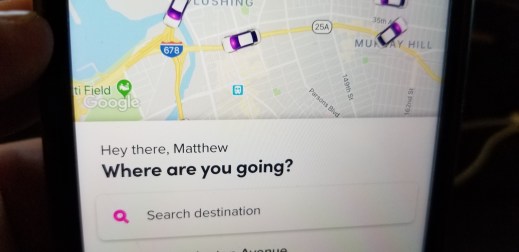
It was after 6 p.m. and since I was out of work late I wanted to waste no time in getting home. I was in downtown Manhattan and the traffic looked painfully slow. I positioned myself near a street corner so a car could make a quick exit off of a bumper-to-bumper Broadway. I requested a ride from Lyft.
I got a call from the first Lyft driver.
“Hi this is your driver from Lyft, can I confirm where you are?”
“Yes. I am at Broadway and Worth Street. I’m a bit before Worth Street so you can make a left and get out of this terrible traffic.”
“And can I confirm where you are going?”
“Flushing, Queens,” I said truthfully.
A few seconds after our call ended. I saw that the driver had canceled my ride and the mobile app was searching for a new driver for me.
I also realized how I had made a terrible mistake. One of the features that is supposed to make ride hailing services better than hailing cabs on the street is that the application does not tell the driver where you are going until they confirm on their device that you are in their vehicle. This stops them from cherry picking rides the way yellow cab drivers do, asking passengers where they are going before they get in the cab, so they can avoid taking fares to destinations they don’t like.
Ride hailing drivers subvert this system in two ways: they will pull over and confirm on their device that you are in the cab when you are not, and then canceling the ride before you get to them. And, like they did with me, they call you and ask where you are going and then cancel the ride if they don’t like what you tell them.
The second Lyft driver called a few minutes later, doing the same thing. I didn’t tell them, but it didn’t help anyway.
“Can you confirm where you are going?”
“I’m on Broadway and Worth. I’ll see you soon. Are you nearby?”
“Yes. I am at Broadway and White Street. I will be there soon. … Can you confirm where you are going?”
“That’s a great question. I’ll confirm when I see you. And I’ll see you soon,” I said with the friendliest confidence I could muster.
My phone soon indicated that this driver had canceled as well, and now I had to start the request for a driver all over again. And guess what? The price for a ride was now about $20 more than when I was first looking for a ride. This made me livid but I was too tired to get worked up about it, and besides, I would have been mistaken for a crazy person, shouting at my smartphone in the middle of Broadway as downtown traffic slowly crawled by.
The third driver arrived and completed the trip. With all the shady driver shenanigans, I probably saved no time in getting home and would have been better off taking a subway or express bus.
A friend who is a yellow cab driver broke down the one issue he may have with taking fares to the outer boroughs: if it’s towards the end of his shift, he faces late fees if he brings his cab back to the garage late. That’s the only time he picks and chooses his fares, and he recommends reporting those drivers that won’t take customers where they want to go. My friend is exceptionally good at what he does, and even lets passengers know when they can get somewhere faster using public transit. I had one Lyft driver tell me that in Maryland recently, and I much appreciated it.
In a few short years, the drivers at ride-share services like Uber and Lyft have perfected many of the repugnant practices that sent riders away from yellow cabs to begin with. Ride-hailing service drivers are known to cancel rides in time to take advantage of surge pricing times. No-show cab drivers can still saddle would-be riders with $5 cancelation charges which are difficult (though not impossible) to fight through the companies’ Web sites. And yellow cab drivers are left in the lurch, many of them deeply in debt with loans for medallions that they may never be able to pay back, a situation regulators ignored.
At the same time, ride sharing services are in greater demand, since our public transit system is so rotten to the core the subways lines can be delayed even by an overflowing toilet.
As with yellow cabs, remain vigilant when you are taking one of the raid hailing services. What looks like a minor inconvenience could be another scam.
Congestion pricing will not fix our subways

New York is a city of many firsts. It was the first capital city of the United States; it had the first hot dog, first American public brewery, ATM, mobile phone call, and children’s museum.
It also promises to be the first American city to institute congestion pricing on cars driving into its busiest areas. Although these fees are not expected to take effect until 2021, it could cost motorists up to $10 to drive into Manhattan below 60th Street according to a plan expected to be passed April 1 as part of the New York State budget.
It could mean as much as $14 for a car and more than $20 for a truck going into Manhattan. That’s likely going to be on top of heavy tolls already paid to take the bridges and tunnels needed to get into Manhattan in the first place. Cities such as London and Stockholm have instituted congestion pricing and it’s considered a success there, but those cities have more viable public transportation.
New York City has one of the most comprehensive public transit systems in the country, and that’s more of a statement on how sorry the U.S.’s transit system is than a compliment to New York.
The politicians that are advocating for congestion pricing are doing so because they don’t want to do the hard work it would take to fully fund the M.T.A. It means possibly raising taxes and definitely raising fares. It means significantly reforming construction policies to reduce exorbitant costs. Governor Andrew Cuomo and Mayor Bill de Blasio, who despise one another, agree 100% that this is a good idea, which is as good a reason as any to oppose it.
People are turning more to cars because public transit is so unreliable and unpleasant. I once worked with a man who had health issues and had to go to the Bronx every other day from work in order to have kidney dialysis done. He took a cab there because he couldn’t be late and his health issues meant he couldn’t be wedged into a subway car with a few hundred of his closes friends. He was able to get some of his cab fare subsidized, but that’s money that could have been spent elsewhere if we had a reliable transit system, and it’s on the backs of people like my former coworker that this new tax is going to be balanced.
I would rather not spend about three times the regular fare to get to work, but I know I need to be on time to work and not on the cattle car that passes for the 7 train these days, so I splurge for an express bus. It’s still a lot less than a cab but more expensive than a regular subway or bus fare.
Congestion pricing is going to cost the people who can afford it the least: cab drivers or people who have their spouses or friends drive them to work or who are carpooling like good citizens. There will be a significant portion of people who will avoid paying it using the same schemes that work with the now toll-booth-free tolls and red light cameras.
We will fight this out in the press and in the courts until congestion pricing becomes the law of the land or not. But all that will be time wasted building the political capital, civic will, and thoughtful plans needed to truly fix our transit system.
 Matthew Sheahan
Recent Comments